Maternal and Perinatal Outcomes in Women with Pre-eclampsia and Eclampsia Treated with MgSO₄ at a Tertiary Care Hospital in Quetta, Pakistan: A Retrospective Observational Study
DOI:
https://doi.org/10.32350/cpr.41.05Keywords:
eclampsia, maternal outcomes, MgSO₄, perinatal outcomes, pre-eclampsiaAbstract
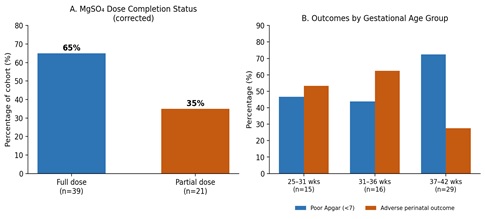
Pre-eclampsia and eclampsia continue to be important causes of morbidity and mortality in developing countries. These conditions are often associated with delayed diagnosis and limited access to appropriate healthcare services. MgSO₄ is the recommended anticonvulsant therapy for the prevention and management of seizures in pre-eclampsia and eclampsia. However, its use is not standardized in most places. To determine the maternal and perinatal outcomes among women with pre-eclampsia and eclampsia managed with MgSO4 at the Bolan Medical Complex Hospital in Quetta, Pakistan. This retrospective observational study was conducted at the Department of Obstetrics and Gynecology, Bolan Medical Complex Hospital, Quetta, Pakistan from February 2025 to September 2025. The study included 60 women with pre-eclampsia/eclampsia who had received MgSO₄ therapy. Information regarding demographic characteristics, clinical presentation, treatment, maternal complications, and neonatal outcomes was collected using a structured proforma and analyzed using SPSS (version 20.0). Among the 60 patients enrolled, 28 (46.7%) had pre-eclampsia and 32 (53.3%) had eclampsia. The majority of participants were aged 39–45 years (45.0%), had a gestational age of 37–42 weeks (48.3%), and presented with eclampsia (51.7%). Sixty-five percent (39) of participants completed the full MgSO₄ regimen, whereas 35% (21) received partial treatment. Fifty-five percent (33) of participants experienced recurrent convulsions, although two-thirds (66.7%) had no serious maternal complications. Such complications included placental abruption (20.0%), HELLP syndrome (10.0%), and pulmonary edema (3.3%). A poor 5-minute Apgar score (<7) was observed in 35 (58.3%) neonates and there were 26 (43.3%) adverse perinatal outcomes. In the multivariable logistic regression analysis, there were no significant association found between maternal age, gestational age, parity, or complete MgSO₄ administration and poor Apgar scores or adverse perinatal outcomes (all p > 0.05). Although most women did not experience major maternal complications (66.7%), recurrent seizures remained frequent (55.0%) and adverse neonatal outcomes occurred in 43.3% of neonates. These findings highlight the continued burden of neonatal complications among women with pre-eclampsia and eclampsia despite MgSO₄ therapy.
Downloads
References
1. Sadiqi H, Amiri GM, Rezaee Q, Ahmadzada M, Jamalzada GH. The global impact of preeclampsia on maternal mortality: A comparative analysis of healthcare accessibility and outcomes in low- and middle-income countries comparing high-income countries. Kateb Journal of Medical Science & Biotechnology. 2026;2(2):33–47. https://doi.org/10.66943/kjmsb.v2i2.66
2. Okikiade A, Kanu C, Iyapo O, et al. Revised pathophysiology of pregnancy-induced hypertension (pre-eclampsia): A multisystemic spectrum of the maternal complications. International Journal of Research and Reports in Gynaecology. 2025;8(1):176–195. https://doi.org/10.9734/ijrrgy/2025/v8i1129
3. Lakshmanan K, Liu BM. Impact of point-of-care testing on diagnosis, treatment, and surveillance of vaccine-preventable viral infections. Diagnostics (Basel). 2025;15(2):123. https://doi.org/10.3390/diagnostics15020123
4. Khan ZL, Balie GM, Chauke L. Hypertensive disorders of pregnancy deaths: A four-year review at a tertiary/quaternary academic hospital. Int J Environ Res Public Health. 2025;22(7):978. https://doi.org/10.3390/ijerph22070978
5. Sibai BM. The Magpie Trial. Lancet. 2002;360(9342):1329. https://doi.org/10.1016/S0140-6736(02)11321-3
6. da Silva Gama ZA, Medeiros WR, Saturno-Hernández PJ, et al. The WHO Safe Childbirth Checklist implementation: Impact on the prescription of magnesium sulphate through a one-year longitudinal study. BMC Pregnancy Childbirth. 2020;20:154. https://doi.org/10.1186/s12884-020-2836-z
7. Pauli JM, Repke JT. Pitfalls with the new American College of Obstetricians and Gynecologists Task Force on Hypertension in Pregnancy. Clin Obstet Gynecol. 2017;60(1):141–152. https://doi.org/10.1097/GRF.0000000000000247
8. Wanjari M, Late S, Umate S, et al. Role of magnesium sulfate in pregnancy: A comprehensive review of benefits and risks. Multidiscip Rev. 2024;7(11):2024094. https://doi.org/10.31893/multirev.2024094
9. Zhang Y, Hillman S, Pereira M, Anderson K, Cross RM. Preliminary findings on psychometric properties of the adolescent story stem profile. Front Psychol. 2025;16:1478372. https://doi.org/10.3389/fpsyg.2025.1478372
10. Marín R, Abad CL, Rojas D, Fernández M, Ruette F. Magnesium sulfate in oxidative stress-associated pathologies: Clinical, cellular, and molecular perspectives. Biophys Rev. 2025;17(2):511–535. https://doi.org/10.1007/s12551-025-01292-z
11. ALhrare H, Bellael M, Ben Taher M. Effect of magnesium sulfate on intraoperative hemodynamics, anesthetic consumption, and postoperative pain in elective laparoscopic cholecystectomy. AlQalam J Med Appl Sci. 2025;8(2):846–851. https://doi.org/10.54361/ajmas.258244
12. Pithara-McKeown C, Stone T, Treloar E, et al. Lessons from using the Normalisation Process Theory to understand adherence to guidance on MgSO₄ in preterm labour. Implement Sci Commun. 2025;6:75. https://doi.org/10.1186/s43058-025-00758-1
13. Gessesse AD, Belete MB, Tadesse F. Time, cause of early neonatal death, and its predictors among neonates admitted to neonatal intensive care units at Bahir Dar City public hospitals, northwest Ethiopia: A prospective follow-up study. Front Pediatr. 2024;12:1335858. https://doi.org/10.3389/fped.2024.1335858
14. Cunningham FG, Nelson DB. Magnesium sulfate for the prevention of seizures in preeclampsia: Origin, experimental basis, clinical studies, and the evolution in obstetrical practice. Am J Obstet Gynecol. 2026;234(5):1277–1285. https://doi.org/10.1016/j.ajog.2025.09.045.
15. Haavaldsen C, Thomas O, Eskild A. Risk of pre-eclampsia according to gestational age across three decades: Population-based study. Ultrasound Obstet Gynecol. 2026;67(2):155–161. https://doi.org/10.1002/uog.70160.
16. Tegegne GA, Rade BK, Yismaw AE, Taye W, Mengistie BA. Predictors of successful trial of labor after cesarean section (TOLAC) in women with one prior transverse cesarean section at tertiary hospitals in northwest Ethiopia: A multicenter study. BMC Pregnancy Childbirth. 2024;24:240. https://doi.org/10.1186/s12884-024-06432-z.
17. Wixey JA, White TA, Piscopo BR, Chand KK, Colditz PB, Miller SL. The effects of therapeutic drugs on brain development in infants with fetal growth restriction. J Physiol. Published online January 28, 2026. https://doi.org/10.1113/JP289645.
Downloads
Published
How to Cite
Issue
Section
License
Copyright (c) 2026 Safia Umar, Najma Ghaffar, Mir Abdul Qadir, Faisal Islam, Saquib Jalil, Raffia Arshad

This work is licensed under a Creative Commons Attribution 4.0 International License.
Authors retain copyright and grant the journal right of first publication with the work simultaneously licensed under a Creative Commons Attribution (CC-BY) 4.0 License that allows others to share the work with an acknowledgement of the work’s authorship and initial publication in this journal