
Role of Diversification in Earnings Management: An Evidence from Pakistan’s Emerging Markets
DOI:
https://doi.org/10.32350/aar.61.05Keywords:
accrual-earnings management, corporate diversification, geographic diversification, product diversification, real earnings managementAbstract
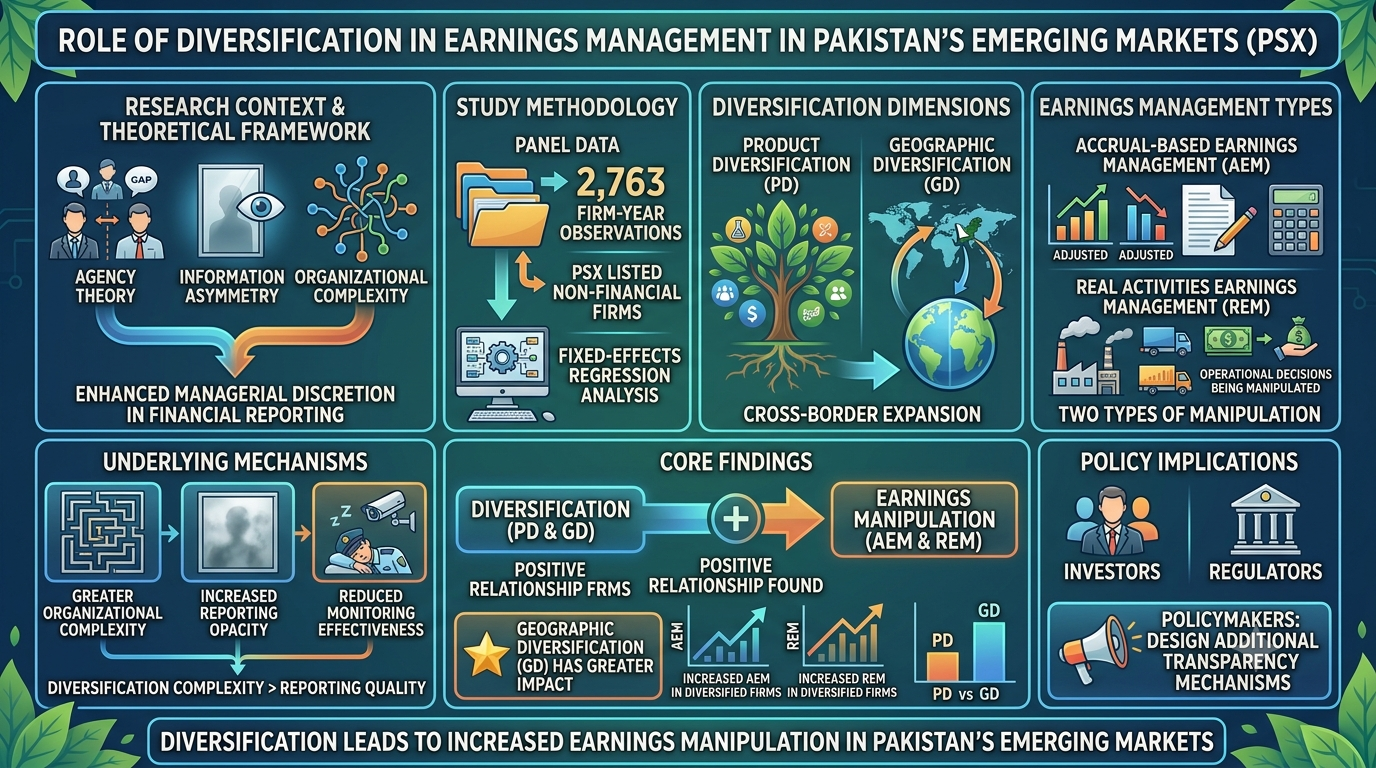
This study aimed to examine the nexus between corporate diversification and earnings manipulation. It considered how product and geographic diversifications (GDs) affect both types of earnings manipulations, such as accruals-based earnings manipulation and real-activities earnings manipulation in emerging markets. Agency theory, information asymmetry, and organizational complexity were utilized to explain the pivotal role of diversification in enhancing managerial discretion in financial reporting. The current study used panel data comprising 2,763 firm-year observations from non-financial firms that are listed on the Pakistan Stock Exchange (PSX). Fixed-effects regression analysis was employed to estimate the model. The results showed that both product and GD are positively related to earnings manipulation. The empirical evidence showed that diversified firms employ both accrual manipulation and real-activity manipulation, with GD having a more significant impact. The findings suggested that cross-border expansion is associated with greater organizational complexity and reporting opacity, which may reduce the effectiveness of monitoring mechanisms. This research added to the existing literature by incorporating all possible dimensions of diversification with both types of earnings manipulations in an emerging market. The empirical evidence also indicated that the complexities associated with diversification may be larger than its potential positive impacts on reporting quality. Therefore, these findings provided substantial implications for both investors and regulators. The policymakers should design additional mechanisms governing diversified firms to ensure higher levels of transparency in disclosures.
Downloads
References
Adejumo, A., & Ogburie, C. (2025). Financial statement manipulation: Ethical and regulatory perspectives. GSC Advanced Research and Reviews, 22(3), 252–264. https://doi.org/10.30574/gscarr.2025.22.3.0087
Ado, A. B., Rashid, N., Mustapha, U. A., & Ademola, L. S. (2020). The financial determinants of earnings management and the profitability of listed companies in Nigeria. Journal of Critical Reviews, 7(9), 31–36. https://doi.org/10.31838/jcr.07.09.06
Ajay, R. (2024). Link between diversification strategies and earnings management: An empirical investigation of manufacturing firms. Afro-Asian Journal of Finance and Accounting, 14(4), 496–514. https://doi.org/10.1504/AAJFA.2024.139927
Alghemary, M., Al-Najjar, B., & Polovina, N. (2024). What do we know about real earnings management in the GCC? Journal of Accounting in Emerging Economies, 14(3), 659–691. https://doi.org/10.1108/JAEE-06-2023-0180
Alhadab, M., & Nguyen, T. (2018). Corporate diversification and accrual and real earnings management: A non-linear relationship. Review of Accounting and Finance, 17(2), 198–214. https://doi.org/10.1108/RAF-06-2016-0098
Amin, Q. A., & Cumming, D. (2021). Blockholders and real earnings management: The emerging markets context. Journal of International Financial Markets, Institutions and Money, 75, Article e101434. https://doi.org/10.1016/j.intfin.2021.101434
Anggara, A. A., Aryoko, Y. P., Dewandaru, R. O., Kharismasyah, A. Y., & Fatchan, I. N. (2025). Does maintaining resources, diversification, and internationalization matter for achieving high firm performance? A sustainable competitiveness strategy for China Taipei firms. Sustainability, 17(4), Article e1576. https://doi.org/10.3390/su17041576
Arellano, M., & Bover, O. (1995). Another look at the instrumental variable estimation of error-components models. Journal of Econometrics, 68(1), 29–51. https://doi.org/10.1016/0304-4076(94)01642-D
Attia, E. F., & Mehafdi, M. (2023). The dynamic endogeneity issue between corporate ownership structure and real-based earnings manipulation. Risks, 11(11), Article 189. https://doi.org/10.3390/risks11110189
Barton, J. (2001). Does the use of financial derivatives affect earnings management decisions? The Accounting Review, 76(1), 1–26. https://doi.org/10.2308/accr.2001.76.1.1
Berrill, J., Campa, D., & O’Hagan-Luff, M. (2021). Firm diversification and earnings management strategies: European evidence. International Review of Financial Analysis, 78, Article e101955. https://doi.org/10.1016/j.irfa.2021.101955
Blundell, R., & Bond, S. (1998). Initial conditions and moment restrictions in dynamic panel data models. Journal of Econometrics, 87(1), 115–143. https://doi.org/10.1016/S0304-4076(98)00009-8
Bui, T. H. (2024). Past, present, and future of earnings management research. Cogent Business & Management, 11(1), Article e2300517. https://doi.org/10.1080/23311975.2023.2300517
Bushman, R., Chen, Q., Engel, E., & Smith, A. (2004). Financial accounting information, organizational complexity and corporate governance systems. Journal of Accounting and Economics, 37(2), 167–201. https://doi.org/10.1016/j.jacceco.2003.09.005
Christensen, T. E., Huffman, A., Lewis-Western, M. F., & Scott, R. (2022). Accruals earnings management proxies: Prudent business decisions or earnings manipulation? Journal of Business Finance & Accounting, 49(3–4), 536–587. https://doi.org/10.1111/jbfa.12585
Claessens, S., Djankov, S., & Lang, L. H. P. (2000). The separation of ownership and control in East Asian corporations. Journal of Financial Economics, 58(1–2), 81–112. https://doi.org/10.1016/S0304-405X(00)00067-2
Dechow, P. M., Sloan, R. G., & Sweeney, A. P. (1995). Detecting earnings management. The Accounting Review, 70(2), 193–225. https://doi.org/10.2307/248303
Dechow, P., Ge, W., & Schrand, C. (2010). Understanding earnings quality: A review of the proxies, their determinants, and their consequences. Journal of Accounting and Economics, 50(2–3), 344–401. https://doi.org/10.1016/j.jacceco.2010.09.001
Denis, D. J., Denis, D. K., & Sarin, A. (1997). Agency problems, equity ownership, and corporate diversification. The Journal of Finance, 52(1), 135–160. https://doi.org/10.1111/j.1540-6261.1997.tb03811.x
Doidge, C., Karolyi, G. A., & Stulz, R. M. (2007). Why do countries matter so much for corporate governance? Journal of Financial Economics, 86(1), 1–39. https://doi.org/10.1016/j.jfineco.2006.09.002
El Mehdi, I. K., & Seboui, S. (2011). Corporate diversification and earnings management. Review of Accounting and Finance, 10(2), 176–196. https://doi.org/10.1108/14757701111129634
Fama, E. F., & French, K. R. (1992). The cross-section of expected stock returns. The Journal of Finance, 47(2), 427–465. https://doi.org/10.1111/j.1540-6261.1992.tb04398.x
Fan, J. P. H., Wong, T. J., & Zhang, T. (2007). Corporate governance and financial reform in China: Evidence from the split-share structure reform. Journal of Financial Economics, 84(2), 330–357. https://doi.org/10.1016/j.jfineco.2006.03.008
Farooqi, J., Harris, O., & Ngo, T. (2014). Corporate diversification, real activities manipulation, and firm value. Journal of Multinational Financial Management, 27, 130–151. https://doi.org/10.1016/j.mulfin.2014.06.010
Ghandour, D. A. M. (2026). Unravelling non-linear dynamics between earnings management, governance quality, and bank profitability: Evidence from emerging financial system. Cogent Business & Management, 13(1), Article 2658105. https://doi.org/10.1080/23311975.2026.2658105
Ghose, B., Borgohain, J., & Laskar, N. (2025). The influence of financial leverage on accrual-based earnings management: Insights from listed Indian firms. Managerial Finance. Advanced online publication. https://doi.org/10.1108/MF-05-2025-0322
Gokhale, M., & Pillai, D. (2024). Firm-level and country-level determinants of earnings management in emerging economies: A systematic framework-based review. Future Business Journal, 10(1), Article 72. https://doi.org/10.1186/s43093-024-00361-1
Grant, R. M., Jammine, A. P., & Thomas, H. (1988). Diversity, diversification, and profitability among British manufacturing companies, 1972–1984. Academy of Management Journal, 31(4), 771–801. https://doi.org/10.5465/256338
Healy, P. M. (1985). The effect of bonus schemes on accounting decisions. Journal of Accounting and Economics, 7(1–3), 85–107. https://doi.org/10.1016/0165-4101(85)90029-1
Healy, P. M., & Wahlen, J. M. (1999). A review of earnings management literature and its implications for standard setting. Accounting Horizons, 13(4), 365–383. https://doi.org/10.2308/acch.1999.13.4.365
Hribar, P., & Collins, D. W. (2002). Errors in estimating accruals: Implications for empirical research. Journal of Accounting Research, 40(1), 105–134. https://doi.org/10.1111/1475-679X.00041
Jensen, M. C., & Meckling, W. H. (1976). Theory of the firm: Managerial behavior, agency costs and ownership structure. Journal of Financial Economics, 3(4), 305–360. https://doi.org/10.1016/0304-405X(76)90026-X
Jensen, M. C., & Meckling, W. H. (2019). Theory of the firm: Managerial behavior, agency costs and ownership structure. In R. I. Tricker (Ed.), Corporate governance (pp. 77–132). Gower.
Jiraporn, P., Kim, Y. S., & Mathur, I. (2008). Does corporate diversification exacerbate or mitigate earnings management? An empirical analysis. International Review of Financial Analysis, 17(5), 1087–1109. https://doi.org/10.1016/j.irfa.2007.09.003
Jones, J. J. (1991). Earnings management during import relief investigations. Journal of Accounting Research, 29(2), 193–228. https://doi.org/10.2307/2491047
Khanchel, I., Lassoued, N., & Souguir, Z. (2025). Corporate social responsibility and earnings management: The moderating effect of CEO personality traits. European Management Review, 22(4), 910–929. https://doi.org/10.1111/emre.12695
Khuong, N. V., Abdul Rahman, A. A., Thuan, P. Q., Liem, N. T., Anh, L. H. T., Thuy, C. T. M., & Ly, H. T. N. (2022). Earnings management, board composition and earnings persistence in emerging market. Sustainability, 14(3), Article e1061. https://doi.org/10.3390/su14031061
Kothari, S. P., Leone, A. J., & Wasley, C. E. (2005). Performance matched discretionary accrual measures. Journal of Accounting and Economics, 39(1), 163–197. https://doi.org/10.1016/j.jacceco.2004.11.002
Lang, L. H. P., & Stulz, R. M. (1994). Tobin’s q, corporate diversification, and firm performance. Journal of Political Economy, 102(6), 1248–1280. https://doi.org/10.1086/261970
Larcker, D. F., Richardson, S. A., & Tuna, I. (2007). Corporate governance, accounting outcomes, and organizational performance. The Accounting Review, 82(4), 963–1008. https://doi.org/10.2308/accr.2007.82.4.963
Leuz, C., Nanda, D., & Wysocki, P. D. (2003). Earnings management and investor protection: An international comparison. Journal of Financial Economics, 69(3), 505–527. https://doi.org/10.1016/S0304-405X(03)00121-1
Liu, Y., Miletkov, M. K., Wei, Z., & Yang, T. (2015). Board independence and firm performance in China. Journal of Corporate Finance, 30, 223–244. https://doi.org/10.1016/j.jcorpfin.2014.12.004
Markowitz, H. (1952). Portfolio selection. The Journal of Finance, 7(1), 77–91. https://doi.org/10.1111/j.1540-6261.1952.tb01525.x
Martin, J. D., & Sayrak, A. (2003). Corporate diversification and shareholder value. Journal of Corporate Finance, 9(1), 37–57. https://doi.org/10.1016/S0929-1199(01)00053-0
Mlawu, L., Matenda, F. R., & Sibanda, M. (2025). Incentives for accrual-based earnings management in emerging economies—A systematic literature review with bibliometric analysis. Administrative Sciences, 15(6), Article e209. https://doi.org/10.3390/admsci15060209
Nguyen, T. A. (2026). Enterprise risk management and earnings management under financial distress: Evidence from an emerging market. Cogent Business & Management, 13(1), Article e2625536. https://doi.org/10.1080/23311975.2026.2625536
Qian, G. (2002). Multinationality, product diversification, and profitability of emerging US small- and medium-sized enterprises. Journal of Business Venturing, 17(6), 611–633. https://doi.org/10.1016/S0883-9026(01)00080-5
Roodman, D. (2009). A note on the theme of too many instruments. Oxford Bulletin of Economics and Statistics, 71(1), 135–158. https://doi.org/10.1111/j.1468-0084.2008.00542.x
Roychowdhury, S. (2006). Earnings management through real activities manipulation. Journal of Accounting and Economics, 42(3), 335–370. https://doi.org/10.1016/j.jacceco.2006.01.002
Sadowski, A., Comporek, M., Osińska, M., Walińska, E., & Engelseth, P. (2025). Earnings management among industries: Between the old and new economies. Technological and Economic Development of Economy, 31(2), 364–387. https://doi.org/10.3846/tede.2025.23117
Schmid, M. M., & Walter, I. (2012). Geographic diversification and firm value in the financial services industry. Journal of Empirical Finance, 19(1), 109–122. https://doi.org/10.1016/j.jempfin.2011.11.003
Singh, D. A., Gaur, A. S., & Schmid, F. P. (2010). Corporate diversification, TMT experience, and performance: Evidence from German SMEs. Management International Review, 50(1), 35–56. https://doi.org/10.1007/s11575-009-0025-4
Tallman, S., & Li, J. (1996). Effects of international diversity and product diversity on the performance of multinational firms. Academy of Management Journal, 39(1), 179–196. https://doi.org/10.5465/256635
Vasilescu, C., & Millo, Y. (2016). Do industrial and geographic diversifications have different effects on earnings management? Evidence from UK mergers and acquisitions. International Review of Financial Analysis, 46, 33–45. https://doi.org/10.1016/j.irfa.2016.04.009
Wang, Y., Abbasi, K., Babajide, B., & Yekini, K. C. (2020). Corporate governance mechanisms and firm performance: Evidence from the emerging market following the revised CG code. Corporate Governance: The International Journal of Business in Society, 20(1), 158–174. https://doi.org/10.1108/CG-07-2018-0244
Wimelda, L., & Chandra, A. (2018). Opportunistic behavior, external monitoring mechanisms, corporate governance, and earnings management. Accounting and Finance Review, 3(1), 44–52. https://doi.org/10.35609/afr.2018.3.1(6)
Wintoki, M. B., Linck, J. S., & Netter, J. M. (2012). Endogeneity and the dynamics of internal corporate governance. Journal of Financial Economics, 105(3), 581–606. https://doi.org/10.1016/j.jfineco.2012.03.005
Wu, Y., & Zhou, S. (2022). Do firms practicing integrated reporting engage in less myopic behavior? International evidence on opportunistic earnings management. Corporate Governance: An International Review, 30(3), 290–310. https://doi.org/10.1111/corg.12401
Yahaya, O. A. (2026). The effect of corporate governance determinants on accounting information disclosure quality in Nigeria. Journal of Accounting and Finance Research, 14(2), 135–170. https://doi.org/10.13847/jafr.2026.v14i2,135
Yang, Y.-J., Hsu, Y., Kweh, Q. L., & Asif, J. (2025). Accrual vs. real earnings management in internationally diversified firms: The role of institutional supervision. Journal of Risk and Financial Management, 18(7), Article e404. https://doi.org/10.3390/jrfm18070404
Zang, A. Y. (2012). Evidence on the trade-off between real activities manipulation and accrual-based earnings management. The Accounting Review, 87(2), 675–703. https://doi.org/10.2308/accr-10196
Zhang, X. (2026). Analysis and governance research on the motives and governance of cross-border financial fraud by listed companies. Economics and Management Innovation, 3(2), 59–71. https://doi.org/10.71222/cd76r336
Downloads
Published
How to Cite
Issue
Section
License
Copyright (c) 2026 Qazi Muhammad Yasir Ayub, Shiraz Khan, and Shujahat Haider Hashmi

This work is licensed under a Creative Commons Attribution 4.0 International License.
Authors retain copyright and grant the journal right of first publication with the work simultaneously licensed under a Creative Commons Attribution (CC-BY) 4.0 License that allows others to share the work with an acknowledgement of the work’s authorship and initial publication in this journal.