
Development and Validation of Screening Tool for Identification of Slow Learners
DOI:
https://doi.org/10.32350/apr.51.01Keywords:
Confirmatory Factor Analysis, Criterion-Related Construct Validity, Exploratory Factor Analysis, Slow Learners, Screening ToolAbstract
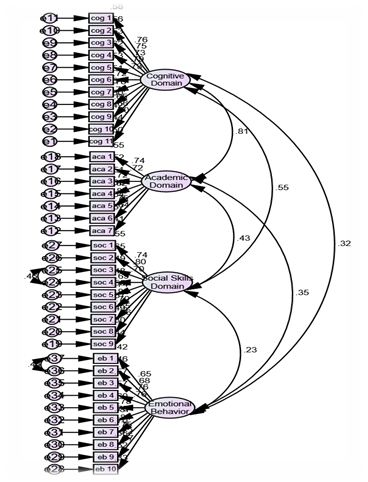
This study aimed to develop and validate a screening tool for the identification of slow learner students studying in special needs schools of Punjab. For this purpose, a systematic scale development procedure was adopted. The first phase of the study involved item generation through literature, focus group discussions, and interviews. The content validity index was established using the Lawshe approach followed by a pilot study. Further, construct validity was established through exploratory factor analysis (EFA) on a sample of 356 students with an age range of 6 to 15 years (M = 10.70, SD = 2.24) recruited from different regions of Punjab. EFA resulted in 37 items distributed into four domains namely, cognitive skills domain, academic performance domain, social skills domain, and emotional and behavioral problems. The Cronbach alpha indicated excellent internal consistency of the items (α = 93). In study two, the four-factor structure was validated with an independent sample of 403 slow learners. The confirmatory factor analysis revealed a good model fit to the data; thus, all 37 items were retained. The contrasted groups' approach was used to establish the criterion-related construct validity of the screening tool. The results showed that the screening tool can effectively distinguish between slow learners and normal children. This study provides valuable insights into the characteristics of slow learners in our cultural context and presents a comprehensive screening tool that can be utilized by institutions to help identify and support slow learners.
Downloads
References
Adawiyah, R., & Daulay, S. H. (2022). Using a cognitive therapy to enhance slow learners’ competence: Teacher’s strategy. Journal of English Language and Education, 6(1), 19–35. https://doi.org/10.29240/ef.v6i1.4210
Afzal, A., Mirza, N., & Arshad, F. (2021). Pakistan’s poverty puzzle: Role of foreign aid, democracy & media. Economic research-Ekonomska istraživanja, 34(1), 368–382.
Alawiyah, S., & Supriatna, M. (2022). Cognitive counseling in improving learning achievement of slow learner students. Proceedings of International Conference on Islamic Guidance and Counseling, 2, 22–29. http://conference.uinsuka.ac.id/index.php/article/view/650
Ayre, C., & Scally, A. J. (2014). Critical values for Lawshe’s content validity ratio. Measurement and Evaluation in Counseling and Development, 47(1), 79–86. https://doi.org/10.1177/0748175613513808
Azzahra, N., & Herman, T. (2022). Cognitive ability characteristics and learning motivation on slow learners student in solving mathematics problems. AIP Conference Proceedings, 2468(1), 6–12. https://doi.org/10.1063/5.0102735
Batool, S. S. (2016). Construction and validation of perceived dimensions of parenting scale (PDPS). Pakistan Journal of Social and Clinical Psychology, 14(2), 15–25.
Braun, V., & Clarke, V. (2006). Using thematic analysis in psychology. Qualitative Research in Psychology, 3(2), 77–101. https://doi.org/10.1191/1478088706qp063oa
Chaudhry, N. (2019, August 24). Who is a slow learner? Daily Times. https://www.dailytimes.com.pk/perspectives
Cheon, K. A. (2024). Comprehensive understanding of slow learners (Borderline Intellectual Functioning). Journal of the Korean Academy of Child and Adolescents Psychiatry, 35(3), 153–154. https://doi.org/10.5765/jkacap.240023
Chow, J. C. C., Snowden, L. R., & McConnell, W. (2001). A confirmatory factor analysis of the BASIS-32 in racial and ethnic samples. The Journal of Behavioral Health Services & Research, 28(4), 400–411. https://doi.org/10.1007/BF02287771
Clark, L. A., & Watson, D. (2016). Constructing validity: Basic issues in objective scale development. In A. E. Kazdin (Ed.), Methodological issues and strategies in clinical research (pp. 187–203). American Psychological Association.
Daga, P., & Jain, E. (2022). The psychosocial factors of slow learners: A comparative study between government and private schools’ students. International Journal of Indian Psychology, 10(1), 762–772. https://doi.org/10.25215/1001.079
Davies, L., Randle-Phillips, C., Russell, A., & Delaney, C. (2021). The relationship between adverse interpersonal experiences and self-esteem in people with intellectual disabilities: The role of shame, self-compassion and social support. Journal of Applied Research in Intellectual Disabilities, 34(4), 1037–1047. https://doi.org/10.1111/jar.12844
Erikson, E. H. (1950). Childhood and society. W. W. Norton.
Escobar, E. B. (2021). Psycho-pedagogical suggestions for achieving adequate self-esteem in children with disabilities. South Florida Journal of Development, 2(2), 2516–2526. https://doi.org/10.46932/sfjdv2n2-109
Gigi, K., Werbeloff, N., Goldberg, S., Portuguese, S., Reichenberg, A., Fruchter, E., & Weiser, M. (2014). Borderline intellectual functioning is associated with poor social functioning, increased rates of psychiatric diagnosis and drug use: A cross sectional population-based study. European Neuropsychopharmacology, 24(11), 1793–1797. https://doi.org/10.1016/j.euroneeuro.2014.07.016
Hair, J. D., Anderson, R. E., Tatham, R. L., & Black, W. C. (2010). Multivariate data analysis (7th ed.). Prentice Hall.
Hassan, A., & Mahmud, M. (2018). Learning motivation for slow learners with tablet technology. International Journal for Studies on Children, Women, Elderly, and Disabled, 5, 201–210.
Hassiotis, A., Noor, M., Bebbington, P., Afia, A., Wieland, J., & Qassem, T. (2017). Borderline intellectual functioning and psychosis: Adult psychiatric morbidity survey evidence. British Journal of Psychiatry, 211(1), 50–51. https://doi:10.1192/bjp.bp.116.190652
Juleha, S., Sudirman, S., Nurafifah, L., & Arifuddin, A. (2021, November 4–5). Investigating the cognitive development of slow learners through constructivist geometry games. [Paper Presentation]. 1st International Conference on Economics, Business and Social Humanities, ICONEBS, Maidun, Indonesia.
Kaiser, H. F. (1970). A second-generation little jiffy. Psychometrika, 35(3), 401–415. https://doi.org/10.1007/BF02291817
Karamat, A., Saleem, S., Zahra, S. T., & Mahmood, Z. (2022). Assessing emotional neglect in adolescents: A scale development and psychometric properties in Pakistani adolescents. Bahria Journal of Professional Psychology, 21(1), 58–69.
Karande, S., Kanchan, S., & Kulkarni, M. (2008). Clinical and psychoeducational profile of children with borderline intellectual functioning. Indian Journal of Pediatrics, 75, 795–800. https://doi.org/10.1007/s12098-008-0101-y
Karishnakumar, P., Jisha, A. M., Sukumaran, S.K., & Nair, M.C. (2011). Developing a model for resource room training for slow learners in normal schools. Indian Journal of Psychiatry, 53(4), 336–339. https://doi.org/10.4103/0019-5545.91908
Kelley-Quon, L. I., Cho, J., Strong, D. R., Miech, R. A., Barrington Trimis, J. L., Kechter, A., & Leventhal, A. M. (2019). Association of nonmedical prescription opioid use with subsequent heroin use initiation in adolescents. JAMA Pediatrics, 173(9), Article e191750. https://doi.org/10.1001/jamapediatrics.2019.1750
Kelloway, E. K. (1998). Using LISREL for structural equation modeling: A researcher’s guide. Sage Publications.
Kline, R. B. (2015). Principles and practice of structural equation modeling. Guilford Publications.
Korikana, A. (2020). Slow learners- a universal problem and providing educational opportunities to them to be a successful learner. PEOPLE: International Journal of Social Sciences, 6(1), 29–42. https://doi.org/10.20319/pijss.2020.61.2942
Lawshe, C. H. (1975). A quantitative approach to content validity. Personnel Psychology, 28, 563–575. https://doi.org/10.1111/j.1744-6570.1975.tb01393.x
Mahmood, S. (2017). Testing the effectiveness of a critical thinking skills intervention for initial teacher education students in Pakistan [Doctoral dissertation, University of Southampton]. ePrints Soton. https://eprints.soton.ac.uk/413358/1/26June17_Shumaila.pdf
Malik, N. I., Rehman, G., & Hanif, R. (2012). Effect of academic interventions on the developmental skills of slow learners. Pakistan Journal of Psychological Research, 27(1), 135–151.
Mardell, C., & Goldenberg, D. (2010). DIAL-4: Developmental indicators for the assessment of learning. Pearson Clinical Assessment.
Miller, P. H. (2022). Developmental theories: Past, present, and future. Developmental Review, 66, 1–13. https://doi.org/10.1016/j.dr.2022.101049
Newborg, J. (2005). Examiner’s manual: Battelle developmental inventory (2nd ed.). The Riverside Publishing Company.
Peltopuro, M., Ahonen, T., Kaartinen, J., Seppälä, H., & Närhi, V. (2014). Borderline intellectual functioning: A systematic literature review. Intellectual Developmental Disability, 52, 419–43. https://doi.org/10.1352/1934-9556-52.6.419
Piaget, J. (1970). Genetic epistemology (E. Duckworth, Trans.). Columbia University Press.
Polit, D. F., & Beck, C. T. (2006). The content validity index: Are you sure you know what's being reported? Critiques and recommendations. Research in Nursing and Health, 29(5), 489–497. https://doi.org/10.1002/nur.20147
Raven, J. C., Court, J. H., & Raven, J. (1977). Manual for ravens colored progressive matrices (2nd ed.). Lewis and Co.
Shaw, S. R. (2000). Slow Learners and mental health issues. NASP Communiqué, 28, Article e4.
Shaw, S. R. (2008). An educational programming framework for a subset of students with diverse learning needs: Borderline intellectual functioning. Interventions in School and Clinic, 43(5), 291–299. https://doi.org/10.1177/1053451208314735
Shaw, S. R. (2010). Rescuing students from the slow learner trap. Principal Leadership. https://www.yumpu.com/en/document/read/48020550/rescuing-students-from-the-slow-learner-trap-national-
Shaw, S.R. (2022). Reaching and teaching students who don’t qualify for special education: Strategies for the inclusive education diverse learners. Routledge.
Slosson R. L. (1963). Slosson Intelligence Test (SIT). Slosson Educational Publications.
Trisnani, R. P., Hidayah, N., Ramli, M., & Indreswari, H. (2023). Self-esteem problem on slow learners students and strategies to solve it in inclusive schools. Journal for Re Attach Therapy and Developmental Diversities, 6(6), 405–413.
Vygotsky, L. S. (1978). The concept of activity in Scottish psychology. In K. Richardson & S. Sheldon (Eds.), Cognitive development and adolescence. Erlbaum.
Wismeijer, A. J. (2012). Dimensionality analysis of the thought suppression inventory: Combining EFA, MSA, AND CFA. Journal of Psychopathological Behavior Assessment, 34, 116–125. http://doi.org/10.1007/s10862-011-9246-5
Wiig, E. H., Semel, E., & Secord W. A. (2013). Clinical evaluation of language fundamentals–Fifth edition (CELF-5). NCS Pearson.
Yilmaz, K. (2011). The cognitive perspective on learning: Its theoretical underpinnings and implications for classroom practices. The Cleaning House, 84(5), 204–212. https://doi.org/10.1080/00098655.2011.568989
Downloads
Published
How to Cite
Issue
Section
License
Copyright (c) 2026 Nosheen Ramzan, Tariq Mahmood Malik, Khaula Munawar Minhas, Iram Fatima

This work is licensed under a Creative Commons Attribution 4.0 International License.
APR follows an open-access publishing policy and full text of all published articles is available free, immediately upon publication of an issue. The journal’s contents are published and distributed under the terms of the Creative Commons Attribution 4.0 International (CC-BY 4.0) license. Thus, the work submitted to the journal implies that it is original, unpublished work of the authors (neither published previously nor accepted/under consideration for publication elsewhere). On acceptance of a manuscript for publication, a corresponding author on the behalf of all co-authors of the manuscript will sign and submit a completed the Copyright and Author Consent Form.