
Microbial Degradation of Low-Density Polyethylene Using a Synergistic Consortium from Landfill Soil
DOI:
https://doi.org/10.32350/bsr.74.03Keywords:
bacterial consortia, degradation, FTIR, LDPE, SEMAbstract
Background. Low-density polyethylene (LDPE) is a widely used plastic. A 4-5% annual increase in plastic usage has been observed since the 1960s. Once coined as a ‘‘magic material’’ for its resilience, flexibility, and affordability, plastic has now become an environmental threat due to its severe ecological burden, persistent nature, and non-degradability. The non-degradation of plastic is a major concern in this growing plastic world. The current study investigates the bacterial growth dynamics to degrade LDPE using it as the only carbon source. The bacteria’s potential to grow in stressed environments enhances their bioremediation ability.
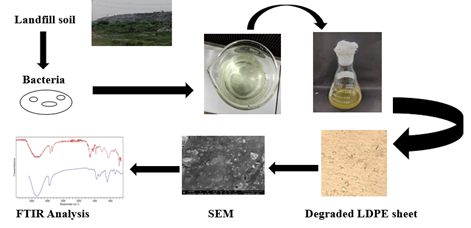
Methods. Four different types of Gram-positive and Gram-negative bacteria were isolated from the landfill soil sample. After initial screening using the Sherman Manual, bacterial strains were grown in an enriched medium and LDPE was added after pretreatment with UV and ethanol.
Results. At the start, no degradation was observed; gradually, the plastic started to degrade. Ultimately, almost 35% of degradation was observed after 60 days of incubation. Various parameters were also studied, including the light microscopic analysis, pH measurement, optical density, and FTIR analysis. During the experiment, the pH decreased, which caused an increase in the metabolic activity of bacteria. As a result of this high metabolic activity, an increase in the optical density of bacteria was observed. Holes were observed in the plastic sheet under the microscope after incubation. Peaks of 1150 cm-1 and 1870 cm-1 were observed in LDPE in the FTIR analysis after incubation in the bacterial consortia.
Conclusion. This study reveals the desired/positive effect of bacterial consortia on plastic degradation. Hence, this method can be used to reduce environmental pollution.
Downloads
References
Tong Y, Lin L, Tao Y, Huang Y, Zhu X. The occurrence, speciation, and ecological effect of plastic pollution in the bay ecosystems. Sci Total Environ. 2023;857:e159601. https://doi.org/ 10.1016/j.scitotenv.2022.159601
Szlachetka O, Witkowska-Dobrev J, Baryła A, Dohojda M. Low-density polyethylene (LDPE) building films – Tensile properties and surface morphology. J Build Eng. 2021;44:e103386. https://doi.org/10.1016/j.jobe.2021.103386
Li Y, Liu C, Yang H, et al. Leaching of chemicals from microplastics: A review of chemical types, leaching mechanisms and influencing factors. Science Total Environ. 2024;906:e167666. https://doi.org/10.1016/j.scitotenv.2023.167666
Suleman R, Amjad A, Ismail A, Javed S, Ghafoor U, Fahad S. Impact of plastic bags usage in food commodities: an irreversible loss to environment. Environ Sci Pollut Res. 2022;29(33):49483-49489. https://doi.org/10.1007/S11356-022-21091-3
Thew C, Lee Z, Srinophakun P, Ooi CW. Recent advances and challenges in sustainable management of plastic waste using biodegradation approach. Bioresource Technol. 2023;374:e128772. https://doi.org/10.1016/J.BIORTECH.2023.128772
Ji SH, Yoo S, Park S, Lee MJ. Biodegradation of low-density polyethylene by plasma-activated Bacillus strain. Chemosphere. 2024;349:e140763. https://doi.org/10.1016/J.CHEMOSPHERE.2023.140763
Han YN, Wei M, Han F, et al. Greater biofilm formation and increased biodegradation of polyethylene film by a microbial consortium of Arthrobacter sp. and Streptomyces sp. Microorganisms. 2020;8(12):e1979. https://doi.org/10.3390/MICROORGANISMS8121979
Muangchinda C, Pinyakong O. Enrichment of LDPE-degrading bacterial consortia: Community succession and enhanced degradation efficiency through various pretreatment methods. Sci Rep. 2024;14(1):e28795. https://doi.org/ 10.1038/s41598-024-80306-4
Jayan N, Skariyachan S, Sebastian D. The escalated potential of the novel isolate Bacillus cereus NJD1 for effective biodegradation of LDPE films without pre-treatment. J Hazard Mater. 2023;455:e131623. https://doi.org/10.1016/J.JHAZMAT.2023.131623
Yao Z, Seong HJ, Jang YS. Degradation of low density polyethylene by Bacillus species. Appl Biol Chem. 2022;65:e84. https://doi.org/10.1186/s13765-022-00753-3
Tiwari N, Santhiya D, Sharma JG. Significance of landfill microbial communities in biodegradation of polyethylene and nylon 6,6 microplastics. J Hazard Mater. 2024;462:132786. https://doi.org/10.1016/J.JHAZMAT.2023.132786
Smith LC, Orgiazzi A, Eisenhauer N, et al. Large-scale drivers of relationships between soil microbial properties and organic carbon across Europe. Glob Ecol Biogeogr. 2021;30(10):2070-2083. https://doi.org/10.1111/geb.13371
Poormontaseri M, Ostovan R, Berizi E, Hosseinzadeh S. Growth rates of Bacillus species probiotics using various enrichment media. Int J Nutr Sci. 2017;2(1):39-42.
Juengert J, Bresan S, Jendrossek D. Determination of Polyhydroxybutyrate (PHB) content in ralstonia eutropha using gas chromatography and Nile red staining. Bio-Protocol. 2018;8(5):e2748. https://doi.org/10.21769/BioProtoc.2748
Tripathi N, Zubair M, Sapra A. Gram Staining. NCBI Bookshelf. http://europepmc.org/books/NBK562156
Salinas J, Martínez-Gallardo MR, Jurado MM, et al. Microbial consortia for multi-plastic waste biodegradation: selection and validation. Environ Technol Innov. 2024;36:e103887. https://doi.org/10.1016/J.ETI.2024.103887
Nadeem H, Alia KB, Muneer F, et al. Isolation and identification of low-density polyethylene degrading novel bacterial strains. Arch Microbiol. 2021;203(9):5417-5423. https:// doi.org/10.1007/S00203-021-02521-1
Wróbel M, Szymańska S, Kowalkowski T, Hrynkiewicz K. Selection of microorganisms capable of polyethylene (PE) and polypropylene (PP) degradation. Microbiol Res. 2023;267:e127251. https://doi.org/10.1016/J.MICRES.2022.127251
Khan N, Ali I, Mazhar S, Munir S, Batool R, Jamil N. Co-Culture of Halotolerant Bacteria to produce Poly(3-hydroxybutyrate-co-3-hydroxyvalerate) using sewage wastewater substrate. Polymers (Basel). 2022;14(22):e4963. https:// doi.org/10.3390/polym14224963
Koller M, Rodríguez-Contreras A. Techniques for tracing PHA-producing organisms and for qualitative and quantitative analysis of intra- and extracellular PHA. Eng Life Sci. 2015;15(6):558-581. https://doi.org/10.1002/elsc.201400228
Sekhohola-Dlamini L, Dlamini P, Selvarajan R, Ogola HJO, Tekere M. Influences of geochemical factors and substrate availability on Gram-positive and Gram-negative bacterial distribution and bio-processes in ageing municipal landfills. Int Microbiol. 2021;24(3):311-324. https://doi.org/10.1007/s10123-021-00167-z
Chukwuma OB, Rafatullah M, Kapoor RT, et al. Isolation and characterization of lignocellulolytic bacteria from municipal solid waste landfill for identification of potential hydrolytic enzyme. Fermentation. 2023;9(3):e298. https://doi.org/10.3390/fermentation9030298
Anggiani M, Kristanti RA, Hadibarata T, Kurniati TH, Shiddiq MA. Degradation of Polypropylene microplastics by a consortium of bacteria colonizing plastic surface waste from Jakarta Bay. Water Air Soil Pollut. 2024;235(5):e308. https:// doi.org/10.1007/s11270-024-07113-5
A study on the combined effect of bacterial consortium on the biodegradation of plastic by the decrease in the pH and increase in the optical density of bacterial consortium.
Khandare SD, Chaudhary DR, Jha B. Marine bacterial biodegradation of low-density polyethylene (LDPE) plastic. Biodegradation. 2021;32(2):127-143. https://doi.org/10.1007/s10532-021-09927-0
A study on the active biodegradation of LDPE by marine bacteria to reduce plastic pollution in the marine environment.
Zhao T, Lozano YM, Rillig MC. Microplastics increase soil ph and decrease microbial activities as a function of microplastic shape, polymer type, and exposure time. Front Environ Sci. 2021;9:e675803. https://doi.org/10.3389/fenvs.2021.675803
Khampratueng P, Anal AK. Enhancing the biodegradation of low-density polyethylene (LDPE) using novel bacterial consortia: Bacillus sp. AS3 and Sphingobacterium sp. AS8. J Environ Sci. 2025;159: 263-270. https://doi.org/10.1016/j.jes.2025.04.007
Downloads
Published
How to Cite
Issue
Section
License
BSR follows an open-access publishing policy and full text of all published articles is available free, immediately upon publication of an issue. The journal’s contents are published and distributed under the terms of the Creative Commons Attribution 4.0 International (CC-BY 4.0) license. Thus, the work submitted to the journal implies that it is original, unpublished work of the authors (neither published previously nor accepted/under consideration for publication elsewhere). On acceptance of a manuscript for publication, a corresponding author on the behalf of all co-authors of the manuscript will sign and submit a completed the Copyright and Author Consent Form.