
Building Climate-resilient Infrastructure through Microorganisms: A Mini Review
DOI:
https://doi.org/10.32350/bsr.74.05Keywords:
bio-concretes, bioremediation, climate resilience, microbial construction, microorganismsAbstract
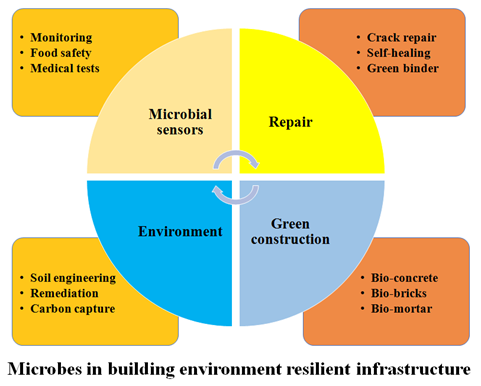
Microorganisms were considered as the disease-causing agents a long time ago. However, this fear transformed into their acceptance due to their biological, physiological, and ecological understanding which resulted in the modification of Germ Theory. Currently, mutualistic and parasitic role of microbes is well-understood which paved the path for their biotechnological use. Additionally, microbial bio-coatings are outstanding bio-sensors for environmental monitoring, food analysis, heavy metal detection, and bioelectronics. The use of bacteria in self-healing concrete repair is advantageous due to their potential for low-cost binding, providing strength, stiffness, durability, and reduction in steel reinforcements. The surface membrane of bacteria is negatively charged which binds with metallic ions in basic medium that is a key factor in carbonate precipitation on their surfaces to repair cracks. On the other hand, calcite precipitation also influences the life span and stability of concrete. Recently, microorganisms assisted remediation, geo-polymerizations, and carbon capture. Furthermore, heavy metal detections were reported which may revolutionize microbial utilization in building climate resilient infrastructure. The current review spotlighted the applications of microorganisms in concretes, soil engineering, bio-coatings, bio-remediation, carbon capturing, and monitoring soil properties. In the end, recent developments and future directions were meticulously-vetted. The study concluded that the application of microbes in building climate-resilient infrastructure is reliable to decrease carbon emissions, enhancing self-repair concrete systems and developing sustainable green systems. Exploitation of natural phenomenon occurring in microorganisms not only aids in more climate resilient systems but also contributes positively for a green environment.
Downloads
References
Rizwan M, Selvanathan V, Rasool A, et al. Metal–Organic framework-based composites for the detection and monitoring of pharmaceutical compounds in biological and environmental matrices. Water Air Soil Pollut. 2022;233:e493. https:// doi.org/10.1007/s11270-022-05904-2
Qureshi MAUR, Arshad N, Rasool A, Rizwan M, Fawy KF, Rasheed T. pH-responsive chitosan dendrimer hydrogels enabling controlled cefixime release. European Polymer Journal. 2024;219:e113377. https://doi.org/10.1016/j.eurpolymj.2024.113377
Rasool A, Qureshi MNUR, Kanwal M, Anwar MA, Butt MS, Firdous N. Chemical modifications of alginates for biomedical applications-a review. Sci Inq Rev. 2025;9(2):1-48. https://doi.org/10.32350/sir.92.03
Chapman R, Gause G. The struggle for existence. Ecology. 1935;16(4):656-657.
Hungate R. Further experiments on cellulose digestion by the protozoa in the rumen of cattle. Biol Bull. 1943;84(2):157-163. https://doi.org/10.2307/1538178
McFall-Ngai MJ, Ruby EG. Symbiont recognition and subsequent morphogenesis as early events in an animal-bacterial mutualism. Science. 1991;254(5037):1491-1494.
Dunlap PV, Mcfall‐Ngai MJ. Initiation and control of the bioluminescent symbiosis between Photobacterium leiognathi and leiognathid fish. Ann New York Acad Sci. 1987;503(1):269-283. https://doi.org/10.1111/j.17496632.1987.tb40614.x
Liu AH. Revisiting the hygiene hypothesis for allergy and asthma. J All Clin Immunol. 2015;136(4):860-865. https://doi.org/10.1016/j.jaci. 2015.08.012
Rook G, Brunet L. Microbes, immunoregulation, and the gut. Gut. 2005;54(3):317-320. https://doi.org/10.1136/gut.2004.053785
Lau CS, Chamberlain RS. Probiotics are effective at preventing Clostridium difficile-associated diarrhea: a systematic review and meta-analysis. Int J Gen Med. 2016:27-37. https://doi.org/10.2147/IJGM.S98280
Manzoor H, Arshad N, Qureshi MAR, Javed A. Hydroxyapatite-reinforced pectin hydrogel films PEC/PVA/APTES/HAp: doxycycline loading for sustained drug release and wound healing applications. RSC Adv. 2025;15(37):30026-30045. https://doi. org/10.1039/D5RA01989C
Arshad N, Chaudhary AA, Saleem S, Akram M, Qureshi MAUR. Surface modification of surgical suture by chitosan-based biocompatible hybrid coatings: In-vitro anti-corrosion, antibacterial, and in-vivo wound healing studies. Int J Biol Macromol. 2024;281:e136571. https://doi.org /10.1016/j.ijbiomac.2024.136571
Qureshi MAUR, Arshad N, Rasool A, et al. Kappa-carrageenan and sodium alginate-based pH-responsive hydrogels for controlled release of methotrexate. Royal Soc Open Sci. 2024;11(4):e231952. https://doi.org/10.1098/rsos.231952
Cockell CS. Are microorganisms everywhere they can be? Environ Microbiol. 2021;23(11):6355-6363. https://doi.org/10.1111/1462-2920.15825
Hassoun MN, Al-Manaseer A. Structural Concrete: Theory and Design. John Wiley & Sons; 2020.
Jefferson A, Joseph C, Lark R, Isaacs B, Dunn S, Weager B. A new system for crack closure of cementitious materials using shrinkable polymers. Cement Concr Res. 2010;40(5):795-801. https://doi.org/10.1016/j.cemconres.2010.01.004
Wu M, Hu X, Zhang Q, Xue D, Zhao Y. Growth environment optimization for inducing bacterial mineralization and its application in concrete healing. Construct Build Mater. 2019;209:631-643. https://doi.org/10.1016/j.conbuildmat.2019.03.181
Omoregie AI, Ngu LH, Ong DEL, Nissom PM. Low-cost cultivation of Sporosarcina pasteurii strain in food-grade yeast extract medium for microbially induced carbonate precipitation (MICP) application. Biocat Agricul Biotech. 2019;17:247-255. https://doi.org/10.1016/j.bcab. 2018.11.030
Schwantes-Cezario N, Porto MF, Sandoval G, Nogueira G, Couto A, Toralles BM. Effects of Bacillus subtilis biocementation on the mechanical properties of mortars. Revista IBRACON de Estruturas e Materiais. 2019;12(01):31-38.
Rao PP, Asadi S, Krishna MR, Babu AS, Alla S. An experimental investigation of bacteria impact on compressive strength of cement mortar and concrete. Materials Today: Proceedings. 2021;43:1949-1955. https://doi.org/10.1016/j.matpr.2020.11.213
Cagatay Ersan Y, Erşan Y. Microbial Nitrate Reduction Induced Autonomous Self-Healing in Concrete [dissertation]. Ghent: Ghent University; 2016.
Wang J, Soens H, Verstraete W, De Belie N. Self-healing concrete by use of microencapsulated bacterial spores. Cement Concr Res. 2014;56:139-152. https://doi.org/10.1016/j.cemconres.2013.11.009
Alazhari MS. The effect of microbiological agents on the efficiency of bio-based repair systems for concrete. University of Bath; 2017.
Gutierrez-Padilla MGD. Activity of Sulfur Oxidizing Microorganisms and Impacts on Concrete Pipe Corrosion [dissertation]. Boulder: University of Colorado at Boulder; 2007.
Kantzas A, Stehmeier L, Marentette D, Ferris F, Jha K, Maurits F. A novel method of sand consolidation through bacteriogenic mineral plugging. Paper presented at: The Annual Technical Meeting; June 6–9, 1992; Calgary, Alberta. https://doi.org/10.2118/92-46
Rivadeneyra M, Delgado G, Ramos-Cormenzana A, Delgado R. Biomineralization of carbonates by Halomonas eurihalina in solid and liquid media with different salinities: crystal formation sequence. Res Microbiol. 1998;149(4):277-287. https://doi.org/10.1016/S0923-2508(98)80303-3
Suthar H, Hingurao K, Desai A, Nerurkar A. Selective plugging strategy based microbial enhanced oil recovery using Bacillus licheniformis TT33. J Microbiol Biotechnol. 2009;19(10):1230-1237.
Sen R. Biotechnology in petroleum recovery: the microbial EOR. Prog Energy Combust Sci. 2008;34(6):714-724. https://doi.org/10.1016/j.pecs. 2008.05.001
Zhong L, Islam M. A new microbial plugging process and its impact on fracture remediation. Paper presented at: SPE Annual Technical Conference and Exhibition; October 22–25, 1995; Dallas, Texas.
Boquet E, Boronat A, Ramos-Cormenzana A. Production of calcite (calcium carbonate) crystals by soil bacteria is a general phenomenon. Nature. 1973;246(5434):527-529. https://doi.org/10.1038/246527a0
Achal V, Mukherjee A, Basu P, Reddy MS. Lactose mother liquor as an alternative nutrient source for microbial concrete production by Sporosarcina pasteurii. J Indust Microbiol Biotechnol. 2009;36(3):433-438. https://doi.org/ 10.1007/s10295-008-0514-7
Martinez B, DeJong J, Ginn T, et al. Experimental optimization of microbial-induced carbonate precipitation for soil improvement. J Geotech Geoenviron Eng. 2013;139(4):587-598. https://doi.org/10.1061/(ASCE)GT.19435606.0000787
Zhu T, Dittrich M. Carbonate precipitation through microbial activities in natural environment, and their potential in biotechnology: a review. Front Bioeng Biotechnol. 2016;4:e4. https://doi.org/10.3389/fbioe.2016.00004
Le Metayer-Levrel G, Castanier S, Orial G, Loubière J-F, Perthuisot J-P. Applications of bacterial carbonatogenesis to the protection and regeneration of limestones in buildings and historic patrimony. Sedim Geol. 1999;126(1-4):25-34. https://doi.org/ 10.1016/S0037-0738(99)00029-9
Rasool A, Islam A, Fayyaz S. Hydrogels and their emerging applications. In: Kumar A, Gupta R, eds. Hydrogels. CRC Press; 2023:24.
D'souza S. Microbial biosensors. Biosens Bioelectron. 2001;16(6):337-353.
Su L, Jia W, Hou C, Lei Y. Microbial biosensors: a review. Biosens Bioelectron. 2011;26(5):1788-1799. https://doi.org/10.1016/j.bios.2010.09.005
Rasheed T, Bilal M. Thermo-responsive functionalized polymeric nanocomposites. In: Ali N, Bilal M, Gupta RK, eds. Smart Polymer Nanocomposites: Design, Synthesis, Functionalization, Properties, and Applications. Elsevier; 2022:219-240.
Bracaglia S, Ranallo S, Ricci F. Electrochemical cell‐free biosensors for antibody detection. Angew Chem. 2023;135(8):e202216512. https:// doi.org/10.1002/ange.202216512
Huang C-W, Lin C, Nguyen MK, Hussain A, Bui X-T, Ngo HH. A review of biosensor for environmental monitoring: principle, application, and corresponding achievement of sustainable development goals. Bioengineered. 2023;14(1):58-80. https://doi.org/10.1080/21655979.2022.2095089
Islam M, Rana MS. Contaminant identification in water by microbial biosensors: a review. J Knowled Learn Sci Technol. 2023;1(1):25-33. https://doi.org/10.60087/jgrkv103
Xu X, Ying Y. Microbial biosensors for environmental monitoring and food analysis. Food Rev Int. 2011;27(3):300-329. https://doi.org /10.1080/87559129.2011.563393
Griño Jr AA, Soriano HSP, Promentilla MAB, Ongpeng JMC. Exploring the potential of polypropylene fibers and bacterial co-culture in repairing and strengthening geopolymer-based construction materials. Buildings. 2023;13(10):e2668. https://doi.org /10.3390/buildings13102668
Hingley-Wilson S, Keddie J. Biocoatings: Painting Bacteria onto Surfaces for Sustainable Processes. University of Surrey; 2019.
Rasool A, Hafeez S, Islam A, et al. Polymer nanocomposite films and coatings for biomedical applications. In: Pandey M, Deshmukh K, Hussain CM, eds. Polymer nanocomposite films and coatings. Elsevier; 2024:729-758.
Flickinger MC, Bernal OI, Schulte MJ, et al. Biocoatings: challenges to expanding the functionality of waterborne latex coatings by incorporating concentrated living microorganisms. J Coat Technol Res. 2017;14:791-808. https://doi.org/10.1007/s11998-017-9933-6
Krings S, Chen Y, Hingley-Wilson S, Keddie, J. Biocoatings: painting bacteria on surfaces. Access Microbiol Soc. 2020;2(74). https://doi.org /10.1099/acmi.ac2020.po0333
DeJong JT, Mortensen BM, Martinez BC, Nelson DC. Bio-mediated soil improvement. Ecoog Eng. 2010:197-210. https://doi.org/10.1016/j.ecoleng. 2008.12.029
Azeem MK, Islam A, Khan RU, et al. Guar gum/polyethylene glycol/graphene oxide environmentally friendly hybrid hydrogels for controlled release of boron micronutrient. Royal Soc Open Sci. 2023;10(12):e231157. https://doi.org/10.1098/rsos.231157
Hart MM, Cross AT, D'Agui HM, et al. Examining assumptions of soil microbial ecology in the monitoring of ecological restoration. Ecol Solut Evid. 2020;1:e12031. https://doi.org/10.1002/2688-8319.12031
El Mountassir G, Minto JM, van Paassen LA, Salifu E, Lunn RJ. Applications of microbial processes in geotechnical engineering. Adv Appl Microbiol. 2018;104:39-91. https://doi .org/10.1016/bs.aambs.2018.05.001
Shahroz M, Arshad N, Qureshi MAR. Investigating synergistic effects of biomass-derived carbon coatings on TiO2 for anode candidacy in electrochemical OER and supercapacitor performance enhancement. Int J Hydro Energy. 2025;137:214-224. https://doi.org/ 10.1016/j.ijhydene.2025.05.117
Liang X, Duan Y, Su Y, et al. Carbon capture by biological methods. Cambridge Prism: Carb Technol. 2025;1:e4. https://doi.org/10.1017/cat. 2025.10005
Chen FY-H, Jung H-W, Tsuei C-Y, Liao JC. Converting Escherichia coli to a synthetic methylotroph growing solely on methanol. Cell. 2020;182(4):933-946. https://doi.org/ 10.1016/j.cell.2020.07.010
Cheng J, Zhu Y, Zhang Z, Yang W. Modification and improvement of microalgae strains for strengthening CO2 fixation from coal-fired flue gas in power plants. Biores Technol. 2019;291:e121850. https://doi.org/10.1016/j.biortech.2019.121850
Fixen KR, Zheng Y, Harris DF, et al. Light-driven carbon dioxide reduction to methane by nitrogenase in a photosynthetic bacterium. Proc Nat Acad Sc. 2016;113(36):10163-10167. https://doi.org/10.1073/pnas.1611043113
Park WG, Kim M, Li S, et al. A light-driven photosynthetic microbial fuel cell for carbon-negative bioelectricity production. Sustain Energ Fuel. 2024;8(11):2476-2484. https://doi.org/10.1039/D3SE01487H
Yuvraj. Microalgal bioremediation: a clean and sustainable approach for controlling environmental pollution. In: Arora S, Kumar A, Ogita S, Yau Y-Y, eds. Innovations in Environmental Biotechnology. Springer; 2022:305-318.
Sharma P. Efficiency of bacteria and bacterial assisted phytoremediation of heavy metals: an update. Bioresour Technol. 2021;328:e124835. https://doi.org/10.1016/j.biortech.2021.124835
Vidali M. Bioremediation. an overview. Pure Appl Chem. 2001;73(7):1163-1172.
Omoregie AI, Wong CS, Rajasekar A, et al. Bio-based solutions for concrete infrastructure: a review of microbial-induced carbonate precipitation in crack healing. Buildings. 2025;15(7):e1052. https://doi.org/10.3390/buildings15071052
Rusanowska P, Dębowski M, Zieliński M. Microalgae-Assisted microbial fuel cell for treatment of difficult waste streams. Energies. 2025;18(4):e963. https://doi.org/10.3390/en18040963
Ali M, Khan M, Naveed M, Tanvir M. Microbe-assisted rhizodegradation of hydrocarbons and growth enhancement of wheat plants in hydrocarbons contaminated soil. Int J Environ Sci Technol. 2024;21(3):3169-3184. https://doi.org/ 10.1007/s13762-023-05174-3
Sharma K, Dhiman S, Mukherjee G. Embracing microbial systems in built environments. In: Dhiman S, Mukherjee G, eds. Waste to Wealth: Emerging Technologies for Sustainable Development. CRC Press; 2025:1¬-32.
Jaramillo HY, Vasco-Echeverri O, López-Barrios R, García-León RA. Optimization of bio-brick composition using agricultural waste: mechanical properties and sustainable applications. Sustainability. 2025;17(5):e1914. https://doi.org /10.3390/su17051914
Lima-Zaloumis J, Cady S, Blank J, et al. Laminae as structural biosignatures in NASA’s Life detection knowledge base. Astrobiology. Preprint posted online April 1, 2025.
Zhao H, Gu Y, Zhang X, et al. Synergistic addition of Cu and Ce enhanced sulfate reducing bacteria-assisted corrosion cracking resistance of 2205 duplex stainless steel. J Mater Sci Technol. 2024;196:1-11. https://doi.org/10.1016/j.jmst.2024.02.023
Zhai S, Zhang D, Liu W, et al. Microbial electrochemical technologies assisted nitrogen recovery from different wastewater sources: performance, life cycle assessment, and challenges. Resour Conserv Recycl. 2023;194:e107000. https://doi.org/10.1016/j.resconrec.2023.107000
Das A, Das N, Pandey P, Pandey P. Microbial enhanced oil recovery: process perspectives, challenges, and advanced technologies for its efficient applications and feasibility. Arch Microbiol. 2025;207(5):e106. https://doi.org/10.1007/s00203-025-04307-1
Qureshi MAUR, Arshad N, Rasool A, Qureshi MN, Kanwal M. Applications of carbon nanotubes for fabrication of photovoltaic devices. In: Singh M, Singh AK, eds. Advanced Nanomaterials for Solution-Processed Flexible Optoelectronic Devices. CRC Press. 2025:1-29.
Downloads
Published
How to Cite
Issue
Section
License
BSR follows an open-access publishing policy and full text of all published articles is available free, immediately upon publication of an issue. The journal’s contents are published and distributed under the terms of the Creative Commons Attribution 4.0 International (CC-BY 4.0) license. Thus, the work submitted to the journal implies that it is original, unpublished work of the authors (neither published previously nor accepted/under consideration for publication elsewhere). On acceptance of a manuscript for publication, a corresponding author on the behalf of all co-authors of the manuscript will sign and submit a completed the Copyright and Author Consent Form.