
EPS Analysis and Phytostimulatory Potential of Biofilm-forming Bacteria
DOI:
https://doi.org/10.32350/bsr.74.06Keywords:
Auxin, biofilm, extracellular polymeric substances (EPS), plant growth promoting rhizobacteria (PGPR), PMI, Pseudomonas sp.Abstract
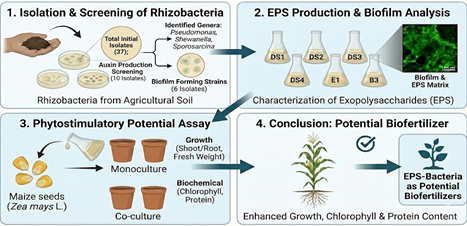
Use of plant growth-promoting rhizobacteria (PGPR) reclaims the productivity of the agricultural land through several mechanisms. Biofilm-forming rhizobacteria secrete extracellular polymeric substances (EPS) embedded in their self-produced exopolysaccharides. In the current study, thirty-seven isolates were evaluated or auxin production ability, however, ten isolates displayed significant auxin production ability. Six out of these ten isolates were biofilm-forming rhizobacteria, that is, Pseudomonas sp. 1 (DS1), Shewanella putrefaciens (DS2), Pseudomonas sp. 2 (DS3), Pseudomonas aeruginosa (DS4), Sporosarcina saromensis (E1), and B3. These were analyzed for their EPS production ability. The EPS production capacity of these rhizobacteria was evaluated under various physiological attributes, such as temperature, pH, and incubation periods. Phytostimulatory potential of the rhizobacterial strains was evaluated using Zea mays L. with monoculture and co-culture conditions. Results indicated that bacterial strains significantly enhanced the growth parameters, such as the percentage germination, shoot length, root length, number of leaves as well as fresh weight and biochemical parameters, that is, chlorophyll and soluble protein content of the plants. Distinct from previous PGPR studies, this study is unique in the evaluation of six rhizobacterial isolates with respect to the EPS production ability under varied pH, temperature, and incubation conditions and their combined effects in consortia in correlation with phytostimulatory impacts on Zea mays L. Thus, the EPS producing bacteria can be used as a sustainable biofertilizer to promote plant growth.
Downloads
References
Adedeji AA, Häggblom MM, Babalola OO. Sustainable agriculture in Africa: Plant growth-promoting rhizobacteria (PGPR) to the rescue. Sci Afr. 2020;9:e00492.https://doi.org/10. 1016/j.sciaf.2020.e00492
Arjumend T, Sarıhan EO, Yıldırım MU. Plant-bacterial symbiosis: an ecologically sustainable agriculture production alternative to chemical fertilizers. In: Meena VS, ed. Revisiting Plant Biostimulants. Intech Open; 2022. https://doi.org/10. 5772/intechopen.104838
Nayak SK, Nayak S, Patra JK. Rhizobacteria and its biofilm for sustainable agriculture: a concise review. In: Yadav MK, Singh BP, eds. New and Future Developments in Microbial Biotechnology And Bioengineering: Microbial Biofilms. Elsevier; 2020:165-75. https://doi.org/ 10.1016/B978-0-444-64279-0.00013-X
Khan N, Bano A, Babar MA. The stimulatory effects of plant growth promoting rhizobacteria and plant growth regulators on wheat physiology grown in sandy soil. Arch Microbiol. 2019;201(6):769-785.https://doi.org/10.1007/s00203-019-01644-w
Radchenkova N, Yaşar Yıldız S. Advanced optimization of bioprocess parameters for exopolysaccharides synthesis in extremophiles. Processes. 2025;13(3):e822. https://doi.org/10.3390/pr13030822
Talbi C, Elmarrakchy S, Youssfi M, et al. Bacterial exopolysaccharides: from production to functional features. Prog Microb Molecul Bio. 2023;6(1):ea0000384.https://doi.org /10.36877/pmmb.a0000384
Behera B, Das T, Raj R, Ghosh S, Raza MB, Sen S. Microbial consortia for sustaining productivity of non-legume crops: prospects and challenges. Agricul Res. 2021;10:1-14.https:// doi.org/10.1007/s40003-020-00482-3
Ahmed A, Hasnain S. Extraction and evaluation of indole acetic acid from indigenous auxin-producing rhizosphere bacteria. J Anim Plant Sci. 2020;30(4):1024-1036. https://doi.org/ 10.36899/JAPS.2020.4.0117
Shultana R, Zuan ATK, Naher UA, et al. The PGPR mechanisms of salt stress adaptation and plant growth promotion. Agronomy. 2022;12(10):e2266.https://doi.org/ 10.3390/agronomy12102266
Prakash J, Mishra S. Role of beneficial soil microbes in alleviating climatic stresses in plants. In: Kumar A, Singh J, Ferreira LFR, eds. Microbiome Under Changing Climate. Elsevier; 2022:29-68.https://doi.org/10.1016/B978-0-323-90571-8.00002-X
Sumbul A, Ansari RA, Rizvi R, Mahmood I. Azotobacter: a potential bio-fertilizer for soil and plant health management. Saudi J Biol Sci. 2020;27(12):3634-40. https://doi.org/ 10.1016/j.sjbs.2020.08.004
Renoud S, Abrouk D, Prigent-Combaret C, et al. Effect of inoculation level on the impact of the PGPR azospirillum lipoferum CRT1 on selected microbial functional groups in the rhizosphere of field maize. Microorganisms. 2022;10:e325. https://doi.org/10.3390/microorganisms10020325
Mubeen M, Bano A, Ali B, et al. Effect of plant growth promoting bacteria and drought on spring maize (Zea mays L.). Pak J Bot. 2021;53(2):731-739. https:// doi.org/10.30848/PJB2021-2(38)
Hu H, Xu J, Chen J, et al. Influence of flagella on Salmonella Enteritidis sedimentation, biofilm formation, disinfectant resistance, and interspecies interactions. Food Path Dis. 2025 Aug;22(8):577-584. https://doi.org/10.1089/fpd.2024.0088
Ansari FA, Ahmad I, Pichtel J, Husain FM. Pantoea agglomerans FAP10: A novel biofilm-producing PGPR strain improves wheat growth and soil resilience under salinity stress. Environ Exper Botany. 2024;222:e105759. https://doi.org/ 10.1016/j.envexpbot.2024.105759
Vaishnav A, Varma A, Tuteja N, Choudhary DK. PGPR-mediated amelioration of crops under salt stress. In: Choudhary DK, Varma A, Tuteja N, eds. Plant-Microbe Interaction: An Approach to Sustainable Agriculture. Springer; 2016:205-526. https:// doi.org/10.1007/978-981-10-2854-0
Morcillo RJ, Manzanera M. The effects of plant-associated bacterial exopolysaccharides on plant abiotic stress tolerance. Metabolites. 2021;11(6):e337.https://doi.org/10. 3390/metabo11060337
Dixit VK, Misra S, Mishra SK, Tewari SK, Joshi N, Chauhan PS. Characterization of plant growth-promoting alkalotolerant Alcaligenes and Bacillus strains for mitigating the alkaline stress in Zea mays. Antonie Van Leeuwenhoek. 2020;113:889-905. https://doi.org/10.1007/s10482-020-01399-1
Ojuederie OB, Olanrewaju OS, Babalola OO. Plant growth promoting rhizobacterial mitigation of drought stress in crop plants: Implications for sustainable agriculture. Agronomy. 2019;9(11):e712. https://doi.org/10.3390/agronomy9110712
Kuzyakov Y, Razavi BS. Rhizosphere size and shape: Temporal dynamics and spatial stationarity. Soil Biol Biochem. 2019;135:343-360. https:// doi.org/10.1016/j.soilbio.2019.05.011
Becze A, Vincze E-B, Varga H-M, Gyöngyvér M. Effect of plant growth promoting rhizobacteria on zea mays development and growth under heavy metal and salt stress condition. Environ Eng Manag J. 2021;20(4):547-557. https://doi.org/10.30638/eemj.2021.053
Morcillo RJ, Manzanera M. The effects of plant-associated bacterial exopolysaccharides on plant abiotic stress tolerance. Metabolites. 2021;11(6):e337.https://doi.org/10.3390/metabo11060337
Nawaz H, Javed S, Faisal M. Influence of Plant growth promoting Rhizobacteria on growth and Biochemical Parameters of Corn (Zea mays l.) Var. Seedlings. J Microbiol Molecul Genet. 2020;1(3):9-24. https://doi.org/10.52700/jmmg.v1i3.9
Haroon U, Khizar M, Liaquat F, et al. Halotolerant plant growth-promoting rhizobacteria induce salinity tolerance in wheat by enhancing the expression of SOS genes. J Plant Grow Regul. 2022:41(6):2435-2448. https://doi. org/10.1007/s00344-021-10457-5
Ning X, Lin M, Huang G, Mao J, Gao Z, Wang X. Research progress on iron absorption, transport, and molecular regulation strategy in plants. Front Plant Sci. 2023;14:e1190768. https://doi.org/10.3389/fpls.2023.1190768
Salimi F, Khorshidi M, Amirahmadi F, Amirahmadi A. Effectiveness of phosphate and zinc solubilizing Paenarthrobacter nitroguajacolicus P1 as Halotolerant Rhizobacterium with Growth-Promoting activity on Pistacia vera L. Curr Microbiol. 2023;80(10):e336.https://doi.org/ 10.1007/s00284-023-03448-0
Bright JP, Maheshwari HS, Thangappan S, et al. Biofilmed-PGPR: next-generation bioinoculant for plant growth promotion in rice under changing climate. Rice Sci. 2025;32(1):94-106. https://doi.org/10.1016/j.rsci.2024.08.008
Saleem S, Iqbal A, Ahmed F, Ahmad M. Phytobeneficial and salt stress mitigating efficacy of IAA producing salt tolerant strains in Gossypium hirsutum. Saudi J Biol Sci. 2021;28(9):5317-5324. https://doi.org/10.1016/j.sjbs.2021.05.056
Roy B, Maitra D, Biswas A, et al. Efficacy of high-altitude biofilm-forming novel Bacillus subtilis species as plant growth-promoting Rhizobacteria on Zea mays L. Appl Biochem Biotechnol. 2024;196(2):643-666. https://doi.org/ 10.1007/s12010-023-04563-1
Downloads
Published
How to Cite
Issue
Section
License
BSR follows an open-access publishing policy and full text of all published articles is available free, immediately upon publication of an issue. The journal’s contents are published and distributed under the terms of the Creative Commons Attribution 4.0 International (CC-BY 4.0) license. Thus, the work submitted to the journal implies that it is original, unpublished work of the authors (neither published previously nor accepted/under consideration for publication elsewhere). On acceptance of a manuscript for publication, a corresponding author on the behalf of all co-authors of the manuscript will sign and submit a completed the Copyright and Author Consent Form.