
Evaluating the Potential of Comprehensive Cycling Network for a Private Sector University Students
DOI:
https://doi.org/10.32350/jaabe.82.02Keywords:
cycling network, students, safety, design intervention, sustainableAbstract
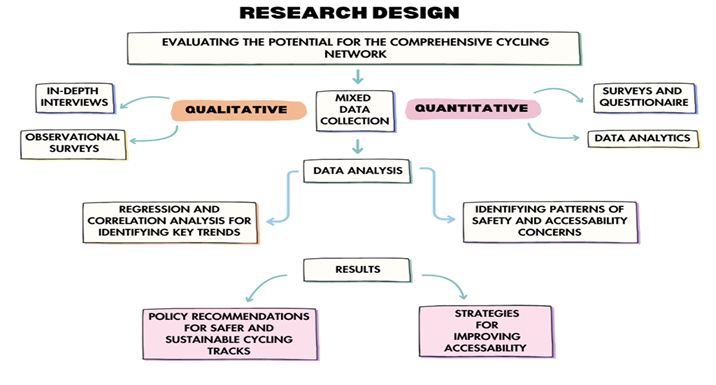
This research focuses on the possibility of a network of linked bicycle lanes that are used to enhance student movement at a private sector university in Lahore. The study also takes into consideration whether this nature of creating special lanes to bicycling could result in a safer, more sustainable and more equitable urban transportation system. At present, the city of Lahore can be described as very reliant on cars and other motorized transport methods. The data required to conduct the research will be acquired among the students of UMT, city planners, and people and workers living or working in the area. Data collection instruments will be interviews, focus groups and on-site observations. The research will elaborate on several problems experienced by its users, the definition of the needs of cyclists, and how the cycling as a means of transport can be enhanced. This paper concludes by giving a suggestion on how to develop continuous and shielded bicycle paths along two major streets; PIA Road, and UMT Road. It is also a demand to build safe and weather-protected bicycle parks in residential and business premises. These parking areas should be well-integrated into the surrounding environment. The results show that students have a strong desire to use cycling if enough infrastructure and safety measures are present. Thus, a well-planned network of cycles is foreseen to bring about better access and congestion, healthier lifestyles, and environmental sustainability. To ensure effectiveness and durability of the proposed cycling network, the study advocated for its phased implementation, ongoing maintenance and policy alignment, and continuous stakeholder engagement.
Downloads
References
Buehler, R., & Dill, J. (2016). Bikeway networks: A review of effects on cycling. Transport Reviews, 36(1), 9–27. https://doi.org/10.1016/j.foar.2012.02.012
Butler, L., Yigitcanlar, T., & Paz, A. (2020). Smart urban mobility innovations: A comprehensive review and evaluation. IEEE Access, 8, 196034–196049. https://doi.org/10.1016/j.foar.2012.02.012
Crow Platform. (2016). Design manual for bicycle traffic.. https://crowplatform.com/product/design-manual-for-bicycle-traffic/
Diao, M., Kong, H., & Zhao, J. (2021). Impacts of transportation network companies on urban mobility. Nature Sustainability, 4(6), 494–500. https://doi.org/10.1016/j.foar.2012.02.012
Federal Highway Administration. (2019). Bikeway selection guide. U.S. Department of Transportation. https://highways.dot.gov/safety/pedestrian-bicyclist/bikeway-selection-guide
Fishman, E. (2016). Bikeshare: A review of recent literature. Transport Reviews, 36(1), 92–113. https://doi.org/10.1016/j.foar.2012.02.012
Forsyth, A., & Krizek, K. J. (2010). Promoting walking and bicycling: Assessing the evidence to assist planners. Built Environment, 36(4), 429–446. https://doi.org/10.1016/j.foar.2012.02.012
Fuller, D., Stanley, K., Huang, Y., et al. (2025). Cycling infrastructure as a determinant of cycling engagement: A longitudinal study in Montréal, Canada. International Journal of Behavioral Nutrition and Physical Activity, 22, Article e71. https://doi.org/10.1186/s12966-025-01767-y
Garrard, J., Rose, G., & Lo, S. K. (2008). Promoting transportation cycling for women: The role of bicycle infrastructure. Preventive Medicine, 46(1), 55–59. https://doi.org/10.1016/j.foar.2012.02.012
Giles-Corti, B., Lowe, M., & Arundel, J. (2022). Creating healthy and sustainable cities: What gets measured, gets done. The Lancet Global Health, 10(6), e782–e785. https://doi.org/10.1016/S2214-109X(22)00070-5
Gitelman, V., Korchatov, A., & Elias, W. (2020). An examination of the safety impacts of bus priority routes in major Israeli cities. Sustainability, 12(20), Article e8617. https://doi.org/10.1016/j.foar.2012.02.012
Gössling, S., Choi, A., Dekker, K., & Metzler, D. (2019). The social cost of automobility, cycling and walking in the European Union. Ecological Economics, 158, 65–74. https://doi.org/10.1016/j.foar.2012.02.012
Guerreiro, T. D. C. M., Providelo, J. K., Pitombo, C. S., Ramos, R. A. R., & da Silva, A. N. R. (2018). Data-mining, GIS and multicriteria analysis in a comprehensive method for bicycle network planning and design. International Journal of Sustainable Transportation, 12(3), 179–191. https://doi.org/10.1016/j.foar.2012.02.012
Handy, S., van Wee, B., & Kroesen, M. (2014). Promoting cycling for transport: Research needs and challenges. Transport Reviews, 34(1), 4–24. https://doi.org/10.1016/j.foar.2012.02.012
Jacobsen, P. L. (2003). Safety in numbers: More walkers and bicyclists, safer walking and bicycling. Injury Prevention, 9(3), 205–209. https://doi.org/10.1016/j.foar.2012.02.012
Liang, X., Teter, J., & Figueroa, M. (2023). A global momentum toward cycling: A review of progress and future prospects. Transport Reviews, 43(5), 875–902. https://doi.org/10.1080/01441647.2023.2189320
Litman, T. (2022). Evaluating active transport benefits and costs. Victoria Transport Policy Institute.
Lucas, K. (2012). Transport and social exclusion: Where are we now? Transport Policy, 20, 105–113. https://doi.org/10.1016/j.foar.2012.02.012
Martens, K. (2007). Promoting bike-and-ride: The Dutch experience. Transportation Research Part A: Policy and Practice, 41(4), 326–338. https://doi.org/10.1016/j.foar.2012.02.012
Miskolczi, M., Földes, D., Munkácsy, A., & Jászberényi, M. (2021). Urban mobility scenarios until the 2030s. Sustainable Cities and Society, 72, Article e103029. https://doi.org/10.1016/j.foar.2012.02.012
Mueller, N., Rojas-Rueda, D., Salmon, M., Martinez, D., Ambros, A., Brand, C., et al. (2018). Health impact assessment of cycling network expansions in European cities. Preventive Medicine, 109, 62–70. https://doi.org/10.1016/j.foar.2012.02.012
National Association of City Transportation Officials. (2022). Global street design guide. Island Press.
Nkurunziza, A., Zuidgeest, M., Brussel, M., & van Maarseveen, M. (2012). Examining the potential for modal change: Motivators and barriers for bicycle commuting in Dar-es-Salaam. Transport Policy, 24, 249–259. https://doi.org/10.1016/j.foar.2012.02.012
Pucher, J., & Buehler, R. (2008). Making cycling irresistible: Lessons from the Netherlands, Denmark and Germany. Transport Reviews, 28(4), 495–528. https://doi.org/10.1016/j.foar.2012.02.012
Qureshi, S., Javed, A., & Aziz, A. (2025). Exploring the 15-minute city concept: Global challenges and opportunities in diverse urban contexts. Urban Science, 9(7), Article e252. https://doi.org/10.3390/urbansci9070252
Sobral, T., Galvão, T., & Borges, J. (2019). Visualization of urban mobility data from intelligent transportation systems. Sensors, 19(2), Article e332. https://doi.org/10.1016/j.foar.2012.02.012
Sorensen, A., Bortolussi, I., Chong, I., Gowie, J., Shankar, N. G., & Vigayan, K. A. (2021). The Scarborough opportunity: A comprehensive walking and cycling network. University of Toronto. https://utoronto.scholaris.ca/items/abf30d4d-cf2b-45e2-bdc5-8e3be4ae1daa
Steinbach, R., Green, J., Datta, J., & Edwards, P. (2011). Cycling and the city: A case study of how gendered, ethnic and class identities can shape healthy transport choices. Social Science & Medicine, 72(7), 1123–1130. https://doi.org/10.1016/j.foar.2012.02.012
Winters, M., Ferster, C., & Laberee, K. (2025). Mapping change in cycling infrastructure across Canada: What, where, and for whom? Canadian Journal of Public Health. Advance online publication. https://doi.org/10.17269/s41997-025-01139-w
Woodcock, J., Edwards, P., Tonne, C., Armstrong, B. G., Ashiru, O., Banister, D., et al. (2009). Public health benefits of strategies to reduce greenhouse-gas emissions: Urban land transport. The Lancet, 374(9705), 1930–1943. https://doi.org/10.1016/j.foar.2012.02.012
World Health Organization. (2024, October 29). Health economic assessment tool (HEAT) for walking and for cycling: Methods and user guide on physical activity, air pollution, road fatalities and carbon impact assessments: 2024 update. https://www.who.int/publications/m/item/health-economic-assessment-tool-(-heat)--for-walking-and-for-cycling.-methods-and-user-guide-on-physical-activity--air-pollution--road-fatalities-and-carbon-impact-assessments--2024-update
Published
How to Cite
Issue
Section
License
Copyright (c) 2025 Rabia Jawad, Muhammad Danial Adil, Ar. Farah Khurram

This work is licensed under a Creative Commons Attribution 4.0 International License.
JAABE follows an open-access publishing policy and full text of all published articles is available free, immediately upon publication of an issue. The journal’s contents are published and distributed under the terms of the Creative Commons Attribution 4.0 International (CC-BY 4.0) license. Thus, the work submitted to the journal implies that it is original, unpublished work of the authors (neither published previously nor accepted/under consideration for publication elsewhere). On acceptance of a manuscript for publication, a corresponding author on the behalf of all co-authors of the manuscript will sign and submit a completed Copyright and Author Consent Form.
Copyright (c) The Authors