
Urban Identity Under Pressure: Placemaking Interventions for Inclusive Development Around Johar Town, Lahore
DOI:
https://doi.org/10.32350/jaabe.82.05Keywords:
placemaking, gentrification, urban Identity, mental mapping, land useAbstract
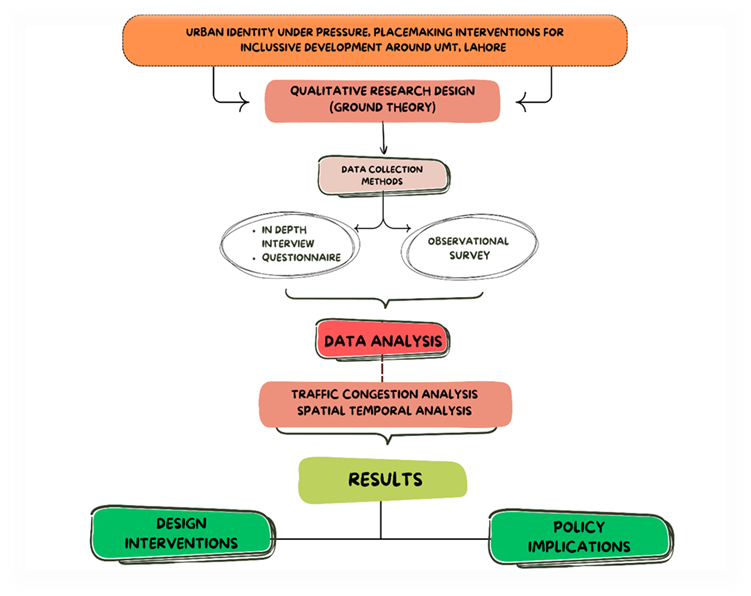
Private educational institutions located within residential neighbourhoods are devices that often lead to urban transformation at a fast pace. Unfortunately, the majority of residents do not control these changes. Expansion around institutions like Minhaj University, University of Management and Technology (UMT) and other in Lahore has changed its land use pattern adversely. The surrounding areas has become congestedd and has started acting as a magnet for informal trade, which is gradually leading to decline in its identity as a residential zone. This research traces the changes and asks the question of how placemaking can be used to recover spatial coherence and inclusivity in the academic district after the gentrification process. The research used satellite imagery (2005, 2025), mental mapping, field observations, and stakeholder interviews to gauge the size of the area covered by the park, which it had increased seven times. Moreover, the research reported a simultaneity of commercial pressures. The research found that there are continuous conflicts between pedestrians and vehicles, while students have insufficient public spaces. Furthermore, vendor activities remain unregulated, and conversation of residential units into hostels has become widespread. The study offers a detailed account of gentrification caused by education in Pakistan and the strategies of design to democratize the redevelopment of similar high, pressure university areas.
Downloads
References
Ali, M., Qureshi, U. A., Mayo, S. M., Islam, H. S., & Ali, W. (2022). Impact assessment of commercialization of main roads in planned housing schemes: A case study of PIA Housing Scheme. International Journal of Innovations in Science and Technology, 4(2), 578–595. https://doi.org/10.33411/IJIST/2022040224
Bond, P. (1999). Basic infrastructure for socio-economic development, environmental protection and geographical desegregation: South Africa’s unmet challenge. Geoforum, 30(1), 43–59. https://doi.org/10.1016/S0016-7185(98)00031-1
Chatterton, P. (2010). The student city: An ongoing story of neoliberalism, gentrification, and commodification. Environment and Planning A, 42(3), 509–514. https://doi.org/10.1068/a42293
Ellery, P. J., Ellery, J., & Borkowsky, M. (2021). Toward a theoretical understanding of placemaking. International Journal of Community Well-Being, 4(1), 55–76. https://doi.org/10.1007/s42413-020-00078-3
Fossey, E., Harvey, C., McDermott, F., & Davidson, L. (2002). Understanding and evaluating qualitative research. Australian and New Zealand Journal of Psychiatry, 36(6), 717–732. https://doi.org/10.1046/j.1440-1614.2002.01100.x
Hackworth, J., & Smith, N. (2001). The changing state of gentrification. Tijdschrift Voor Economische En Sociale Geografie, 92(4), 464–477. https://doi.org/10.1111/1467-9663.00172
Lees, L., Slater, T., & Wyly, E. (2013). Gentrification. Routledge.
Moos, M., Revington, N., Wilkin, T., & Andrey, J. (2019). The knowledge economy city: Gentrification, studentification and youthification, and their connections to universities. Urban Studies, 56(6), 1075–1092. https://doi.org/10.1177/0042098017745235
Moran, R., & Berbary, L. A. (2022). Placemaking as unmaking: Settler colonialism, gentrification, and the myth of “revitalized” urban spaces. In B. Lashua, S. Baker & T. Glover (Eds.), Leisure myths and mythmaking (pp. 106–120). Routledge.
Open Science Framework. (2025, October 2). Social bond theory. https://doi.org/10.17605/osf.io/4afk5
Pathak, V., Jena, B., & Kalra, S. (2013). Qualitative research. Perspectives in Clinical Research, 4(3), 192–195. https://doi.org/10.4103/2229-3485.115389
Pervaiz, S., Tariq, F., Jamil, F., Khilat, F., Tariq, S., & Basheer, M. A. (2025). Placemaking for social cohesion and economic vitality: The role of urban design in transforming local markets in Pakistan. Frontiers of Architectural Research, 14(4), 1035–1047. https://doi.org/10.1016/j.foar.2024.10.009
Rana, I. A., & Bhatti, S. S. (2018). Lahore, Pakistan – Urbanization challenges and opportunities. Cities, 72, 348–355. https://doi.org/10.1016/j.cities.2017.09.014
Revington, N., Zwick, A., Hartt, M., & Schlosser, J. (2023). Universities and urban social structure: Gentrification, studentification, and youthification in five United States legacy cities. Urban Geography, 44(1), 83–104. https://doi.org/10.1080/02723638.2021.1985306
Serreli, S. (2013). City project and public space. Springer.
Strydom, W., Puren, K., & Drewes, E. (2018). Exploring theoretical trends in placemaking: Towards new perspectives in spatial planning. Journal of Place Management and Development, 11(2), 165–180. https://doi.org/10.1080/02723638.2021.1985306
Wyckoff, M. A. (2014). Definition of placemaking: Four different types. Planning & Zoning News, 32(3), 1–4.
Published
How to Cite
Issue
Section
License
Copyright (c) 2025 Muhammad Mudaser Naeem, Shahzaib Mahmood, Shayan Zulfiqar

This work is licensed under a Creative Commons Attribution 4.0 International License.
JAABE follows an open-access publishing policy and full text of all published articles is available free, immediately upon publication of an issue. The journal’s contents are published and distributed under the terms of the Creative Commons Attribution 4.0 International (CC-BY 4.0) license. Thus, the work submitted to the journal implies that it is original, unpublished work of the authors (neither published previously nor accepted/under consideration for publication elsewhere). On acceptance of a manuscript for publication, a corresponding author on the behalf of all co-authors of the manuscript will sign and submit a completed Copyright and Author Consent Form.
Copyright (c) The Authors