
Do numbers speak? Bibliometric Analysis of AI Application and Corporate ESG Performance
DOI:
https://doi.org/10.32350/aar.61.04Keywords:
artificial intelligence, bibliometric analysis, environmental, social, and governance, sustainabilityAbstract
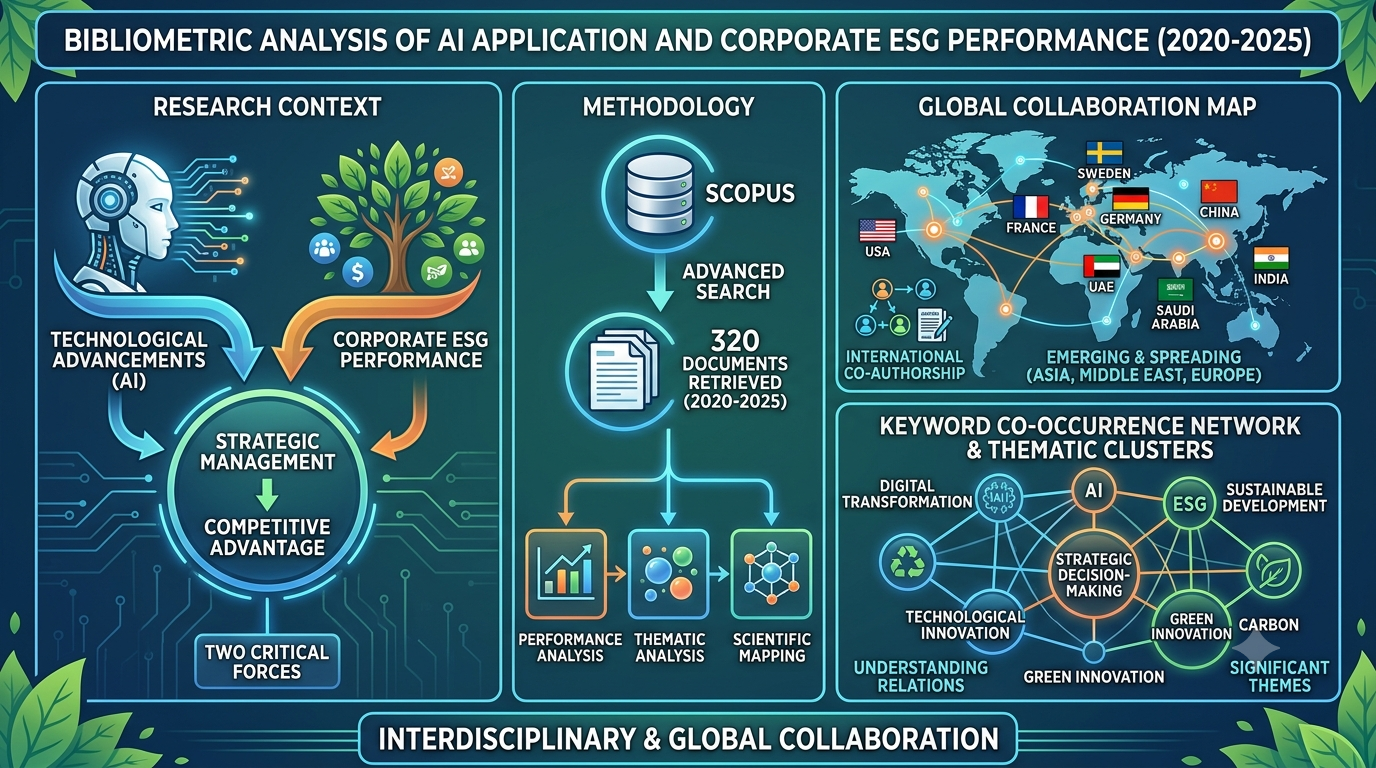
In current business landscape, strategic management confronts two forces, one is technological advancements and other is corporate Environmental, Social, and Governance (ESG) performance for competitive advantage in complex economic system. The current study aimed to observe Artificial Intelligence (AI) application and corporate ESG performance. Bibliometric analysis was performed using Scopus database, and 320 related documents were retrieved through advanced search. The study employed performance analysis, thematic analysis, and scientific mapping technique to achieve the mentioned goals. The results depicted a global collaboration in this field. International collaboration was evidenced from journals and authors’ names with co-authorship among countries, including China, United Arab Emirates (UAE), India, France, Italy, United States of America (USA), Germany, Sweden, and Saudi Arabia. This shows that the topic is emerging and spreading over Asia, Middle East, and Europe. Co-occurrence of keywords helps to understand the relation among digital transformation, AI, sustainable development, ESG, technological innovation, green innovation and carbon in the strategic decision-making process. Moreover, the current study focused to explain AI application and corporate ESG performance between the years 2020 and 2025. Therefore, significant themes explained interdisciplinary and globally collaboration.
Downloads
References
Abdelwahab, S. I., Taha, M. M. E., Moni, S. S., & Alsayegh, A. A. (2023). Bibliometric mapping of solid lipid nanoparticles research (2012–2022) using VOSviewer. Medicine in Novel Technology and Devices, 17, Article e100217. https://doi.org/10.1016/j.medntd.2023.100217
Baas, J., Schotten, M., Plume, A., Côté, G., & Karimi, R. (2020). Scopus as a curated, high-quality bibliometric data source for academic research in quantitative science studies. Quantitative Science Studies, 1(1), 377–386. https://doi.org/10.1162/qss_a_00019
Bansal, P., & Song, H. C. (2017). Similar but not the same: Differentiating corporate sustainability from corporate responsibility. Academy of Management Annals, 11(1), 105–149. https://doi.org/10.5465/annals.2015.0095
Borges, A. F. S., Laurindo, F. J. B., Spínola, M. M., Gonçalves, R. F., & Mattos, C. A. (2021). The strategic use of artificial intelligence in the digital era: Systematic literature review and future research directions. International Journal of Information Management, 57, Article e102225. https://doi.org/10.1016/j.ijinfomgt.2020.102225
Clarkson, M. E. (1995). A stakeholder framework for analyzing and evaluating corporate social performance. Academy of Management Review, 20(1), 92–117. https://www.jstor.org/stable/258888
Cobo, M. J., López-Herrera, A. G., Herrera-Viedma, E., & Herrera, F. (2011). Science mapping software tools: Review, analysis, and cooperative study among tools. Journal of the American Society for Information Science and Technology, 62(7), 1382–1402. https://doi.org/10.1002/asi.21525
Costa, D. F., Carvalho, F. D. M., & Moreira, B. C. D. M. (2019). Behavioral economics and behavioral finance: A bibliometric analysis of the scientific fields. Journal of Economic Surveys, 33(1), 3–24. https://doi.org/10.1111/joes.12262
del Río González, P. (2005). Analysing the factors influencing clean technology adoption: A study of the Spanish pulp and paper industry. Business Strategy and the Environment, 14(1), 20–37. https://doi.org/10.1002/bse.426
Donthu, N., Kumar, S., & Pattnaik, D. (2021). The Journal of Consumer Marketing at age 35: A retrospective overview. Journal of Consumer Marketing, 38(2), 178–190. https://doi.org/10.1108/JCM-06-2020-3876
Dwivedi, Y. K., Hughes, L., Ismagilova, E., Aarts, G., Coombs, C., Crick, T., Williams, M. D. (2021). Artificial intelligence (AI): Multidisciplinary perspectives on emerging challenges, opportunities, and agenda for research, practice and policy. International Journal of Information Management, 57, Article 101994. https://doi.org/10.1016/j.ijinfomgt.2019.08.002
Ekaristi, C. Y. D., Utomo, D. C., & Rohman, A. (2025). Big data and AI in ESG performance measurement: A bibliometric analysis. Edelweiss Applied Science and Technology, 9(5), 2732–2749. https://doi.org/10.55214/25768484.v9i5.7587
Freeman, R. E. (2010). Strategic management: A stakeholder approach. Cambridge University Press.
Freeman, R. E., Harrison, J. S., Wicks, A. C., Parmar, B. L., & De Colle, S. (2010). Stakeholder theory: The state of the art. Cambridge University Press.
Freeman, R. E., Phillips, R., & Sisodia, R. (2020). Tensions in stakeholder theory. Business & Society, 59(2), 213–231. https://doi.org/10.1177/0007650318773750
Gao, Y., Cai, C., Grifoni, A., Müller, T. R., Niessl, J., Olofsson, A., Buggert, M. (2022). Ancestral SARS-CoV-2-specific T cells cross-recognize the Omicron variant. Nature Medicine, 28(3), 472–476. https://doi.org/10.1038/s41591-022-01700-x
George, G., Merrill, R. K., & Schillebeeckx, S. J. (2021). Digital sustainability and entrepreneurship: How digital innovations are helping tackle climate change and sustainable development. Entrepreneurship Theory and Practice, 45(5), 999–1027. https://doi.org/10.1177/1042258719899425
Guleria, D., & Kaur, G. (2021). Bibliometric analysis of ecopreneurship using VOSviewer and RStudio Bibliometrix, 1989–2019. Library Hi Tech, 39(4), 1001–1024. https://doi.org/10.1108/LHT-09-2020-0218
Hart, S. L. (1995). A natural-resource-based view of the firm. Academy of Management Review, 20(4), 986–1014. https://www.jstor.org/stable/258963
Liu, Y., Huang, J., & Wang, H. (2025). Who on earth is using generative AI? Global trends and shifts in 2025. Social Science Research Network. https://doi.org/10.2139/ssrn.5495020
Mikalef, P., & Gupta, M. (2021). Artificial intelligence capability: Conceptualization, measurement calibration, and empirical study on its impact on organizational creativity and firm performance. Information & Management, 58(3), Article 103434. https://doi.org/10.1016/j.im.2021.103434
Moral-Muñoz, J. A., Herrera-Viedma, E., Santisteban-Espejo, A., & Cobo, M. J. (2020). Software tools for conducting bibliometric analysis in science: An up-to-date review. Profesional de la Información, 29(1), Article e290103. https://doi.org/10.3145/epi.2020.ene.03
Nobanee, H., Al Hamadi, F. Y., Abdulaziz, F. A., Abukarsh, L. S., Alqahtani, A. F., AlSubaey, S. K.,Almansoori, H. A. (2021). A bibliometric analysis of sustainability and risk management. Sustainability, 13(6), Article e3277. https://doi.org/10.3390/su13063277
OECD. (2025). OECD corporate governance factbook 2025. OECD Publishing.
Parida, V., Sjödin, D., & Reim, W. (2019). Reviewing literature on digitalization, business model innovation, and sustainable industry: Past achievements and future promises. Sustainability, 11(2), Article e391. https://doi.org/10.3390/su11020391
Shahmoradi, A. R., Ranjbarghanei, M., Javidparvar, A. A., Guo, L., Berdimurodov, E., & Ramezanzadeh, B. (2021). Theoretical and surface/electrochemical investigations of walnut fruit green husk extract as effective inhibitor for mild-steel corrosion in 1M HCl electrolyte. Journal of Molecular Liquids, 338, Article e116550. https://doi.org/10.1016/j.molliq.2021.116550
Stanford Institute for Human-Centered Artificial Intelligence. (2025). AI index report 2025. https://hai.stanford.edu/ai-index/2025-ai-index-report/
Tunger, D., & Eulerich, M. (2018). Bibliometric analysis of corporate governance research in German-speaking countries: applying bibliometrics to business research using a custom-made database. Scientometrics, 117(3), 2041-2059. https://doi.org/10.1007/s11192-018-2919-z
Wernerfelt, B. (1984). A resource-based view of the firm. Strategic Management Journal, 5(2), 171–180. https://doi.org/10.1002/smj.4250050207
Xie, H., Luo, J., & Tan, X. (2025). Artificial intelligence technology application and corporate ESG performance: Evidence from national pilot zones for artificial intelligence innovation and application. Frontiers in Artificial Intelligence, 8, Article e1643684. https://doi.org/10.3389/frai.2025.1643684
Yu, X., Fan, L., & Yu, Y. (2025). Artificial intelligence and corporate ESG performance: A mechanism analysis based on corporate efficiency and external environment. Sustainability, 17(9), Article e3819. https://doi.org/10.3390/su17093819
Zhang, L., Ling, J., & Lin, M. (2022). Artificial intelligence in renewable energy: A comprehensive bibliometric analysis. Energy Reports, 8, 14072–14088. https://doi.org/10.1016/j.egyr.2022.10.347
Downloads
Published
How to Cite
Issue
Section
License
Copyright (c) 2026 Hafiz Khurram Shahzad, Fouzia Hadi Ali, and Sabra Munir

This work is licensed under a Creative Commons Attribution 4.0 International License.
Authors retain copyright and grant the journal right of first publication with the work simultaneously licensed under a Creative Commons Attribution (CC-BY) 4.0 License that allows others to share the work with an acknowledgement of the work’s authorship and initial publication in this journal.