
Impact of Energy Drink Consumption on Sleep Quality of Medical Students
DOI:
https://doi.org/10.32350/ihr.51.02Keywords:
caffeine, energy drinks, insomnia, sleeplessness, sleep quality, young peopleAbstract
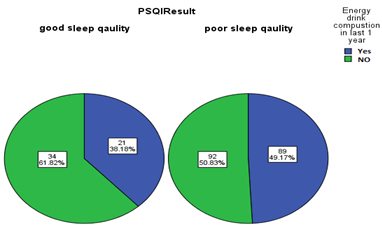
The study aims to evaluate the impact of energy drink consumption on the sleep quality of the medical students of Lahore, Pakistan. A cross-sectional study design was employed and data were collected through convenience sampling. After taking informed consent, 236 MBBS students of both gender within the age range of 18-25 years filled the questionnaire. Quality of sleep was by assessed by using the Pittsburgh Sleep Quality Index. The mean age of students was 22.33 ± 1.47 years, with 94 (39.8%) male and 142 (60.2%) female students. Among these 236 participants, 110 (46.6%) were regular consumers of energy drinks, while 126 (53.4%) had not consumed any energy drink during the last 1 year. Out of 110 students who consumed energy drinks during the last 1 year, 21 (38.16%) reported good quality sleep. Among the 106 students who consumed energy drinks in the last 1 month, only 19 (17.92%) reported good quality sleep. These findings indicate that students who consumed energy drinks continuously in the last month had a higher percentage of poor sleep quality. The study concluded that the majority of students consuming energy drinks had poor sleep quality. This shows an association between energy drink consumption and poor sleep quality among students. The findings suggest that the students who consumed energy drinks in the past month were more likely to have difficulty in their sleep as compared to those who did not.
Downloads
References
Gariépy G, Doré I, Whitehead RD, Elgar FJ. More than just sleeping in: a late timing of sleep is associated with health problems and unhealthy behaviours in adolescents. Sleep Med. 2019;56:66-72. https://doi.org/10.1016/j.sleep.2018.10.029
Dinis J, Bragança M. Quality of sleep and depression in college students: a systematic review. Sleep Sci. 2018;11(4):e290. https://doi.org/10.5935/1984-0063.20180045
Mwape RK, Mulenga D. Consumption of energy drinks and their effects on sleep quality among students at the Copperbelt University School of Medicine in Zambia. Sleep Disord. 2019;2019. https://doi.org/10.1155/2019/3434507
Cojocaru T, Pî GM, Sauciuc DG, et al. The impact of sleep patterns on academic performance and social integration among medical students. J Biosci Med. 2024;12(8):189-98.
Choi J. Motivations influencing caffeine consumption behaviors among college students in Korea: associations with sleep quality. Nutrients. 2020;12(4):e953. https://doi.org/10.3390/nu12040953
Erdmann J, Wiciński M, Wódkiewicz E, et al. Effects of energy drink consumption on physical performance and potential danger of inordinate usage. Nutrients. 2021;13(8):e2506. https://doi.org/10.3390/nu13082506
Hladun O, Papaseit E, Martín S, et al. Interaction of energy drinks with prescription medication and drugs of abuse. Pharmaceutics. 2021;13(10):e1532. https://doi.org/10.3390/pharmaceutics13101532
Erdmann J, Wiciński M, Wódkiewicz E, et al. Effects of energy drink consumption on physical performance and potential danger of inordinate usage. Nutrients. 2021;13(8):e2506. https://doi.org/10.3390/nu13082506
Mahajan R, Singh M, Fahim T, Singh AK. Thumb pain in physiotherapists practicing manual therapy: prevalence and conse fluences. Int J Health Sci Res. 2020;10(6):194-200.
Ghozayel M, Ghaddar A, Farhat G, Nasreddine L, Kara J, Jomaa L. Energy drinks consumption and perceptions among University Students in Beirut, Lebanon: a mixed methods approach. PLoS One. 2020;15(4):e0232199. https://doi.org/10.1371/journal.pone.0232199
Shadzi MR, Rahmanian M, Heydari A, Salehi A. Structural validity of the Pittsburgh Sleep Quality Index among medical students in Iran. Sci Rep. 2024;14(1):e1538. https://doi.org/10.1038/s41598-024-51379-y
Mollayeva T, Thurairajah P, Burton K, Mollayeva S, Shapiro CM, Colantonio A. The Pittsburgh sleep quality index as a screening tool for sleep dysfunction in clinical and non-clinical samples: a systematic review and meta-analysis. Sleep Med Rev. 2016;25:52-73. https://doi.org/10.1016/j.smrv.2015.01.009
Miech RA, Johnston LD, Patrick ME, O'Malley PM, Bachman JG, Schulenberg JE. Monitoring the future national survey results on drug use, 1975-2022: Secondary school students. Institute for Social Research; 2023.
Patrick ME, Veliz P, Linden-Carmichael A, Terry-McElrath YM. Alcohol mixed with energy drink use during young adulthood. Addict Behav. 2018;84:224-230. https://doi.org/10.1016/j.addbeh.2018.03.022
Sánchez-Sánchez E, Trujillo-Garrido N, Díaz-Jimenez J, et al. Attitudes and consumption habits of energy drinks among adolescents and young adults in a Spanish population. AIMS Public Health. 2025;12(1):16-32. https://doi.org/10.3934/publichealth.2025002
Lee KM. The Relationship between Caffeine Consumption, Perceived Stress, Coping Style, and Burnout among Football Bowl Subdivision University Athletic Department Support Staff. Dissertations. Dissertation, Baylor University; 2025.
Faris ME, Al Gharaibeh F, Islam MR, et al. Caffeinated energy drink consumption among Emirati adolescents is associated with a cluster of poor physical and mental health, and unhealthy dietary and lifestyle behaviors: a cross-sectional study. Front Public Health. 2023;11:e1259109. https://doi.org/10.3389/fpubh.2023.1259109
Godos J, Grosso G, Castellano S, Galvano F, Caraci F, Ferri R. Association between diet and sleep quality: a systematic review. Sleep Med Rev. 2021;57:e101430. https://doi.org/10.1016/j.smrv.2021.101430
Published
How to Cite
Issue
Section