
Digital Epidemiology in the Post-pandemic Era: Opportunities and Gaps in Public Health Surveillance
DOI:
https://doi.org/10.32350/ihr.51.03Keywords:
Artificial Intelligence (AI) in Epidemiology, data privacy and ethics in surveillance, digital divide and health equity, digital epidemiology, post-pandemic eraAbstract
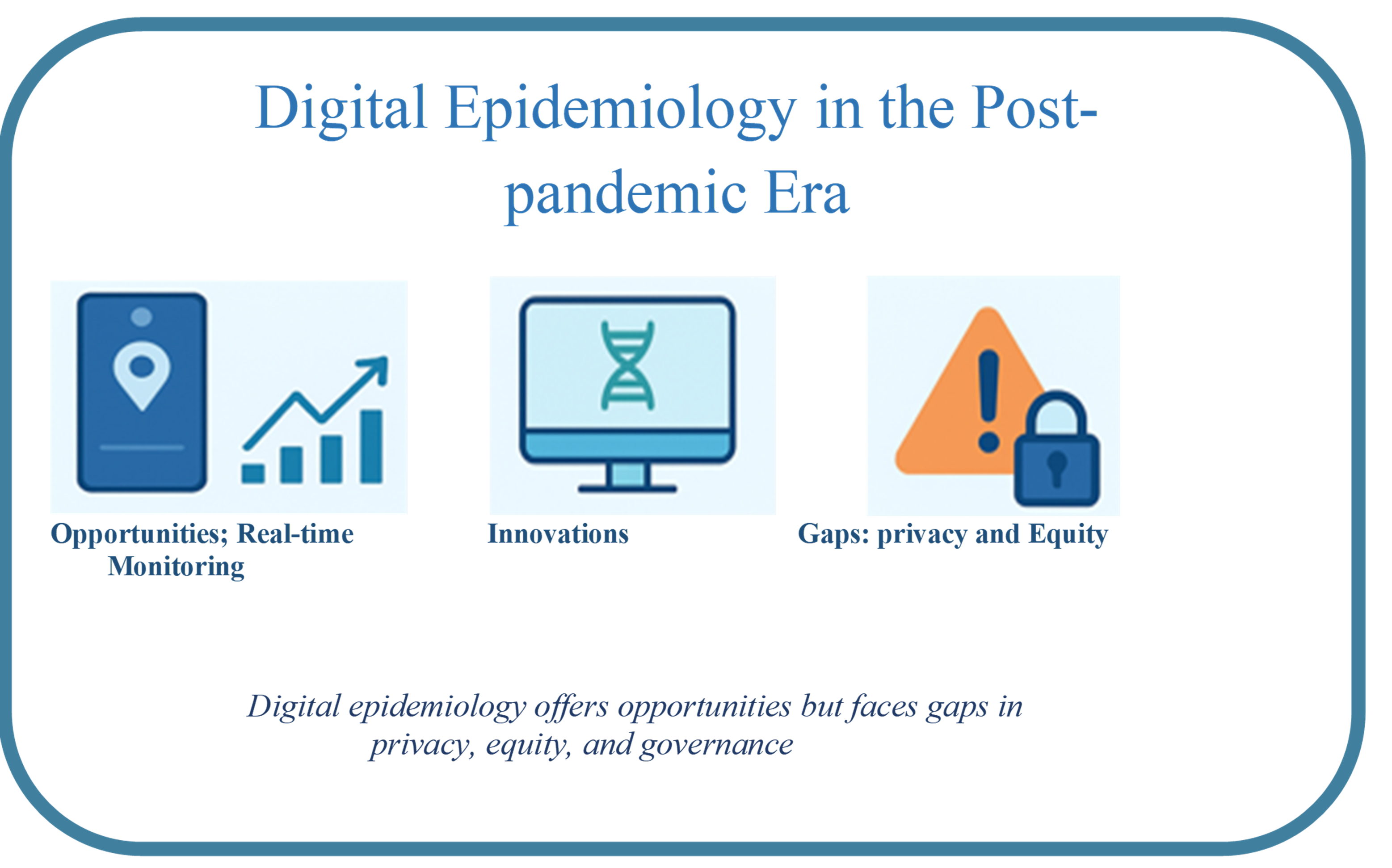
The COVID-19 pandemic has irreversibly changed our approach to public health surveillance, piloting the widespread use of digital epidemiological tools and exposing new possibilities along with ongoing deficits in our surveillance architecture. The current study looked at recent developments in digital epidemiology during the post-pandemic period in terms of evolution, opportunities, and challenges. The study presented important opportunities, such as the ability to provide real-time surveillance, democratized access to epidemiological data, and integrated data sources. Furthermore, it also identified common challenges surrounding data privacy rules, digital divide, technical constraints, and governance systems. It demonstrated that although digital epidemiology holds great promise to improve public health surveillance, to fulfil it, the community must grapple with such key challenges as interoperability, equity, trust, and governance. These findings underscore the need for the post-pandemic period (2020–2025) to be a policy window of opportunities where it would be possible to build strong digital surveillance systems that are sustainable, equitable, and can effectively meet the needs of future public health emergencies whilst protecting individual rights and promoting health equity.
Downloads
References
Wang Q, Su M, Zhang M, Li R. Integrating digital technologies and public health to fight Covid-19 pandemic: key technologies, applications, challenges and outlook of digital healthcare. Int J Environ Res Public Health. 2021;18(11):e6053. https://doi.org/10.3390/ijerph18116053
Sohrabi C, Alsafi Z, O'neill N, Khan M, Kerwan A, Al-Jabir A, et al. World Health Organization declares global emergency: A review of the 2019 novel coronavirus (COVID-19). Int J Surg. 2020;76:71-76. https://doi.org/10.1016/j.ijsu.2020.02.034
Ghanbari B. On forecasting the spread of the COVID-19 in Iran: the second wave. Chao, Soli Fract. 2020;140:e110176. https://doi.org/10.1016/j.chaos.2020.110176
Wang Q, Su M. A preliminary assessment of the impact of COVID-19 on environment – a case study of China. Sci Total Environ. 2020;728:e138915. https://doi.org/10.1016/j.scitotenv.2020.138915
Bayram M, Springer S, Garvey CK, Özdemir V. COVID-19 digital health innovation policy: a portal to alternative futures in the making. OMICS: A J Integ Biol. 2020;24(8):460-469. https://doi.org/10.1089/omi.2020.0089
Daughton C. The international imperative to rapidly and inexpensively monitor community-wide Covid-19 infection status and trends. Sci Total Environ. 2020;726:e138149. https://doi.org/10.1016/j.scitotenv.2020.138149
Braithwaite I, Callender T, Bullock M, Aldridge RW. Automated and partly automated contact tracing: a systematic review to inform the control of COVID-19. Lancet Digit Health. 2020;2(11):e607-e621. https://doi.org/10.1016/S2589-7500(20)30184-9
Abeler J, Bäcker M, Buermeyer U, Zillessen H. COVID-19 contact tracing and data protection can go together. JMIR Mhealth Uhealth. 2020;8(4):e19359. https://doi.org/10.2196/19359
Sun Z, Zhang H, Yang Y, Wan H, Wang Y. Impacts of geographic factors and population density on the COVID-19 spreading under the lockdown policies of China. Sci Total Environ. 2020;746:e141347. https://doi.org/10.1016/j.scitotenv.2020.141347
Bai X, Fang C, Zhou Y, et al. Predicting COVID-19 malignant progression with AI techniques. MedRxiv. 2020;3:e20037325. https://doi.org/10.1101/2020.03.20.20037325
Jia JS, Lu X, Yuan Y, Xu G, Jia J, Christakis NA. Population flow drives spatio-temporal distribution of COVID-19 in China. Nature. 2020;582(7812):389-394. https://doi.org/10.1038/s41586-020-2284-y
Al-Qaness MA, Ewees AA, Fan H, Abd El Aziz M. Optimization method for forecasting confirmed cases of COVID-19 in China. Clinic Med. 2020;9(3):e674. https://doi.org/10.3390/jcm9030674
Tuli S, Tuli S, Tuli R, Gill SS. Predicting the growth and trend of COVID-19 pandemic using machine learning and cloud computing. Int Things. 2020;11:e100222. https://doi.org/10.1016/j.iot.2020.100222
Boban M, Klarić M. Impact of Covid 19 pandemic on digital transformation of public administration in European Union. Paper presented at: 44th International Convention on Information, Communication and Electronic Technology (MIPRO): September 27 – 01 October; 2021. https://doi.org/10.23919/MIPRO52101.2021.9596678
Zhao S, Chen H. Modeling the epidemic dynamics and control of COVID‐19 outbreak in China. Quant Biol. 2020;8(1):11-19. https://doi.org/10.1007/s40484-020-0199-0
Haenlein M, Kaplan A. A brief history of artificial intelligence: on the past, present, and future of artificial intelligence. California Manag Rev. 2019;61(4):5-14. https://doi.org/10.1177/0008125619864925
Nadarzynski T, Miles O, Cowie A, Ridge D. Acceptability of artificial intelligence (AI)-led chatbot services in healthcare: a mixed-methods study. Digital Health. 2019;5:1-12. http://dx.doi.org/10.1177/2055207619871808
Liu R, Rong Y, Peng Z. A review of medical artificial intelligence. Glob Health J. 2020;4(2):42-45.
Yang Y, Zheng X, Liu X, Zhong S, Chang V. Cross-domain dynamic anonymous authenticated group key management with symptom-matching for e-health social system. Future Gener Comput Syst. 2018;84:160-176. https://doi.org/10.1016/j.future.2017.06.025
Zhu R, Niu H, Yin N, Wu T, Zhao Y. Analysis of varicose veins of lower extremities based on vascular endothelial cell inflammation images and multi-scale deep learning. IEEE Access. 2019;7:174345-174358. https://doi.org/10.1109/ACCESS.2019.2954708
Liu Y, Zhang W, Pan S, Li Y, Chen Y. Analyzing the robotic behavior in a smart city with deep enforcement and imitation learning using IoRT. Comput Commun. 2020;150:346-356. https://doi.org/10.1016/j.comcom.2019.11.031
Banta HD. Future health care technology and the hospital. Health Policy. 1990;14(1):61-73. https://doi.org/10.1016/0168-8510(90)90364-J
Catarinucci L, De Donno D, Mainetti L, et al. An IoT-aware architecture for smart healthcare systems. IEEE Int Things J. 2015;2(6):515-526. https://doi.org/10.1109/JIOT.2015.2417684
Branger J, Pang Z. From automated home to sustainable, healthy and manufacturing home: a new story enabled by the Internet-of-Things and Industry 4.0. J Manag Anal. 2015;2(4):314-332. https://doi.org/10.1080/23270012.2015.1115379
Alrobei EK, Alrobaei SM, Yousef FME, Kalfot BMF, Altakroni RB, Alshahrani AN. Wearable sensors for monitoring infection risks among healthcare workers. Biomater Translat. 2024;5(2):212-225.
Leifels M, Rahman OK, Sam I-C, et al. The one health perspective to improve environmental surveillance of zoonotic viruses: lessons from COVID-19 and outlook beyond. ISME Commun. 2022;2(1):e107. https://doi.org/10.1038/s43705-022-00191-8
Akande OA. Integrating blockchain with federated learning for privacy-preserving data analytics across decentralized governmental health information systems. Int J Comput Appl Technol Res. 2022;11(12):622-637. https://doi.org/10.7753/IJCATR1112.1025
Marbouh D, Simsekler MCE, Salah K, Jayaraman R, Ellahham S. Blockchain for patient safety: use cases, opportunities and open challenges. Data. 2022;7(12):e182. https://doi.org/10.3390/data7120182
D'Anza B, Pronovost PJ. Digital health: unlocking value in a post-pandemic world. Popul Health Manag. 2022;25(1):11-22. https://doi.org/10.1089/pop.2021.0031
Mizani MA, Dashtban A, Pasea L, Lai AG, Thygesen J, Tomlinson C. Using national electronic health records for pandemic preparedness: validation of a parsimonious model for predicting excess deaths among those with COVID-19-a data-driven retrospective cohort study. Global Health Action. 2023;116(1):10-20. https://doi.org/10.1177/01410768221131897
Broeder LD, Devilee J, Oers HV, Schuit AJ, Wagemakers A. Citizen science for public health. Health Prom Int. 2018;33(3):505-514. https://doi.org/10.1093/heapro/daw086
Cunha MN, Chuchu T, Maziriri E. Threats, challenges, and opportunities for open universities and massive online open courses in the digital revolution. Int J Emerg Technol Learn. 2020;15(12):191-204.
Li C, Mowery DL, Ma X, et al. Realizing the potential of social determinants data in EHR systems: a scoping review of approaches for screening, linkage, extraction, analysis, and interventions. J Clinic Translat Sci. 2024;8(1):e147. https://doi.org/10.1017/cts.2024.571
Gomes HM, Read J, Bifet A, Barddal JP, Gama J. Machine learning for streaming data: state of the art, challenges, and opportunities. ACM SIGKDD Explor Newsletter. 2019;21(2):6-22. https://doi.org/10.1145/3373464.3373470
Palaniyandi M, Anand P, Maniyosai R. Spatial cognition: a geospatial analysis of vector borne disease transmission and the environment, using remote sensing and GIS. Inform Syst. 2014;1(3):39-54.
Froelicher D, Troncoso-Pastoriza JR, Raisaro JL, et al. Truly privacy-preserving federated analytics for precision medicine with multiparty homomorphic encryption. Nature Commun. 2021;12(1):e5910. https://doi.org/10.1038/s41467-021-25972-y
Mello MM, Wang CJ. Ethics and governance for digital disease surveillance. Science. 2020;368(6494):951-954. https://doi.org/10.1126/science.abb9045
Martin AK, Van Brakel RE, Bernhard DJ. Understanding resistance to digital surveillance: Towards a multi-disciplinary, multi-actor framework. Surveill Soc. 2009;6(3):213-232. https://doi.org/10.24908/ss.v6i3.3282
Noormahomed EV, Reid MJ, Mubuuke AG, et al. Prioritizing post-COVID-19 health research in sub-Saharan Africa: a modified Delphi study for future pandemic. Sci Afr. 2024;23:e02103. https://doi.org/10.1016/j.sciaf.2024.e02103
Saeed SA, Masters RM. Disparities in health care and the digital divide. Curr Psych Rep. 2021;23(9):e61. https://doi.org/10.1007/s11920-021-01274-4
Adedinsewo D, Eberly L, Sokumbi O, Rodriguez JA, Patten CA, Brewer LC. Health Disparities, Clinical Trials, and The Digital Divide. Elsevier; 2023.
Ezenwaji CO, Alum EU, Ugwu OP-C. The role of digital health in pandemic preparedness and response: securing global health? Glob Health Action. 2024;17(1):e2419694. https://doi.org/10.1080/16549716.2024.2419694
Faust O, Salvi M, Barua PD, Chakraborty S, Molinari F, Acharya UR. Issues and Limitations on the road to fair and inclusive AI solutions for biomedical challenges. Sensors. 2025;25(1):e205. https://doi.org/10.3390/s25010205
Ampavathi A, Saradhi VT. Research challenges and future directions towards medical data processing. Comput Meth Biomech Biomed Eng: Imag Visualiz. 2022;10(6):633-652. https://doi.org/10.1080/21681163.2021.2018665
Iroju O, Soriyan A, Gambo I, Olaleke J. Interoperability in healthcare: benefits, challenges and resolutions. Int J Innov Appl Stud. 2013;3(1):262-270.
Okoye SC. Harnessing digital epidemiology and AI surveillance to combat emerging infectious disease outbreaks globally. Int J Adv Res Publ Rev. 2025;2(6):48-72. https://doi.org/10.5281/zenodo.15761153
Savage L, Gaynor M, Adler-Milstein J. Digital health data and information sharing: a new frontier for health care competition. Antitrust LJ. 2018;82:e593.
Adegoke BO, Odugbose T, Adeyemi C. Data analytics for predicting disease outbreaks: a review of models and tools. Int J Life Sci Res Updates. 2024;2(2):1-9.
Groseclose SL, Buckeridge DL. Public health surveillance systems: recent advances in their use and evaluation. Annu Rev Public Health. 2017;38:57-79. https://doi.org/10.1146/annurev-publhealth-031816-044348
Eckmanns T, Füller H, Roberts SL. Digital epidemiology and global health security; an interdisciplinary conversation. Life Sci Soc Pol. 2019;15(1):e2. https://doi.org/10.1186/s40504-019-0091-8
Baker BE. Were Out of What? The Disastrous Consequences of Supply Shortages on First Responders During Public Health Emergencies. Thesis. Naval Postgraduate School; 2023.
Choudhary V, Mehta A, Patel K, Niaz M, Panwala M, Nwagwu U. Integrating data analytics and decision support systems in public health management. South East Euro J Public Health. 2024:158-172.
Perez-Pozuelo I, Spathis D, Gifford-Moore J, Morley J, Cowls J. Digital phenotyping and sensitive health data: implications for data governance. J Amer Med Inform Assoc. 2021;28(9):2002-2008. https://doi.org/10.1093/jamia/ocab012
Khan MNI. Cross-Border data privacy and legal support: a systematic review of international compliance standards and cyber law practices. SSRN. 2025. https://dx.doi.org/10.2139/ssrn.5227777
Salathé M. Digital pharmacovigilance and disease surveillance: combining traditional and big-data systems for better public health. J Infect Dis. 2016;214(suppl_4):S399-S403. https://doi.org/10.1093/infdis/jiw281
Noormahomed EV, Reid MJA, Mubuuke AG, et al. Prioritizing post-COVID-19 health research in sub-Saharan Africa: a modified Delphi study for future pandemic. Sci Afr. 2024;23:e02103. https://doi.org/10.1016/j.sciaf.2024.e02103
Petrou C, Jameel L, Nahabedian N, Kane F. A call for digital inclusion initiatives in mental health services: an integrative review. J Psych Ment Health Nurs. 2023;30(5):911-941. https://doi.org/10.1111/jpm.12931
Gonzalez-Hernandez G, Sarker A, O'Connor K, Savova G. Capturing the patient's perspective: a review of advances in natural language processing of health-related text. Yearbook Med Info. 2017;26(1):214-227. https://doi.org/10.15265/IY-2017-029
Birkhead GS, Klompas M, Shah NR. Uses of electronic health records for public health surveillance to advance public health. Annu Rev Public Health. 2015;36:345-359. https://doi.org/10.1146/annurev-publhealth-031914-122747
Pavia G, Branda F, Ciccozzi A, et al. Integrating digital health solutions with immunization strategies: improving immunization coverage and monitoring in the Post-COVID-19 Era. 2024;12(8):e847. https://doi.org/10.3390/vaccines12080847
Aina YA, Abubakar IR, Almulhim AI, Dano UL, Tilaki MJM, Dawood SR. Digitalization and smartification of urban services to enhance urban resilience in the post-pandemic era: the case of the pilgrimage city of Makkah. Smart Cities. 2023;6(4):1973-1995. https://doi.org/10.3390/smartcities6040092
Published
How to Cite
Issue
Section