
The Golden Circle of Sustainability: Aligning Why, How, and What
DOI:
https://doi.org/10.32350/jarms.62.02Keywords:
conceptual model, Golden Circle framework, sustainability, sustainable development, sustainable performance, why-how-whatAbstract
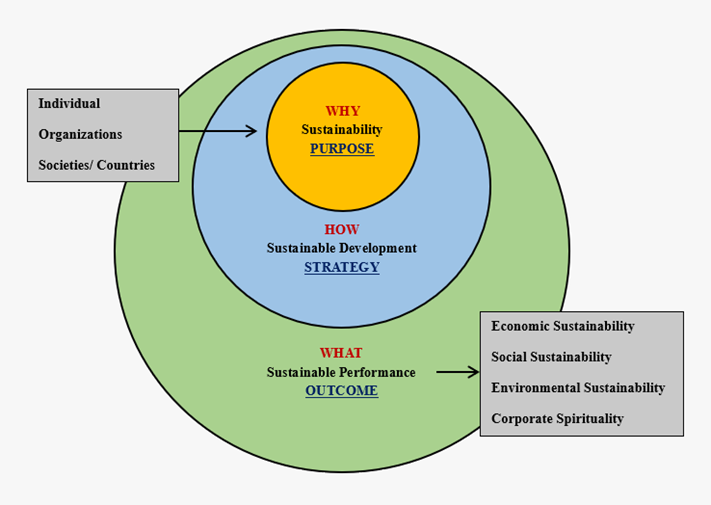
Sustainability has become a buzz word and garners a lot of scholarly attention. To achieve business sustainability, sustainable development and sustainable performance play a vital role. However, frequent use of terms such as sustainability, sustainable development, and sustainable performance interchangeably leads to misunderstanding and lack of conceptual clarity. This conceptual paper provides a framework to conceptually clarify each term by using Simon Sinek’s Golden Circle framework based on why, how, and what. This study offers a framework which connects purpose with action and action with performance, along with the Quadruple Bottom Line (QBL) approach, that is, economic sustainability, social sustainability, environmental sustainability, and corporate spirituality. In addition, it shares the muti-stakeholder perspective which includes multiple players, namely individuals, companies and nations as important contributors. This study was conducted in light of the Golden Circle framework and it highlights sustainability as ‘why’ which comprises purpose, sustainable development as ‘how’ which comprises action, and sustainable performance as ‘what’ which comprises the outcome. This results into a clear concept and understanding of sustainability, sustainable development, and sustainable performance for individuals, companies, and countries, form purpose to action to performance.
Downloads
References
Abbas, G., Yasin, I. M., Wahab, S. A., & Qammar, A. (2025). Innovative safety moderation among workplace environment, workplace health, and employee sustainable performance: A holistic approach for SMEs. Journal of the Knowledge Economy, 16(1), 3108–3139. https://doi.org/10.1007/s13132-024-01923-y
Al Qudah, S. M. A., Bargues, J. L. F., Gisbert, P. F., & Al-Abdallat, H. N. (2025). AI-driven risk management to promote SDGs? An exploratory study in Jordan construction sector. Sustainable Development, 33, 1107–1123. https://doi.org/10.1002/sd.3534
Ali, H., Chen, T., & Hao, Y. (2021). Sustainable manufacturing practices, competitive capabilities, and sustainable performance: Moderating role of environmental regulations. Sustainability, 13(18), Article e10051. https://doi.org/10.3390/su131810051
Alwakid, W. N., & Dahri, N. A. (2025). Harnessing AI capabilities and green entrepreneurial orientation for sustainable SME performance using SEM analysis approach. Technology in Society, 83, Article e103007. https://doi.org/10.1016/j.techsoc.2025.103007
Ashida, A. (2023). The role of higher education in achieving the sustainable development goals. In S. Urata, K. Kuroda, & Y. Tonegawa (Eds.), Sustainable development disciplines for humanity: Breaking down the 5Ps—People, planet, prosperity, peace, and partnerships (pp. 71–84). Springer Nature Singapore. https://doi.org/10.1007/978-981-19-4859-6_5
Bhagavathula, S., Brundiers, K., Stauffacher, M., & Kay, B. (2021). Fostering collaboration in city governments’ sustainability, emergency management and resilience work through competency-based capacity building. International Journal of Disaster Risk Reduction, 63, Article e102408. https://doi.org/10.1016/j.ijdrr.2021.102408
Blokland, P., & Reniers, G. (2021). Achieving organisational alignment, safety and sustainable performance in organisations. Sustainability, 13, Article e10400. https://doi.org/10.3390/su131810400
Brundtland, G., Khalid, M., Agnelli, S., Al-Athel, S., Chidzero, B., Fadika, L., Hauff, V., Lang, I., Shijun, M., & de Botero, M. M. (1987). Our common future. Oxford University Press.
Callaghan, C. W., & Mitchell, A. (2024). Environmental sustainability and management theory development: Post‐paradigm insights from the Anthropocene. European Management Review, 21(3), 520–532. https://doi.org/10.1111/emre.12567
Chaturvedi, D. (2024). The economics of sustainable development: Challenges and solutions. Educational Administration: Theory and Practice, 30, 9061–9067. https://doi.org/10.53555/kuey.v30i5.4497
Chen, P. (2023). Curse or blessing? The relationship between sustainable development plans for resource cities and corporate sustainability—Evidence from China. Journal of Environmental Management, 341, Article e117988. https://doi.org/10.1016/j.jenvman.2023.117988
Corbett, C. J. (2024). OM forum—The operations of well-being: An operational take on happiness, equity, and sustainability. Manufacturing & Service Operations Management, 26(2), 409–430. https://doi.org/10.1287/msom.2022.0521
Correia, M. (2019). Sustainability: An overview of the triple bottom line and sustainability implementation. International Journal of Strategic Engineering, 2, 29–38. https://doi.org/10.4018/IJoSE.2019010103
Cruz, N., de Almeida, F. P., & Herédia-Colaço, V. (2020). Purposedriven business: latest fad or the ultimate sustainable competitive advantage? Nuno Moreira da Cruz’s Lab Report. https://doi.org/10.13140/RG.2.2.27286.98888
Dai, J. (2025). Is policy pilot a viable path to sustainable development? Attention allocation perspective. International Review of Financial Analysis, 98, Article e103923. https://doi.org/10.1016/j.irfa.2025.103923
Damtoft, N. F., van Liempd, D., & Lueg, R. (2025). Sustainability performance measurement: A framework for context-specific applications. Journal of Global Responsibility, 16(1), 162–201. https://doi.org/10.1108/JGR-05-2023-0082
de Souza Barbosa, A., da Silva, M. C. B. C., da Silva, L. B., Morioka, S. N., & de Souza, V. F. (2023). Integration of environmental, social, and governance (ESG) criteria: Their impacts on corporate sustainability performance. Humanities and Social Sciences Communications, 10(1), 1–18.
Emina, K. (2021). Sustainable development and the future generations. Social Sciences, Humanities and Education Journal, 2, Article e57. https://doi.org/10.25273/she.v2i1.8611
Farchi, C., Touzi, B., Farchi, F., & Ahmed, M. (2021). Sustainable performance assessment: A systematic literature review. Journal of Sustainable Development of Transport and Logistics, 6, 124–142. https://doi.org/10.14254/jsdtl.2021.6-2.8
Filho, W. L., Dinis, M. A. P., Sivapalan, S., Begum, H., Ng, T. F., Al-Amin, A. Q., Alam, G. M., Sharifi, A., Salvia, A. L., Kalsoom, Q., Saroar, M., & Neiva, S. (2022). Sustainability practices at higher education institutions in Asia. International Journal of Sustainability in Higher Education, 23(6), 1250–1276. https://doi.org/10.1108/IJSHE-06-2021-0244
Filho, W. L., Trevisan, L. V., Sivapalan, S., Mazhar, M., Kounani, A., Mbah, M. F., Abubakar, I. R., Matandirotya, N. R., Dinis, M. A. P., Borsari, B., & Abzug, R. (2025). Assessing the impacts of sustainability teaching at higher education institutions. Discover Sustainability, 6(1), Article e227. https://doi.org/10.1007/s43621-025-01024-z
Fosu, E., Fosu, F., Akyina, N., & Asiedu, D. (2024). Do environmental CSR practices promote corporate social performance? The mediating role of green innovation and corporate image. Cleaner and Responsible Consumption, 12, Article e100155. https://doi.org/10.1016/j.clrc.2023.100155
García-Sánchez, I. M., Hussain, N., Khan, S. A., & Martínez-Ferrero, J. (2022). Assurance of corporate social responsibility reports: Examining the role of internal and external corporate governance mechanisms. Corporate Social Responsibility and Environmental Management, 29(1), 89–106.
Gebara, C. H., Thammaraksa, C., Hauschild, M., & Laurent, A. (2024). Selecting indicators for measuring progress towards sustainable development goals at the global, national and corporate levels. Sustainable Production and Consumption, 44, 151–165. https://doi.org/10.1016/j.spc.2023.12.004
Hariram, N. P., Mekha, K. B., Suganthan, V., & Sudhakar, K. (2023). Sustainalism: An integrated socio-economic-environmental model to address sustainable development and sustainability. Sustainability, 15(13), Article e10682. https://doi.org/10.3390/su151310682
Hariram, N. P., Mekha, K. B., Suganthan, V., & Sudhakar, K. (2024). Decoding the epics of sustainable world: Sustainalism. Social Sciences & Humanities Open, 10, Article e100958. https://doi.org/10.1016/j.ssaho.2024.100958
Hermundsdottir, F., & Aspelund, A. (2022). Competitive sustainable manufacturing: Sustainability strategies, environmental and social innovations, and their effects on firm performance. Journal of Cleaner Production, 370, Article e133474. https://doi.org/10.1016/j.jclepro.2022.133474
Hofstad, H. (2023). Well understood? A literature study defining and operationalising community social sustainability. Local Environment, 28(9), 1193–1209. https://doi.org/10.1080/13549839.2023.2195620
Huo, C., Safdar, M. A., & Ahmed, M. (2023). Impact of responsible leadership on sustainable performance: A moderated mediation model. Kybernetes, 53(12), 5263–5284. https://doi.org/10.1108/K-03-2023-0342
Işık, C., Ongan, S., & Islam, H. (2025). Global environmental sustainability: The role of economic, social, governance factors, climate policy uncertainty and carbon emissions. Air Quality, Atmosphere & Health, 18(3), 851–866. https://doi.org/10.1007/s11869-024-01675-3
Islam, A., Wahab, S. A., & Tehseen, S. (2024). Rethinking holistic sustainable growth of Malaysian SMEs: A university helix–quadruple bottom line perspective. International Journal of Innovation Science, 17(6), 1443–1486. https://doi.org/10.1108/IJIS-07-2023-0158
Kantabutra, S. (2024). Toward a sustainability performance management framework. Heliyon, 10(13), Article e33729. https://doi.org/10.1016/j.heliyon.2024.e33729
Khan, M., Khan, H., & Ghouri, A. (2022). Corporate social responsibility, sustainability governance and sustainable performance: A preliminary insight. Asian Academy of Management Journal, 27, 1–22. https://doi.org/10.21315/aamj2022.27.1.1
Khan, R. U., Saqib, A., Abbasi, M. A., Mikhaylov, A., & Pinter, G. (2023). Green leadership, environmental knowledge sharing, and sustainable performance in manufacturing industry: Application from upper echelon theory. Sustainable Energy Technologies and Assessments, 60, Article e103540. https://doi.org/10.1016/j.seta.2023.103540
Khan, S. A. R., Umar, M., Asadov, A., Tanveer, M., & Yu, Z. (2022). Technological revolution and circular economy practices: A mechanism of green economy. Sustainability, 14(8), Article e4524. https://doi.org/10.3390/su14084524
Le, T. T., Tran, P. Q., & Dhar, B. K. (2024). Circular economy and social life cycle assessment: The role of corporate renewable energy strategies, environmental justice, and environmental impacts. Journal of Cleaner Production, 485, Article e144387. https://doi.org/10.1016/j.jclepro.2024.144387
Li, H., Kuo, Y. K., Mir, M. M., & Omar, M. (2022). Corporate social responsibility and environmental sustainability: Achieving firms’ sustainable performance supported by plant capability. Economic Research–Ekonomska Istraživanja, 35(1), 4580–4602. https://doi.org/10.1080/1331677X.2021.2015612
Liu, R., Yue, Z., Ijaz, A., Lutfi, A., & Mao, J. (2023). Sustainable business performance: Examining the role of green HRM practices, green innovation and responsible leadership through the lens of pro-environmental behavior. Sustainability, 15(9), Article e7317. https://doi.org/10.3390/su15097317
Lozano, R., Barreiro-Gen, M., & Zafar, A. (2021). Collaboration for organizational sustainability limits to growth: Developing a factors, benefits, and challenges framework. Sustainable Development, 29(4), 728–737. https://doi.org/10.1002/sd.2170
Mastria, S., Vezzil, A., & De Cesarei, A. (2023). Going green: A review on the role of motivation in sustainable behavior. Sustainability, 15(21), Article e15429. https://doi.org/10.3390/su152115429
Mensah, J. (2019). Sustainable development: Meaning, history, principles, pillars, and implications for human action: Literature review. Cogent Social Sciences, 5(1), Article e1653531. https://doi.org/10.1080/23311886.2019.1653531
Moallemi, E. A., Malekpour, S., Hadjikakou, M., Raven, R., Szetey, K., Ningrum, D., Dhiaulhaq, A., & Bryan, B. A. (2020). Achieving the sustainable development goals requires transdisciplinary innovation at the local scale. One Earth, 3(3), 300–313. https://doi.org/10.1016/j.oneear.2020.08.006
Nogueira, E., Gomes, S., & Lopes, J. M. (2023). Triple bottom line, sustainability, and economic development: What binds them together? A bibliometric approach. Sustainability, 15(8), Article e6706. https://doi.org/10.3390/su15086706
Olawumi, T. O., & Chan, D. W. M. (2018). A scientometric review of global research on sustainability and sustainable development. Journal of Cleaner Production, 183, 231–250. https://doi.org/10.1016/j.jclepro.2018.02.162
Oliveira, M. C., & Proença, J. (2025). Sustainable campus operations in higher education institutions: A systematic literature review. Sustainability, 17(2), Article e607. https://doi.org/10.3390/su17020607
Raman, R., Nair, V. K., Shivdas, A., Bhukya, R., Viswanathan, P. K., Subramaniam, N., & Nedungadi, P. (2023). Mapping sustainability reporting research with the UN’s sustainable development goals. Heliyon, 9(8), Article e18510. https://doi.org/10.1016/j.heliyon.2023.e18510
Ranga, M., & Kim, S. Y. (2023). Editorial: Next-generation innovation policies: Promoting systemic socio-economic transformative change. Frontiers in Research Metrics and Analytics, 8, Article e1146039. https://doi.org/10.3389/frma.2023.1146039
Rehman, S. U., Bhatti, A., Kraus, S., & Ferreira, J. J. M. (2021). The role of environmental management control systems for ecological sustainability and sustainable performance. Management Decision, 59(9), 2217–2237. https://doi.org/10.1108/MD-06-2020-0800
Ruggerio, C. A. (2021). Sustainability and sustainable development: A review of principles and definitions. Science of the Total Environment, 786, Article e147481. https://doi.org/10.1016/j.scitotenv.2021.147481
Shayan, N., Mohabbati-Kalejahi, N., Alavi, S., & Zahed, M. A. (2022b). Sustainable development goals (SDGs) as a framework for corporate social responsibility (CSR). Sustainability, 14(3), Article e1222. https://doi.org/10.3390/su14031222
Sheehy, B., & Farneti, F. (2021). Corporate social responsibility, sustainability, sustainable development and corporate sustainability: What is the difference, and does it matter? Sustainability, 13(11), Article e5965. https://doi.org/10.3390/su13115965
Siddiqui, A. A., Nigam, R., & Khalid, M. A. (2024). Environmental ethics and sustainability. In M. A. Khalid, D. S. Malik, R. A. Balikai, B. M. A. Tamimi, K. K. Yadav, & P. R. Yadav (Eds.), Environmental problems, protection and policies (pp. 321–338). M/S Academic Publishers & Distributors.
Sinek, S. (2009). Start with why: How great leaders inspire everyone to take action. Penguin Publishing Group.
Singha, R., & Singha, S. (2024). Positive interventions at work: Enhancing employee well-being and organizational sustainability. In E. Baykal (Ed.), Fostering organizational sustainability with positive psychology (pp. 151–179). https://doi.org/10.4018/979-8-3693-1524-8.ch007
Sun, L., Ong, T. S., Teh, B. H., & Di Vaio, A. (2024). Sustainable performance measurement through digital transformation within the sustainable development framework: The mediating effect of supply chain concentration. Sustainable Development, 32(6), 5895–5912. https://doi.org/10.1002/sd.3007
Tajbakhsh, A., Nematollahi, M., & Shamsi Zamenjani, A. (2024). Migration to the quadruple bottom line framework for achieving sustainable development goals: The 4Ps of sustainability. Annals of Operations Research, 356, 1191–1229. https://doi.org/10.1007/s10479-024-06042-0
Umar, S. B., Ahmad, J., Bukhori, M. A. B. M., Ali, K. A. M., & Hussain, W. M. H. W. (2024). A decade in review: Bibliometric analysis of sustainable performance trends in higher education institutes. Frontiers in Education, 9, Article e1433525. https://doi.org/10.3389/feduc.2024.1433525
United Nations. (2024). Sustainable development report—Rankings. https://unstats.un.org/sdgs/report/2024/The-Sustainable-Development-Goals-Report-2024.pdf
Vale, J., Miranda, R., Azevedo, G., & Tavares, M. C. (2022). The impact of sustainable intellectual capital on sustainable performance: A case study. Sustainability, 14(8), Article e4382. https://doi.org/10.3390/su14084382
Whyte, P., & Lamberton, G. (2020). Conceptualising sustainability using a cognitive mapping method. Sustainability, 12(5), Article e1977. https://doi.org/10.3390/su12051977
Yang, W., Feng, L., Wang, Z., & Fan, X. (2023). Carbon emissions and national sustainable development goals coupling coordination degree study from a global perspective: Characteristics, heterogeneity, and spatial effects. Sustainability, 15(11), Article e9070. https://doi.org/10.3390/su15119070
Yavuz, O., Uner, M. M., Okumus, F., & Karatepe, O. M. (2023). Industry 4.0 technologies, sustainable operations practices and their impacts on sustainable performance. Journal of Cleaner Production, 387, Article e135951. https://doi.org/10.1016/j.jclepro.2023.135951
Zhang, J., Wu, R., & Wang, H. (2025). Environmental governance innovation and corporate sustainable performance in emerging markets: A study of the green technology innovation driving effect of China’s new environmental protection laws. Sustainability, 17(14), Article e6556. https://doi.org/10.3390/su17146556
Ogryzek, M. (2023). The sustainable development paradigm. Geomatics and Environmental Engineering, 17(1), 5–18. https://doi.org/10.7494/geom.2023.17.1.5
Rudolf, M., & Schmidt, M. (2025). Efficiency, sufficiency and consistency in sustainable development: Reassessing strategies for reaching overarching goals. Ecological Economics, 227, Article e108426. https://doi.org/10.1016/j.ecolecon.2024.108426
Published
How to Cite
Issue
Section
License
Copyright (c) 2025 NUMAN ASLAM, Sazali Abdul Wahab, AHMAD SHAHARUDIN ABDUL LATiFF

This work is licensed under a Creative Commons Attribution 4.0 International License.