
Development and Validation of the Scale of Illness Anxiety (SIA)
DOI:
https://doi.org/10.32350/jarms.62.06Keywords:
Illness Anxiety, IAD, Psychological Assessment, Culture, IndigenizationAbstract
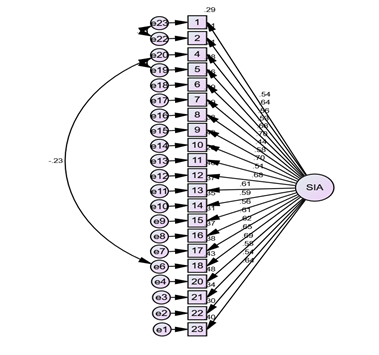
It has been established that the manifestation of psychiatric disorders varies across cultures, which often presents difficulties during the clinical assessment, as indigenous expressions may differ. For this reason, the present study aimed to develop an indigenous measure to support the assessment of illness anxiety disorder (IAD), which entails culture-specific features of illness anxiety. The study consisted of two phases. In the first phase, the researcher developed a pool of items by exploring the existing literature, conducting a focus group discussion with clinical psychologists, interviewing general physicians and psychiatrists, and examining the clinical interview archives of a patient diagnosed with IAD. Following the development of an item pool, the initial version of the scale was obtained after item evaluation by researchers and expert clinicians, establishing content validity. This initial version had 24 items within three factors. The exploratory factor analysis (EFA) was performed on N = 229 university students, through principal component analysis using varimax rotation to examine this initial version, and suggested a single-factor structure with 23 items. This single-factor structure was later confirmed through confirmatory factor analysis (CFA), performed using a sample of N = 240 university students. The final model consisted of 21 items and demonstrated an acceptable fit (CFI = .93; RMSEA = .05). The final scale, Scale of Illness Anxiety (SIA), had an excellent reliability value of α = .92. This version was further used to calculate cut-off and normative scores for a sample of N = 300 university students. This newly developed scale can be used for the assessment of IAD in both clinical and research settings in Pakistan. It was concluded to be a noticeable contribution to the indigenous literature, supporting culturally relevant psychological assessment.
Downloads
References
Alberts, N. M., Hadjistavropoulos, H. D., Sherry, S. B., & Stewart, S. H (2016). Linking illness in parents to health anxiety in offspring: Do beliefs about health play a role? Behavioral and Cognitive Psychotherapy, 44(1), 18–29. https://doi.org/10.1017/s1352465814000319
Almalki, M., Al-Tawayjri, I., Al-Anazi, A., Mahmoud, S., & Al-Mohrej, A. (2016). A recommendation for the management of illness anxiety disorder patients abusing the health care system. Case Report in Psychiatry, Article e6073598. https://doi.org/10.1155/2016/6073598
American Psychiatric Association. (2013). Diagnostic and statistical manual of mental disorders (5th ed.). https://doi.org/10.1176/appi.books.9780890425596
American Psychiatric Association. (2022). Diagnostic and statistical manual of mental disorders (5th ed., text rev.). https://doi.org/10.1176/appi.books.9780890425787opens in new window
Bhugra, D., Watson, C., & Wijesuriya, R. (2021). Culture and mental illnesses. International Review of Psychiatry, 33(1–2), 1–2. https://doi.org/10.1080/09540261.2020.1777748
Blackburn, J., Fischerauer, S. F., Talaei-Khoei, M., Chen, N. C., Oh, L. S., & Vranceanu, A. M. (2019). What are the implications of excessive internet searches for medical information by orthopaedic patients? Clinical Orthopaedics and Related Research, 477(12), 2665–2673. https://doi.org/10.1097/CORR.0000000000000888
Braun, V. and Clarke, V. (2006) Using thematic analysis in Psychology. Qualitative Research in Psychology, 3, 77–101.
Briggs, S. R., & Cheek, J. M. (1986). The role of factor analysis in the development and evaluation of personality scales. Journal of Personality, 54(1), 106–148. https://doi.org/10.1111/j.1467-6494.1986.tb00391.x
Chappell, A. S. (2018). Toward a lifestyle medicine approach to illness anxiety disorder (formerly hypochondriasis). American Journal of Lifestyle Medicine, 12(5), 365–369. https://doi.org/10.1177/1559827618764649
Din, U. M., Mashhadi, S. F., Khan, S., Safdar, T., Ashraf, B., & Awan, Z. K. (2022). Anxiety experienced by people searching internet for medical information. Journal of Islamabad Medical & Dental College, 11(1), 25–29. https://doi.org/10.35787/jimdc.v11i1.711
Doherty-Torstrick, E. R., Walton, K. E., & Fallon, B. A. (2016). Cyberchondria: Parsing health anxiety from online behavior. Psychosomatics, 57(4), 390–400. https://doi.org/10.1016/j.psym.2016.02.002
Fergus, T. A., Griggs, J. O., Cunningham, S. C., & Kelley, L. P. (2017). Health anxiety and medical utilization: The moderating effect of age among patients in primary care. Journal of Anxiety Disorders, 51, 79–85. https://doi.org/10.1016/j.janxdis.2017.06.002
French, J. H. & Hameed, S. (2023, July 16). Illness anxiety disorder. StatPearls Publishing.
Goretzko, D., Siemund, K., & Sterner, P. (2024). Evaluating model fit of measurement models in confirmatory factor analysis. Educational and Psychological Measurement, 84(1), 123–144. https://doi.org/10.1177/00131644231163813
Hair, J. F., Black, W. C., Babin, B. J., & Anderson, R. E. (2019). Multivariate data analysis (8th ed.). Cengage.
Higgins-Chen, A. T., Abdallah, S. B., Dwyer, J. B., Kaye, A. P., Angarita, G. A., & Bloch, M. H. (2019). Severe illness anxiety treated by integrating inpatient psychotherapy with medical care and minimizing reassurance. Frontiers in Psychiatry, 10, Article e150. https://doi.org/10.3389/fpsyt.2019.00150
Ilyas, U., Aslam, F., Fatima, M., Tariq, Z., & Hotiana, U. (2024). Health anxiety, fear of COVID-19, nosophobia, and health-protective behaviors among healthcare professionals. Innovations in Clinical Neuroscience, 21(1-3), 31–35.
Jain, S., & Bargayary, H. (2025). Internet, hypochondriasis and doctor shopping: A triad of modern healthcare challenge. Open Access Journal of Behavioural Science & Psychology, 8(1), Article e180166.
Kaiser, H. F. (1960). The application of electronic computers to factor analysis. Educational and Psychological Measurement, 20, 141–151. https://doi.org/10.1177/001316446002000116
Kellner, R. (1986). Somatization and hypochondriasis. Praeger Publishers.
Kikas, K., Werner-Seidler, A., Corkish, B., Upton, E., Holden, M., & Newby, J. M. (2025). Illness anxiety disorder: A qualitative study of people with health anxiety and their experiences seeking and avoiding medical care. The British Journal of Clinical Psychology, 65(1), 68–85. https://doi.org/10.1111/bjc.70005
Kikas, K., Werner-Seidler, A., Upton, E., & Newby, J. (2024). Illness anxiety disorder: A review of the current research and future directions. Current Psychiatry Reports, 26(7), 331–339. https://doi.org/10.1007/s11920-024-01507-2
Lawshe, C. H. (1975). A quantitative approach to content validity. Personnel Psychology, 28, 563–575.
Lucock, M. P. and Morley, S. (1996), The Health Anxiety Questionnaire. British Journal of Health Psychology, 1(2), 137–150. https://doi.org/10.1111/j.2044-8287.1996.tb00498.x
Mahdavifar, N., Mohammadian, M., Kalan Farmanfarma, K., Khosrorad, R., Dizavandi, A. R., Sani, F. V., & Salehiniya, H. (2022). Evaluation of the prevalence of illness anxiety disorder following the COVID-19 pandemic in Iran and its related factors: A cross-sectional study. Health Science Reports, 6(1), e943. https://doi.org/10.1002/hsr2.943
Mawar, L., Rahmadi, M. A., Siagian, L. A., Siregar, S. M., Pratiwi, A., Nasution, H., Sihombing, N., & Tarigan, A. A. B. (2025). Development of a culturally grounded trauma assessment protocol in the Middle Eastern context. Jurnal Riset Ilmu Kesehatan Umum dan Farmasi, 3(4), 146–163. https://doi.org/10.57213/jrikuf.v3i4.885
Newby, J. M., Hobbs, M. J., Mahoney, A. E. J., Wong, S. K., & Andrews, G. (2017). DSM-5 illness anxiety disorder and somatic symptom disorder: Comorbidity, correlates, and overlap with DSM-IV hypochondriasis. Journal of Psychosomatic Research, 101, 31–37. https://doi.org/10.1016/j.jpsychores.2017.07.010
Newby, J. M., O'Moore, K., Tang, S., Christensen, H., & Faasse, K. (2020). Acute mental health responses during the COVID-19 pandemic in Australia. PloS One, 15(7), Article e0236562. https://doi.org/10.1371/journal.pone.0236562
Pandey, S., Parikh, M. N., Brahmbhatt, M. J., & Vankar, G. K. (2017). Clinical study of illness anxiety disorder in medical outpatients. Archives of Psychiatry and Psychotherapy, 19(4), 32–41. https://doi.org/10.12740/APP/76932
Pilowsky I. (1967). Dimensions of hypochondriasis. The British Journal of Psychiatry, 113(494), 89–93. https://doi.org/10.1192/bjp.113.494.89
Ree, M. J., Carretta, T. R., & Teachout, M. S. (2015). Pervasiveness of dominant general factors in organizational measurement. Industrial and Organizational Psychology, 8(3),409–427. https://doi.org/10.1017/iop.2015.16
Salkovskis, P. M., & Clark, D. M. (1993). Panic disorder and hypochondriasis. Advances in Behaviour Research and Therapy, 15(1), 23–48. https://doi.org/10.1016/0146-6402(93)90002-J
Salkovskis, P. M., & Rimes, K. A. (1997). Predictive genetic testing: Psychological factors. Journal of Psychosomatic Research, 43(5), 477–487. https://doi.org/10.1016/s0022-3999(97)00170-0
Salkovkis, P., Rimes, K. A., Warwick, H. M. C., & Clark, D. (2002). The Health Anxiety Inventory: Development and validation of scales for the measurement of health anxiety and hypochondriasis. Psychological Medicine, 32(5), 843–853. https://doi.org/10.1017/s0033291702005822
Salkovskis, P. M., & Warwick, H. M. (1986). Morbid preoccupations, health anxiety and reassurance: A cognitive-behavioural approach to hypochondriasis. Behaviour Research and Therapy, 24(5), 597–602. https://doi.org/10.1016/0005-7967(86)90041-0
Salkovskis, P. M., Warwick, H. M. C., & Deale, A. C. (2003). Cognitive-behavioral treatment for severe and persistent health anxiety (hypochondriasis). Brief Treatment and Crisis Intervention, 3(3), 353–367. https://doi.org/10.1093/brief-treatment/mhg026
Sansakorn, P., Mushtaque, I., Awais-E-Yazdan, M., & Dost, M. K. B. (2024). The relationship between cyberchondria and health anxiety and the moderating role of health literacy among the Pakistani public. International Journal of Environmental Research and Public Health, 21(9), Article e1168. https://doi.org/10.3390/ijerph21091168
Scarella, T. M., Boland, R. J., & Barsky, A. J. (2019). Illness anxiety disorder: Psychopathology, epidemiology, clinical characteristics, and treatment. Psychosomatic Medicine, 81(5), 398–407. https://doi.org/10.1097/PSY.0000000000000691
Starcevic, V. (2023). Keeping Dr. Google under control: How to prevent and manage cyberchondria. World Psychiatry, 22(2), 233–234. https://doi.org/10.1002/wps.21076
Thorgaard, M. V., Frostholm, L., & Rask, C. U. (2018). Childhood and family factors in the development of health anxiety: A systematic review. Children's Health Care, 47(2), 198–238. https://doi.org/10.1080/02739615.2017.1318390
Tavakoli, N., Kaviani, S., & Amini, Z. (2022). Illness anxiety disorder and its relationship with social health in the elderly, Isfahan, Iran. Advanced Biomedical Research, 11, 42. https://doi.org/10.4103/abr.abr_185_21
Tyrer, P., Cooper, S., Tyrer, H., Wang, D., & Bassett, P. (2019). Increase in the prevalence of health anxiety in medical clinics: Possible cyberchondria. The International Journal of Social Psychiatry, 65(7–8), 566–569. https://doi.org/10.1177/0020764019866231
Wang, K., Xu, Y., Wang, C., Tan, M., & Chen, P. (2019). A corrected goodness-of-fit index (CGFI) for model evaluation in structural equation modeling. Structural Equation Modeling, 27(5), 735–749. https://doi.org/10.1080/10705511.2019.1695213
Warwick, H. M., & Salkovskis, P. M. (1990). Hypochondriasis. Behaviour Research and Therapy, 28(2), 105–117. https://doi.org/10.1016/0005-7967(90)90023-C
Yong, G. A., & Pearce, S. (2013). A beginner’s guide to factor analysis: Focusing on exploratory factor analysis. Tutorials in Quantitative Methods for Psychology, 9(2), 79–94.
Downloads
Published
How to Cite
Issue
Section
License
Copyright (c) 2025 Zarmin Tariq, Saima Dawood

This work is licensed under a Creative Commons Attribution 4.0 International License.