
Evaluation of Drought-Tolerant Epiphytic Bacteria for Plant Growth Promotion
DOI:
https://doi.org/10.32350/bsr.83.01Keywords:
Drought Tolerance, Epiphytic Bacteria, Growth Promotion, Sustainable Agriculture, Zea maysAbstract
Background
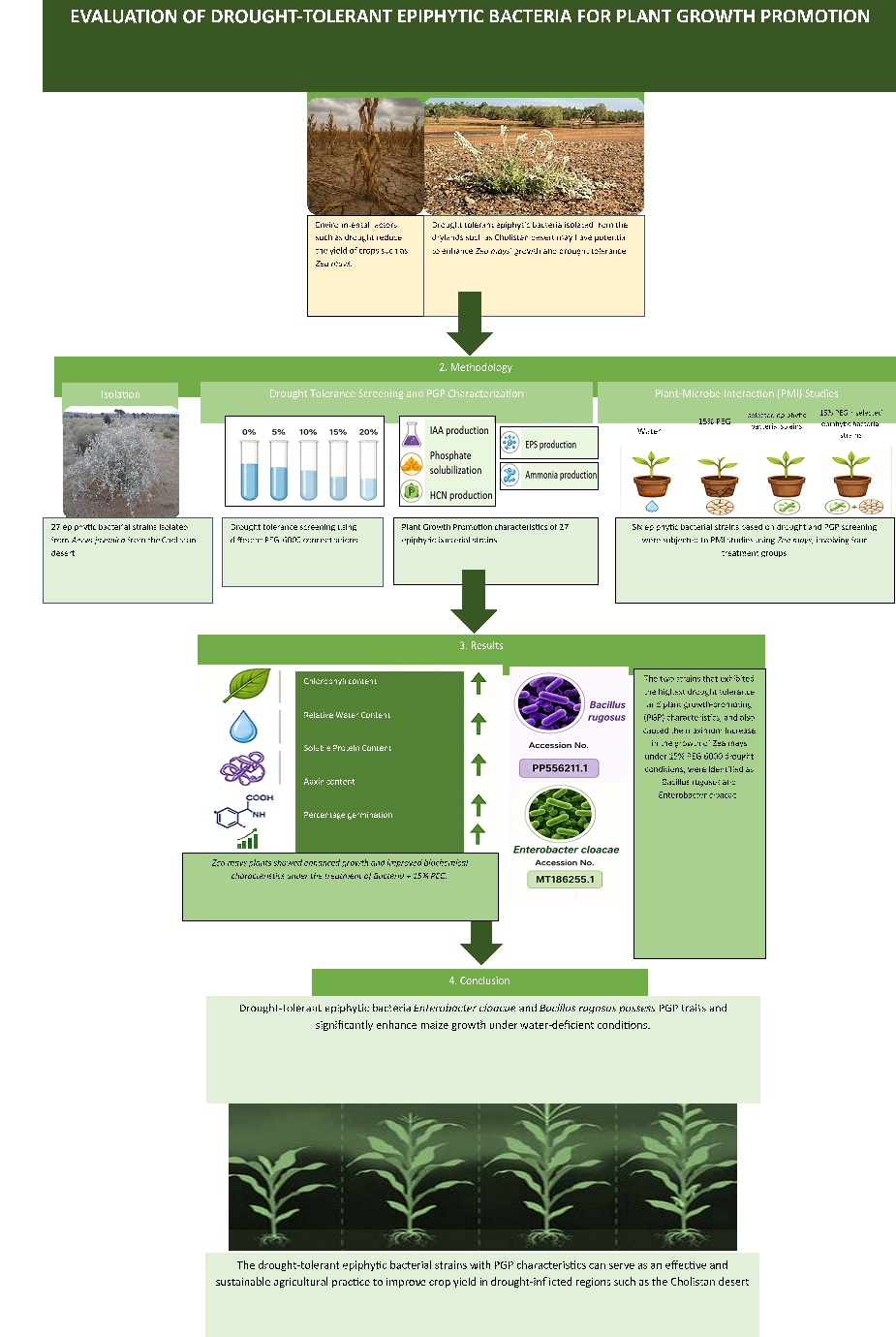
Drought is the leading environmental factor affecting the yield of crops such as Zea mays. This study explores the potential of epiphytic bacteria isolated from the Cholistan desert to enhance Zea mays' growth and drought tolerance.
Methods
For this, 27 epiphytic bacterial strains were isolated from Aerva javanica; screened for drought tolerance potential using different concentrations of PEG-6000; and tested for PGP characteristics. Based on the screening, six best epiphytic bacterial strains were selected and a Plant-Microbe-Interaction study was conducted in four treatment groups. Zea mays seeds were treated with Water, PEG, selected bacterial strains and a combination of selected bacterial strains along with 15% PEG. After 30 days of germination, the biochemical characteristics (chlorophyll content, relative water content, soluble protein content, and auxin content) were checked for each group.
Results
The results showed an increase in chlorophyll content, Relative Water Content, soluble proteins, and auxin content in plants treated with drought-tolerant epiphytic bacterial strains in combination with 15% PEG. Among the tested strains, the 2 most efficient bacterial strains were identified as Bacillus rugosus under the accession number PP556211.1 and Enterobacter cloacae under the accession number MT186255.1. It was observed that under PEG-6000, Enterobacter cloacae produced the highest amount of Exopolysaccharides, followed by Bacillus rugosus.
Conclusion
Therefore, these epiphytic strains, identified as Enterobacter cloacae and Bacillus rugosus with drought tolerance potential and plant growth promotion characteristics, can be used as an effective, sustainable agricultural approach to enhance crop resilience and productivity in water-deficient conditions.
Highlights
- Epiphytic bacteria isolated from drought-inflicted regions, such as the Cholistan Desert, have drought-tolerance potential.
- Drought-tolerant epiphytic bacteria with plant growth-promoting characteristics can increase plant yield in drought conditions.
- Bacillus rugosus and Enterobacter cloacae increased maize production in water-deficient conditions.
Downloads
References
1. Hagenlocher M, Meza I, Anderson CC, et al. Drought vulnerability and risk assessments: State of the art, persistent gaps, and research agenda. Environ Res Lett. 2019;14(8):e083002. https://doi.org/10.1088/17489326/ab225d
2. Huang J, Yu H, Guan X, Wang G, Guo R. Accelerated dryland expansion under climate change. Nat Clim Chang. 2016;6(2):166–171. https://doi.org/10.1038/nclimate2837
3. Aslam M, Maqbool MA, Cengiz R. Drought Stress in Maize (Zea mays L.): Effects, Resistance Mechanisms, Global Achievements and Biological Strategies for Improvement. Springer; 2015. https://doi.org/10.1007/978-3-319-25442-5
4. Hubert B, Rosegrant M, van Boekel MAJS, Ortiz R. The future of food: Scenarios for 2050. Crop Sci. 2010;50(2):S33–S50. https://doi.org/10.2135/cropsci2009.09.0530
5. Mir MSA, Bhat HA. Adaptations of desert plants to extreme environments. Medalion J Med Res Nurs Health Midwife Particip. 2023;4(4):185–190. https://doi.org/10.59733/medalion.v4i4.121
6. Alsharif W, Saad MM, Hirt H. Desert microbes for boosting sustainable agriculture in extreme environments. Front Microbiol. 2020;11:e1666. https://doi.org/10.3389/fmicb.2020.01666
This review focuses on the contribution of desert microorganisms to plant growth and to plant tolerance to a harsh environment. It gives a good theoretical support for screening drought-tolerant bacteria from the Cholistan Desert for Agricultural uses.
7. Nwogwu NA, Ajibade FO, Ajibade TF, et al. Adapting to the changing environment: Microbial way of life. In: Kumar A, ed. Microbial Biocontrol: Food Security and Post Harvest Management. Springer; 2022:311–334. https://doi.org/10.1007/978-3-030-87289-2_14
8. Altaf M. The major deserts of Pakistan—a review. J Wildl Ecol. 2022;6(2):88–102.
https://jwepak.com/wpcontent/uploads/2023/02/JWE-624-Deserts-of-Pakistan.pdf
9. Malik SM, Ali A. Sustainability of subsistence livelihoods of agro-pastoralists in changing socioeconomic environment of Cholistan Desert-Pakistan. Pak J Commer Soc Sci. 2017;11(3):1100–1133. https://hdl.handle.net/10419/188331
10. Khan A, Chaudhry MS, Aziz S. Natural resource diversity in Cholistan Desert (Pakistan) and possible conservational measures. J Pure Appl Sci. 2004;23(1):25–47.
11. Amin A, Ahmed I, Khalid N, et al. Insights on comparative bacterial diversity between different arid zones of Cholistan Desert, Pakistan. 3 Biotech. 2020;10(5):e224. https://doi.org/10.1007/s13205-020-02204-6
12. Khan A, Khan K, Chudary M. Ecosystem services and human wellbeing in Cholistan Desert, Pakistan. Pak J Geogr. 2010;20:51–74.
13. Zoppellari F, Malusà E, Chitarra W, Lovisolo C, Spanna F, Bardi L. Improvement of drought tolerance in maize (Zea mays L.) by selected rhizospheric microorganisms. Ital J Agrometeorol. 2014;18(1):5–18.
According to his study, beneficial microorganisms can enhance drought tolerance and growth of maize. It aligns with the objective to determine the effect of bacterial inoculation on Zea mays under drought stress.
14. Aslam MM, Idris AL, Karanja JK, Yuan W. Rhizosphere microbiomes can regulate plant drought tolerance. Pedosphere. 2022;32(1):61–74. https://doi.org/10.1016/S1002-0160(21)60061-9
15. Mazinani Z, Zamani M, Sardari S. Isolation and identification of phyllospheric bacteria possessing antimicrobial activity from Astragalus obtusifolius, Prosopis juliflora, Xanthium strumarium, and Hippocrepis unisiliqousa. Avicenna J Med Biotechnol. 2017;9(1):31–37.
16. Eida AA, Ziegler M, Lafi FF, et al. Desert plant bacteria reveal host influence and beneficial plant growth properties. PLoS One. 2018;13(12):e0208223. https://doi.org/10.1371/journal.pone.0208223
In this study, bacteria from desert plants showed several plant growth-promoting properties and improved the adaptation of plants to harsh desert environments. It provides the rationale for the assessment of epiphytic bacteria isolated from desert ecosystems for plant growth promotion.
17. Cappuccino JG, Sherman N. Microbiology: A Laboratory Manual. Pearson; 2014.
18. Jain P, Bansal D, Bhasin P. Antibacterial activity of aqueous plant extracts against Escherichia coli and Bacillus subtilis. Drug Invent Today.2010;2(4):e220.
19. Mehta S, Nautiyal CS. An efficient method for qualitative screening of phosphate-solubilizing bacteria. Curr Microbiol. 2001;43(1):51–56. https://doi.org/10.1007/s002840010259
20. Lotfi N, Soleimani A, Çakmakçı R, Vahdati K, Mohammadi P. Characterization of plant growth-promoting rhizobacteria (PGPR) in Persian walnut associated with drought stress tolerance. Sci Rep. 2022;12(1):e12725. https://doi.org/10.1038/s41598-022-16852-6
21. Kifle MH, Laing MD. Isolation and screening of bacteria for their diazotrophic potential and their influence on growth promotion of maize seedlings in greenhouses. Front Plant Sci. 2016;6:e1225. https://doi.org/10.3389/fpls.2015.01225
22. Lebrazi S, Niehaus K, Bednarz H, Fadil M, Chraibi M, Fikri-Benbrahim K. Screening and optimization of indole-3-acetic acid production and phosphate solubilization by rhizobacterial strains isolated from Acacia cyanophylla root nodules and their effects on its plant growth. J Genet Eng Biotechnol. 2020;18(1):e71. https://doi.org/10.1186/s43141020-00090-2
23. Sharma A, Dev K, Sourirajan A, Choudhary M. Isolation and characterization of salt-tolerant bacteria with plant growth-promoting activities from saline agricultural fields of Haryana, India. J Genet Eng Biotechnol. 2021;19(1):e99. https://doi.org/10.1186/s43141-021-00186-3
24. Yadav VK, Bhagat N, Sharma SK. Modulation in plant growth and drought tolerance of wheat crop upon inoculation of drought-tolerant Bacillus species isolated from hot arid soil of India. J Pure Appl Microbiol. 2022;16(1):246–263. https://doi.org/10.22207/JPAM.16.1.14
25. Heydari A, Kim ND, Horswell J, et al. Co-selection of heavy metal and antibiotic resistance in soil bacteria from agricultural soils in New Zealand. Sustainability (Basel). 2022;14(3):e1790. https://doi.org/10.3390/su14031790
26. Jurášková D, Ribeiro SC, Silva CC. Exopolysaccharides produced by lactic acid bacteria: From biosynthesis to health-promoting properties. Foods. 2022;11(2):e156. https://doi.org/10.3390/foods11020156
27. Agogbua JU, Okoli BE, Osuji J. Procedure for in vitro seed sterilization, germination and aseptic seedling establishment of Zehneria capillacea (Schumach) C. Jeffrey. GSC Biol Pharm Sci. 2022;19(1):143–148. https://doi.org/10.30574/gscbps.2022.19.1.0135
28. Chen YE, Su YQ, Zhang CM, et al. Comparison of photosynthetic characteristics and antioxidant systems in different wheat strains. J Plant Growth Regul. 2018;37(2):347–359. https://doi.org/10.1007/s00344-017-9731-5
29. Mullan D, Pietragalla J. Leaf relative water content. In: Pask, A ed. Physiological Breeding II: A Field Guide to Wheat Phenotyping. CIMMYT; 2012:25–35.
30. Novák P, Havlíček V. Protein extraction and precipitation. In: Ciborowski, P & Silberring, J ed. Proteomic Profiling and Analytical Chemistry. Elsevier; 2016:51–62.
31. Manna M, Rengasamy B, Sinha AK. A rapid and robust colorimetric method for measuring relative abundance of auxins in plant tissues. Phytochem Anal. 2024;35(5):1052–1062. https://doi.org/10.1002/pca.3340
32. Anandan M, Dinesh S, Krishnakumar N, Balamurugan K. Improved photocatalytic properties and anti-bacterial activity of size reduced ZnO nanoparticles via PEG-assisted precipitation route. J Mater Sci Mater Electron. 2016;27(12):12517–12526. https://doi.org/10.1007/s10854-016-5764-y
33. Schlechter RO, Miebach M, Remus-Emsermann MNP. Driving factors of epiphytic bacterial communities: A review. J Adv Res. 2019;19:57–65. https://doi.org/10.1016/j.jare.2019.03.003
34. Harris LK, Theriot JA. Surface area to volume ratio: A natural variable for bacterial morphogenesis. Trends Microbiol. 2018;26(10):815–832. https://doi.org/10.1016/j.tim.2018.04.008
35. Laue M, Han HM, Dittmann C, Setlow P. Intracellular membranes of bacterial endospores are reservoirs for spore core membrane expansion during spore germination. Sci Rep. 2018;8(1):e11388.
https://doi.org/10.1038/s41598-01829879-5
36. Yuan F, Yin S, Xu Y, et al. The richness and diversity of catalases in bacteria. Front Microbiol. 2021;12:e645477. https://doi.org/10.3389/fmicb.2021.645477
37. Borisov VB, Siletsky SA, Nastasi MR, Forte E. ROS defense systems and terminal oxidases in bacteria. Antioxidants (Basel). 2021;10(6):e839. https://doi.org/10. 3390/antiox10060839
38. Bertoldo C, Antranikian G. Starch-hydrolyzing enzymes from thermophilic archaea and bacteria. Curr Opin Chem Biol. 2002;6(2):151–160. https://doi.org/10.1016/S1367-5931(02)00311-3
39. Tahjib-Ul-Arif M, Zahan MI, Karim MM, et al. Citric acid-mediated abiotic stress tolerance in plants. Int J Mol Sci. 2021;22(13):e7235. https://doi.org/10.3390/ijms22137235
40. El-Deeb B, Fayez K, Gherbawy Y. Isolation and characterization of endophytic bacteria from Plectranthus tenuiflorus medicinal plant in Saudi Arabia desert and their antimicrobial activities. J Plant Interact. 2013;8(1):56–64. https://doi.org/10.1080/17429145.2012.680077
41. Lebre PH, De Maayer P, Cowan DA. Xerotolerant bacteria: Surviving through a dry spell. Nat Rev Microbiol. 2017;15(5):285–296. https://doi.org/10.1038/nrmicro.2017.16
42. Ashry NM, Alaidaroos BA, Mohamed SA, Badr OA, El-Saadony MT, Esmael A. Utilization of drought-tolerant bacterial strains isolated from harsh soils as a plant growth-promoting rhizobacteria (PGPR). Saudi J Biol Sci. 2022;29(3):1760–1769. https://doi. org/10.1016/j.sjbs.2021.10.054
43. Abou-Aly HE, Youssef AM, El-Meihy RM, Tawfik TA, El-Akshar EA. Evaluation of heavy metals tolerant bacterial strains as antioxidant agents and plant growth promoters. Biocatal Agric Biotechnol. 2019;19:e101110. https://doi.org/10.1016/j.bcab.2019.101110
44. Sandhya V, Ali SZ, Grover M, Reddy G, Venkateswarlu B. Alleviation of drought stress effects in sunflower seedlings by the exopolysaccharides producing Pseudomonas putida strain GAP-P45. Biol Fertil Soils. 2009;46(1):17–26. https://doi.org/10.1007/s00374-009-0401-z
45. Glick BR. Plant growth-promoting bacteria: Mechanisms and applications. Scientifica (Cairo). 2012;2012:963401. https://doi.org/10.6064/2012/963401
This comprehensive review incorporates the key mechanisms through which plant growth-promoting bacteria promote plant growth and abiotic stress tolerance. This provides a guide to understanding how bacterial isolates grow under different conditions and how they help plants grow in drier environments.
46. Ramesh A, Sharma SK, Sharma MP, Yadav N, Joshi OP. Plant growth-promoting traits in Enterobacter cloacae subsp. dissolvens MDSR9 isolated from soybean rhizosphere and its impact on growth and nutrition of soybean and wheat upon inoculation. Agric Res. 2014;3(1):53–66. https://doi.org/10.1007/s40003-014-0100-3
47. Vardharajula S, Zulfikar Ali S, Grover M, Reddy G, Bandi V. Drought-tolerant plant growth promoting Bacillus spp.: Effect on growth, osmolytes, and antioxidant status of maize under drought stress. J Plant Interact. 2011;6(1):1–14. https://doi.org/10.1080/17429145.2010.535178
The present paper has proven that the use of drought-tolerant PGPR can be a great asset in improving the growth of maize crops in water-deficient conditions, thereby increasing the production of osmolytes and the antioxidant defense system.
48. Abdullahi S, Ado AM, Gimba MY, et al. Effect of different strains of Bacillus species on lipid peroxidation and antioxidant enzymes in rice exposed to drought stress. Malays J Sci Adv Technol. 2024:18–22. https://doi.org/10.56532/mjsat.v4i1.210
Downloads
Published
How to Cite
Issue
Section
License
Copyright (c) 2026 Ayesha Faisal, Nazia Jamil, Rida Batool

This work is licensed under a Creative Commons Attribution 4.0 International License.
BSR follows an open-access publishing policy and full text of all published articles is available free, immediately upon publication of an issue. The journal’s contents are published and distributed under the terms of the Creative Commons Attribution 4.0 International (CC-BY 4.0) license. Thus, the work submitted to the journal implies that it is original, unpublished work of the authors (neither published previously nor accepted/under consideration for publication elsewhere). On acceptance of a manuscript for publication, a corresponding author on the behalf of all co-authors of the manuscript will sign and submit a completed the Copyright and Author Consent Form.