
Cognitive Behavioral Therapy for Anxiety and Quality of Life in Parkinson’s Disease Patients
DOI:
https://doi.org/10.32350/ccpr.81.05Keywords:
Anxiety, Cognitive Behavioral Therapy, Parkinson's DiseaseAbstract
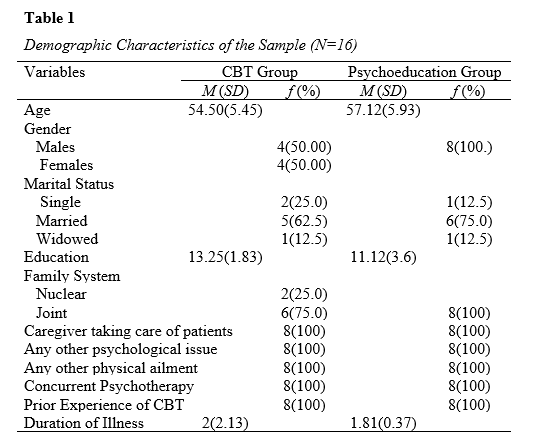
Parkinson's disease (PD), chiefly acknowledged for its motor indications, also contains noteworthy non-motor signs, such as anxiety that can strictly impact the quality of life (QoL) and aggravate the general load of illness. cognitive behavioral therapy (CBT) has appeared as an inspiring management for minimizing psychological signs, predominantly anxiety, among individuals diagnosed with PD. This study aimed to examine the efficiency of CBT for the psychological manifestation in PD. Purposive sampling was used, and sixteen participants (12 men; and 4 women) were randomly assigned to the two treatment conditions (the experimental group receiving therapy and the control group receiving only psycho-education). Therapy comprised ten structured sessions. The age range of participants were between 50 to 69 years (Mean=55.81). The cognitive functioning and specific patients’ illness was assessed through Movement Disorder Society - Unified Parkinson's Disease Rating Scale (MDS-UPDRS), The Standardized Mini-Mental State Examination (SMMSE), respectively. The Parkinson’s Anxiety Scale (PAS-12) and Parkinson's Disease Questionnaire (PDQ-8) were used to assess anxiety and QoL, respectively. Pre- and post-scores of the treatment showed considerable reduction in scores on the Parkinson’s Disease Quality of Life (PDQ-8) scale and Parkinson Anxiety Questionnaire (PAS-8) in the treatment group. To compare the pre- and post-treatment scores of two related groups, the nonparametric test was used. Experimental group showed significant improvement at the post-treatment, indicating alleviation of anxiety and enhancement of QoL in comparison to the psychoeducation group. The study concluded that quality of life improved after adapting healthy routines and modifying dysfunctional thoughts, emotions, and behaviors in PD patients. The findings gave evidence of CBT-based lifestyle adjustment as a psychotherapeutic intervention for PD-related distress and impaired QoL.
Downloads
References
American Psychiatric Association. (2013). Diagnostic and statistical manual of mental disorders (5th ed.). https://doi.org/10.1176/appi.books.9780890425596
Apostol, A. E., Mohamed, B., Thomas, C., Williams, T., Mahon, S., Fisher, M., & Lewis-Morton, R. (2024). CBT for generalized anxiety disorder in Parkinson's disease: A case study. Clinical Gerontologist, 47(2), 352–361. https://doi.org/10.1080/07317115.2023.2254311
Beck, J. S. (2011). Cognitive behavior therapy: Basics and beyond (2nd ed.). Guilford Press.
Blundell, E. K., Grover, L. E., Stott, J., & Schrag, A. (2023). The experience of anxiety for people with Parkinson's disease. npj Parkinson's Disease, 9, Article e75. https://doi.org/10.1038/s41531-023-00512-1
Duncan, B. L., Miller, S. D., Sparks, J. A., Claud, D. A., Reynolds, L. R., Brown, J., & Johnson, L. D. (2003). The Session Rating Scale: Preliminary psychometric properties of a “working” alliance measure. Journal of Brief Therapy, 3(1), 3–12.
Fernie, B. A., Spada, M. M., Ray Chaudhuri, K., Klingelhoefer, L., & Brown, R. G. (2015). Thinking about motor fluctuations: An examination of metacognitions in Parkinson's disease. Journal of Psychosomatic Research, 79(6), 669–673. https://doi.org/10.1016/j.jpsychores.2015.05.001
Gibson, J. S., Flanigan, J. L., Patrie, J. T., Dalrymple, W. A., & Harrison, M. B. (2023). Predictors of anxiety in Parkinson's disease: Results from a 3-year longitudinal cohort study. Neurological Sciences, 44(2), 547–556. https://doi.org/10.1007/s10072-022-06427-8
Goetz, C. G., Poewe, W., Rascol, O., Sampaio, C., Stebbins, G. T., Counsell, C., Giladi, N., Holloway, R. G., Moore, C. G., Wenning, G. K., Yahr, M. D., Seidl, L. (2004). Movement Disorder Society Task Force report on the Hoehn and Yahr staging scale: Status and recommendations. Movement Disorders, 19(9), 1020–1028. https://doi.org/10.1002/mds.20213
Hao, X., Wang, Z., Feng, Y., Li, M., Hao, C., Liang, Y., Zuo, C., Yang, X., Ma, D., Wang, Y., Li, S., Qi, S., Sun, Y., Mao, C., Sun, S., Xu, Y., & Shi, C. (2025). Association between anxiety disorder, anxiolytic drugs, and risk of incident Parkinson's disease. npj Parkinson's Disease, 11, Article e252. https://doi.org/10.1038/s41531-025-01104-x
Interian, A., Miller, R. B., St. Hill, L. M., Latorre, M., King, A. R., Rodriguez, K. M., Mann, S. L., Kashan, R. S., Dissanayaka, N. N., & Dobkin, R. D. (2023). A pilot study of telehealth mindfulness-based cognitive therapy for depression in Parkinson's disease. Journal of Geriatric Psychiatry and Neurology, 36(2), 143–154. https://doi.org/10.1177/08919887221103579
Jellinger, K. A. (2025). Behavioral disorders in Parkinson disease: Current view. Journal of Neural Transmission, 132(2), 169–201. https://doi.org/10.1007/s00702-024-02846-3
Jenkinson, C., Fitzpatrick, R., & Peto, V. (1999). Health-related quality-of-life measurement in patients with Parkinson's disease. Pharmacoeconomics, 15(2), 157–165. https://doi.org/10.2165/00019053-199915020-00004
Kalbe, E., Warnecke, T., Eggers, C., Ophey, A., & Folkerts, A.-K. (2025). Prevention of cognitive impairment and dementia in people with Parkinson's disease: A call-to-action. Journal of Parkinson's Disease, 15(8), 1353–1366. https://doi.org/10.1177/1877718X251365769
Kassm, S. A., Naja, W., Haddad, R., & Pelissolo, A. (2021). The relationship between anxiety disorders and Parkinson's disease: Clinical and therapeutic issues. Current Psychiatry Reports, 23(4), Article e20. https://doi.org/10.1007/s11920-021-01229-9
Kim, S. H., Park, M., & Jeong, S. H. (2024). Increased risk of new-onset Parkinson’s disease following a diagnosis of retinal vascular occlusion: A 14-year cohort study. The Journals of Gerontology, Series A: Biological Sciences and Medical Sciences, 79(5), Article eglae081. https://doi.org/10.1093/gerona/glae081
Lee, S. (2021). Perceived health, psychological distress, and subjective well-being among older adults with Parkinson's disease: A cross-lagged analysis. International Journal of Environmental Research and Public Health, 18(23), Article e12566. https://doi.org/10.3390/ijerph182312566
Leentjens, A. F. G., Dujardin, K., Pontone, G. M., Starkstein, S. E., Weintraub, D., & Martinez-Martin, P. (2014). The Parkinson Anxiety Scale (PAS): Development and validation of a new anxiety scale. Movement Disorders, 29(8), 1035–1043. https://doi.org/10.1002/mds.25919
Maggio, M. G., Culicetto, L., Bonanno, L., De Luca, R., Corallo, F., Rizzo, A., Marino, S., Quartarone, A., Luca, A., Nicoletti, A., & Calabrò, R. S. (2025). Comprehensive assessment of caregiver burden and strain in early-stage Parkinson's disease: An exploratory study. Journal of Health Psychology, 30(11), 3169–3181. https://doi.org/10.1177/13591053241312505
Molloy, D. W., Alemayehu, E., & Roberts, R. (1991). Reliability of a standardized Mini-Mental State Examination compared with the traditional Mini-Mental State Examination. The American Journal of Psychiatry, 148(1), 102–105. https://doi.org/10.1176/ajp.148.1.102
Moonen, A. J. H., Mulders, A. E. P., Defebvre, L., Duits, A., Flinois, B., Köhler, S., Kuijf, M. L., Leterme, A.-C., Servant, D., de Vugt, M., Dujardin, K., & Leentjens, A. F. G. (2021). Cognitive behavioral therapy for anxiety in Parkinson's disease: A randomized controlled trial. Movement Disorders, 36(11), 2539–2548. https://doi.org/10.1002/mds.28533
Morley, J. F., Subramanian, I., Farahnik, J., Grout, L., Salcido, C., Kurtzer, J., & Mischley, L. K. (2026). Physical activity, patient-reported outcomes, and quality of life in Parkinson's disease. Journal of Geriatric Psychiatry and Neurology, 39(1), 14–23. https://doi.org/10.1177/08919887251346495
Mulders, A. E. P., Moonen, A. J. H., Dujardin, K., Kuijf, M. L., Duits, A., Flinois, B., Handels, R. L. H., Lopes, R., & Leentjens, A. F. G. (2018). Cognitive behavioural therapy for anxiety disorders in Parkinson's disease: Design of a randomised controlled trial to assess clinical effectiveness and changes in cerebral connectivity. Journal of Psychosomatic Research, 112, 32–39. https://doi.org/10.1016/j.jpsychores.2018.04.002
Poewe, W., Seppi, K., Tanner, C. M., Halliday, G. M., Brundin, P., Volkmann, J., Schrag, A.-E., & Lang, A. E. (2017). Parkinson disease. Nature Reviews Disease Primers, 3, Article e17013. https://doi.org/10.1038/nrdp.2017.13
Pontone, G. M., Perepezko, K. M., Hinkle, J. T., Gallo, J. J., Grill, S., Leoutsakos, J.-M., Mills, K. A., Weiss, H. D., & Mari, Z. (2022). “Anxious fluctuators”: A subgroup of Parkinson's disease with high anxiety and problematic on-off fluctuations. Parkinsonism & Related Disorders, 105, 62–68. https://doi.org/10.1016/j.parkreldis.2022.11.002
Remy, P., Doder, M., Lees, A., Turjanski, N., & Brooks, D. (2005). Depression in Parkinson's disease: Loss of dopamine and noradrenaline innervation in the limbic system. Brain, 128(6), 1314–1322. https://doi.org/10.1093/brain/awh478
Reynolds, G. O., Saint-Hilaire, M., Thomas, C. A., Barlow, D. H., & Cronin-Golomb, A. (2020). Cognitive-behavioral therapy for anxiety in Parkinson's disease. Behavior Modification, 44(4), 552–579. https://doi.org/10.1177/0145445519838828
Sarapura-Castro, E., Milla-Neyra, K., Ríos-Pinto, J., Maguiña, J. L., Rivera-Valdivia, A., Inca-Martinez, M., Illanes-Manrique, M., Galecio-Castillo, M., Montano, S., Mata, I. F., & Cornejo-Olivas, M. (2026). Prevalence of Parkinson's disease in a town of the central highlands of Peru: A population-based study. Movement Disorders Clinical Practice, 13(3), 692–701. https://doi.org/10.1002/mdc3.70354
Seritan, A. L., Iosif, A.-M., Prakash, P., Wang, S., & Eisendrath, S. (2023). Mindfulness-based cognitive therapy improves anxiety and depression in people with Parkinson's disease: Evidence from two pilot clinical trials. The American Journal of Geriatric Psychiatry, 31(10), e11–e12. https://doi.org/10.1016/j.jagp.2023.02.020
Soilemezi, D., Siquier, A., & Andrés, P. (2025). Exploring stigma in people living with Parkinson's disease and their caregivers: A review of qualitative studies. Journal of Parkinson's Disease, 15(3), 480–494. https://doi.org/10.1177/1877718X251330995
van Wegen, E. E. H., van Balkom, T. D., Hirsch, M. A., Rutten, S., & van den Heuvel, O. A. (2024). Non-pharmacological interventions for depression and anxiety in Parkinson's disease. Journal of Parkinson's Disease, 14(S1), S135–S146. https://doi.org/10.3233/JPD-230228
Wang, Z., Wei, H., Xin, Y., & Qin, W. (2025). Advances in the study of depression and anxiety in Parkinson's disease: A review. Medicine, 104(10), Article e41674. https://doi.org/10.1097/MD.0000000000041674
Weintraub, D., Aarsland, D., Ray Chaudhuri, K., Dobkin, R. D., Leentjens, A. F. G., Rodriguez-Violante, M., & Schrag, A. (2022). The neuropsychiatry of Parkinson's disease: Advances and challenges. The Lancet Neurology, 21(1), 89–102. https://doi.org/10.1016/S1474-4422(21)00330-6
Yazd, S. A. Y., Gashtil, S., Moradpoor, M., Pishdar, S., Nabian, P., Kazemi, Z., & Naeim, M. (2023). Reducing depression and anxiety symptoms in patients with Parkinson's disease: The effectiveness of group cognitive behavioral therapy. Parkinsonism & Related Disorders, 112, Article e105456. https://doi.org/10.1016/j.parkreldis.2023.105456
Young, J. E., & Beck, A. T. (1980). Cognitive therapy scale [Unpublished manuscript]. University of Pennsylvania.
Zhu, B., Kohn, R., Patel, A., Koo, B. B., Louis, E. D., & de Figueiredo, J. M. (2021). Demoralization and quality of life of patients with Parkinson disease. Psychotherapy and Psychosomatics, 90(6), 415–421. https://doi.org/10.1159/000514270
Downloads
Published
How to Cite
Issue
Section