
Personality Types and Beliefs in Hoarding Disorder: A Cross Sectional Study
DOI:
https://doi.org/10.32350/ccpr.81.03Keywords:
Hoarding Behaviours, Obsessive Compulsive Disorder, PersonalityAbstract
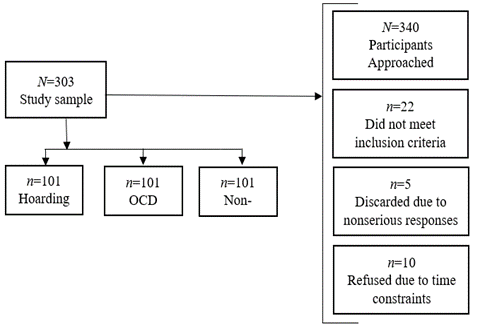
Hoarding is a prevalent psychological condition, with evidence suggesting that approximately 2-6% of the global adult population is affected. The objective of this study was to differentiate these individuals into three groups: hoarding disorder (HD), obsessive-compulsive disorder (OCD), and non-clinical in terms of personality and beliefs behind hoarding behaviors. The study was cross-sectional in nature with a matched group research design. Sample size (N=303) was determined through G*Power analysis, collected through a purposive sampling strategy, following a specific inclusion criteria. Participants in three groups were matched on age and education. Participants with OCD were recruited from psychiatric units, whereas people with HD and those falling in the third category were recruited from the general population in the same vicinity. Standardized measures were administered to screen out HD and OCD, personality types and beliefs, as well as other mental health conditions, which were part of the exclusion criteria. ANOVA and Post Hoc analysis revealed a significant difference in the beliefs of emotional attachment with possession, control over saved items, and responsibility towards their cluttered material, as compared to normal and OCD participants. Neuroticism was highly reported by the individuals with HD. Individuals with HD were reported to be less conscientious, open to experience, and agreeable, as compare to those with OCD and normal control. Rigid beliefs related to collecting/saving and neurotic personality traits are significant factors in hoarding behaviors, including acquiring, saving, and difficulty with recycling, discarding, and disorganizing collected material.
Downloads
References
Advameg. (n.d.). Culture of Pakistan. Retrieved on December, 03 2025, https://www.everyculture.com/No-Sa/Pakistan.html
American Psychiatric Association. (2022). Diagnostic and statistical manual of mental disorders (5th ed., text rev). https://doi.org/10.1176/appi.books.9780890425787
Al-Islam. (n.d.). The forty-fifth greater sin: Hoarding and black marketing. Retrieved on May 11, 2026, https://www.al-islam.org/greater-sins-volume-3-ayatullah-sayyid-abdul-husayn-dastghaib-shirazi/forty-fifth-greater-sin
Ayers, C. R., Wetherell, J. L., Golshan, S., & Saxena, S. (2011). Cognitive-behavioral therapy for geriatric compulsive hoarding. Behaviour Research and Therapy, 49(10), 689–694. https://doi.org/10.1016/j.brat.2011.07.002
Bratiotis, C., Muroff, J., & Lin, N. X. (2021). Hoarding disorder: Development in conceptualization, intervention, and evaluation. Focus, 19(4), 392–404. https://doi.org/10.1176/appi.focus.20210016
Bratiotis, C., & Woody, S. R. (2020). What's so complicated about hoarding? A view from the nexus of psychology and social work. Journal of Obsessive-Compulsive and Related Disorders, 24, Article e100496. https://doi.org/10.1016/j.jocrd.2019.100496
Büscher, T. P., Dyson, J., & Cowdell, F. (2014). The effects of hoarding disorder on families: An integrative review. Journal of Psychiatric & Mental Health Nursing, 21(6), 491–498. https://doi.org/10.1111/jpm.12098
Chasson, G. S., Tang, S., Gray, B., Sun, H., & Wang, J. (2013). Further validation of a Chinese version of the Obsessive-Compulsive Inventory-Revised. Behavioural and Cognitive Psychotherapy, 41(2), 249–254. https://doi.org/10.1017/S1352465812000379
Collett, J. (2019). Unpacking hoarding disorder. InPsych 2019, 41(5). https://psychology.org.au/for-members/publications/inpsych/2019/october/unpacking-hoarding-disorder
Daniela, V., Jorge, G., & Pedro, M. (2017). Hoarding disorder: A case report. Frontiers in Psychiatry, 8, 112. https://doi.org/10.3389/fpsyt.2017.00112
Dozier, M. E., & DeShong, H. L. (2022). The association between personality traits and hoarding behaviors. Current Opinion in Psychiatry, 35(1), 53–58. https://doi.org/10.1097/yco.0000000000000754
Dozier, M. E., Davidson, E. J., Pittman, J. O., & Ayers, C. R. (2020). Personality traits in adults with hoarding disorder. Journal of Affective Disorders, 276, 191–196. https://doi.org/10.1016/j.jad.2020.07.033
Foa, E. B., Huppert, J. D., Leiberg, S., Langner, R., Kichic, R., Hajcak, G., & Salkovskis, P. M. (2002). The Obsessive-Compulsive Inventory: Development and validation of a short version. Psychological Assessment, 14(4), 485–496.
Freud, S. (1908). Character and anal eroticism. In J. Strachey (Ed. & Trans.), The standard edition of the complete works of Sigmund Freud (Vol. 9, pp. 169-175). Hogarth Press.
Frost, R. O., Steketee, G., Williams, L. F., & Warren, R. (2000). Mood, personality disorder symptoms and disability in obsessive compulsive hoarders: A comparison with clinical and nonclinical controls. Behaviour Research and Therapy, 38(11), 1071–1081. https://doi.org/10.1016/S0005-7967(99)00137-0
Frost, R. O., Steketee, G., & Grisham, J. (2004). Measurement of compulsive hoarding: Saving inventory-revised. Behaviour Research and Therapy, 42(10), 1163–1182. https://doi.org/10.1016/j.brat.2003.07.006
Frost, R. O., Steketee, G., Tolin, D. F., Sinopoli, N., & Ruby, D. (2015). Motives for acquiring and saving in hoarding disorder, OCD, and community controls. Journal of Obsessive-Compulsive and Related Disorders, 4, 54–59. https://doi.org/10.1016/j.jocrd.2014.12.006
Grisham, J. R., & Baldwin, P. A. (2015). Neuropsychological and neurophysiological insights into hoarding disorder. Neuropsychiatric Disease and Treatment, 11, 951–962. https://doi.org/10.2147/NDT.S62084
Hezel, D. M., & Hooley, J. M. (2014). Creativity, personality, and hoarding behavior. Psychiatry Research, 220, 322–327. https://doi.org/10.1016/j.psychres.2014.07.037
Inchausti, F., Delgado, A. R., & Prieto, G. (2015). Obsessive-compulsive disorder and its relationship with disgust vulnerability and conscientiousness. Psicothema, 27(3), 254–260. https://doi.org/10.7334/psicothema2015.7
Itrat, A., Taqui, A. M., Qazi, F., & Qidwai, W. (2007). Family systems: Perceptions of elderly patients and their attendants presenting at a university hospital in Karachi, Pakistan. Journal of Pakistan Medical Association, 57(2), 106–110.
Jantz, G. L., & McMurray, A. (2011). Overcoming anxiety, worry, and fear: Practical ways to find peace. Revell.
Kartal, E., Scott, J., & Morein-Zamir, S. (2026). Attitudes to possessions in emerging adults: Predictors of hoarding behaviours and beliefs. British Journal of Clinical Psychology, 65(1), 33–53. https://doi.org/10.1111/bjc.70003
Khalid, S., Fatima, I., & Khan, W. (2015). Personality traits and conflict management in bankers. Journal of Behavioral Sciences, 25(2).
Kovaleva, A., Beierlein, C., Kemper, C. J., & Rammstedt, B. (2013). Psychometric properties of the BFI-K: A cross-validation study. The International Journal of Educational and Psychological Assessment, 13(1), 34–50.
LaSalle-Ricci, V. H., Arnkoff, D. B., Glass, C. R., Crawley, S. A., Ronquillo, J. G., & Murphy, D. L. (2006). The hoarding dimension of OCD: Psychological comorbidity and the five-factor personality model. Behaviour Research and Therapy, 44(10), 1503–1512. https://doi.org/10.1016/j.brat.2005.11.009
Lee, E-K., & Park, H-H. (2025). The effect of compulsive hoarding behavior on consumers' two-sided responses. Sustainability, 17(5), Article e2230. https://doi.org/10.3390/su17052230
Mackin, R. S., Vigil, O., Insel, P., Kivowitz, A., Kupferman, E., Hough, C. M., Fekri, S., Crothers, R., Bickford, D., Delucchi, K. L., & Mathews, C. A. (2016). Patterns of clinically significant cognitive impairment in hoarding disorder. Depression and Anxiety, 33(3), 211–218. https://doi.org/10.1002/da.22439
Malik, F., & Kamal, A. (2020). Perception of hoarding behavior among general population of Rawalpindi and Islamabad cities of Pakistan: An exploratory qualitative inquiry. Gomal Journal of Medical Sciences, 18(3), 83–92. https://doi.org/10.46903/gjms/18.03.833
MAPI Research Trust. (n.d.). Linguistic validation manual for health outcome assessments. Retrieved on April 21, 2026, from https://www.mapi-trust.org/services/translation-linguistic-validation
Mirza, M., & Kausar, R. (2013). Development of the perceived expressed emotion scale and its illustrations on the patients with schizophrenia, OCD and depressive illness [Unpublished doctoral dissertation]. University of the Punjab.
Morein-Zamir, S., & Ahluwalia, S. (2023). Hoarding disorder: Evidence and best practice in primary care. The British Journal of General Practice, 73(729), 182¬–183. https://doi.org/10.3399/bjgp23X732513
Mueller, S. M. (2025, February). New insights into hoarding behavior. Psychology Today. Retrieved on May 6, 2026, from https://www.psychologytoday.com/us/blog/the-mind-of-a-collector/202502/new-insights-into-hoarding-behavior
Nordsletten, A. E., Fernández de la Cruz, L., Aluco, E., Alonso, P., López-Solà, C., Menchón, J. M., Nakao, T., Kuwano, M., Yamada, S., Fontenelle, L. F., Campos-Lima, A. L., & Mataix-Cols, D. (2018). A transcultural study of hoarding disorder: Insights from the United Kingdom, Spain, Japan, and Brazil. Transcultural Psychiatry, 55(2), 261–285. https://doi.org/10.1177/1363461518759203
Nordsletten, A. E., Reichenberg, A., Hatch, S. L., de la Cruz, L. F., Pertusa, A., Hotopf, M., & Mataix-Cols, D. (2013). Epidemiology of hoarding disorder. The British Journal of Psychiatry, 203(6), 445–452. https://doi.org/10.1192/bjp.bp.113.130195
Nutley, S. K., Read, M., Martinez, S., Eichenbaum, J., Nosheny, R. L., Weiner, M., . . . Mathews, C. A. (2022). Hoarding symptoms are associated with higher rates of disability than other medical and psychiatric disorders across multiple domains of functioning. BMC Psychiatry, 22(1), Article e647. https://doi.org/10.1186/s12888-022-04287-2
Piroozian, Z. M., Khanjani, Z., Esmaeilpour, K., & Mahmoud Alilou, M. (2025). The role of attachment styles in hoarding disorder with the mediation of avoidant personality and emotion regulation among students of Tabriz University. Journal of Modern Psychological Researches, 20(77), 272–282. https://doi.org/10.22034/jmpr.2024.62951.6352
Postlethwaite, A., Kellett, S., & Mataix-Cols, D. (2019). Prevalence of hoarding disorder: A systematic review and meta-analysis. Journal of Affective Disorders, 256, 309–316. https://doi.org/10.1016/j.jad.2019.06.004
Ragan, K., Tinlin-Dixon, R. M., & Lomax, C. L. (2026). Developing a measure of beliefs about items in hoarding disorder (BIHD). Behavioural and Cognitive Psychotherapy, 1–17. Advance online publication. https://doi.org/10.1017/s1352465825101227
Rasheed, N., Qasim, A., Jabeen, S., & Khan, P. (2026). Big five personality trait and hoarding behavior prevalence. Pakistan Journal of Psychological Research, 41(1), 185–194. https://doi.org/10.33824/PJPR.2026.41.1.11
Ricci, G., Gibelli, F., Bailo, P., Caraffa, A. M., Casamassima, M. A., & Sirignano, A. (2023). Hoarding disorder: A sociological perspective. Sci, 5(2), Article e21. https://doi.org/10.3390/sci5020021
Samuels, J. F., Bienvenu, O. J., Grados, M. A., Cullen, B., Riddle, M. A., Liang, K. Y., . . . Nestadt, G. (2008). Prevalence and correlates of hoarding behavior in a community-based sample. Behaviour Research and Therapy, 46(7), 836–844. https://doi.org/10.1016/j.brat.2008.04.004
Sharma, I., Pandit, B., Pathak, A., & Sharma, R. (2013). Hinduism, marriage, and mental illness. Indian Journal of Psychiatry, 55(6), S243–S249. https://doi.org/10.4103/0019-5545.105544
Smith, A., Nathwani, F., Barry, T., & Gregory, J. (2025). Beliefs about possessions associated with hoarding disorder: A systematic review and meta-analysis. Journal of Affective Disorders, 395, Article e120698. https://doi.org/10.1016/j.jad.2025.120698
Spittlehouse, J. K., Vierck, E., Pearson, J. F., & Joyce, P. R. (2016). Personality, mental health, and demographic correlates of hoarding behaviors in a midlife sample. PeerJ, 4, Article e2826. https://doi.org/10.7717/peerj.2826
Steketee, G., Frost, R. O., & Kyrios, M. (2003). Cognitive aspects of compulsive hoarding. Cognitive Therapy and Research, 27(4), 463–479. https://doi.org/10.1023/A:1025428631552
Tang, T., Wang, J. P., Tang, S. Q., & Zhao, L. N. (2012). Psychometric properties of the Saving Inventory-Revised in Chinese university students sample. Chinese Journal of Clinical Psychology, 20(1), 21-24.
Tarzian, M., Ndrio, M., & Fakoya, A. O. (2023). An introduction and brief overview of psychoanalysis. Cureus, 15(9), Article e45171. https://doi.org/10.7759/cureus.45171
Timpano, K. R., Exner, C., Glaesmer, H., Rief, W., Keshaviah, A., Brähler, E., & Wilhelm, S. (2011). The epidemiology of the proposed DSM-5 hoarding disorder: Exploration of the acquisition specifier, associated features, and distress. Journal of Clinical Psychiatry, 72(6), 780–786. https://doi.org/10.4088/JCP.10m06380
Tinlin, R. M., Beckwith, H., Gregory, J. D., & Lomax, C. L. (2022). What is underneath all that stuff? A Q-methodological exploration of profiles of beliefs and vulnerabilities in hoarding disorder. Behavioural and Cognitive Psychotherapy, 50(5), 538–555. https://doi.org/10.1017/s1352465822000261
Weintraub, M. J., Brown, C. A., & Timpano, K. R. (2018). The relationship between schizotypal traits and hoarding symptoms: An examination of symptom specificity and the role of perceived cognitive failures. Journal of Affective Disorders, 237, 10–17. https://doi.org/10.1016/j.jad.2018.04.121
Zaboski, B. A., II, Merritt, O. A., Schrack, A. P., Gayle, C., Gonzalez, M., Guerrero, L. A., Dueñas, J. A., Soreni, N., & Mathews, C. A. (2019). Hoarding: A meta-analysis of age of onset. Depression and Anxiety, 36(6), 552–564. https://doi.org/10.1002/da.22896
Zafar, W., & Arshad, T. (2017). Social comparison, cognitions and submissive behaviors in patients with social anxiety disorders [Unpublished bachelor's thesis]. University of the Punjab.
Zakrzewski, J. J., Henderson, R., Archer, C., Vigil, O. R., Mackin, S., & Mathews, C. A. (2022). Subjective cognitive complaints and objective cognitive impairment in hoarding disorder. Psychiatry Research, 307, Article e114331. https://doi.org/10.1016/j.psychres.2021.114331
Downloads
Published
How to Cite
Issue
Section