
Investigative Analysis of the Entrance Marble Façade of Lahore Museum
DOI:
https://doi.org/10.32350/jaabe.91.02Keywords:
arches, Bhai Ram Singh, Gothic, lotus, marble façadeAbstract
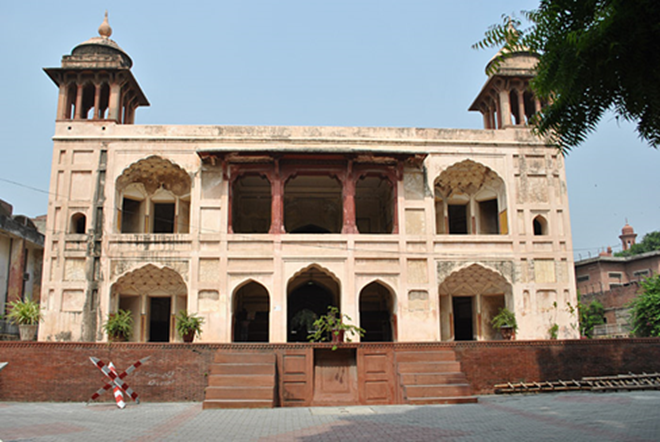
Architecture of any place represents its culture, tradition, and topographical situations. The current study aimed to focus on an architectural edifice that displays the merging of local elements with foreign influences. The structure selected was the marble façade and entrance to the Lahore Museum. The methodology used in the study was based on formal analysis of the architectural features of the façade. For this, primary data was collected and analyzed for comparative analysis with past and present architectural trends. Historical references were used for the structural elements and their symbolism in various cultures of this land. The study concluded that although, the entire structure is an amalgamation of varied elements of Indo-Saracenic style, yet it has retained its identity and presented a new architectural trend with its uniqueness and elegance.
Downloads
References
Bhatti, S. (2016). Translating museums: A counterhistory of South Asian museology. Routledge.
Bloom, S. S. (1995). The art and architecture of Islam. Mapin Publishing
Britannica. (2026a, April 23). Sacred lotus. https://www.britannica.com/plant/sacred-lotus
Britannica. (2026b, April 23). Where is Akbar’s Tomb? https://www.britannica.com/question/Where-is-Akbars-Tomb
Brown, P. (1994). History of Lahore Museum. Lahore Museum Bulletin's Century, 7(1 & 2), 17–18.
Chaudhry, N. A. (1998). Lahore: Glimpses of a glorious heritage. Sang-e-Meel.
Craven, R. C. (1996). Indian Art: A concise history. Praeger Publishers.
Crossley, T. (2025). Visual reality: Architecture, culture and the body. Routledge.
Dalal, R. (2010). The religions of India: A concise guide to nine major faiths. Penguin Books.
Degeorge, D. C. (2000). Ornamentation and decoration in Islamic architecture. Thames and Hudson.
Gardetti, M. A., & Muthu, S. S. (Eds.). (2015). Handbook of sustainable luxury textile and fashion. Springer.
Government of the Punjab. (1890-1891). Administration report of the buildings and roads branch. Caxton Printing.
Government of the Punjab. (1905-1906). Administration report of the buildings and roads branch. Caxton Printing.
Ijazuddin, F. S. (2008). Lahore recollected: An album. Sang e Meel.
Mumtaz, K. K. (1989). Architecture in Pakistan. Singapore: A mimar book. Butterworth Architecture.
Soon, T. E. (2002). The Lotus in the Buddhist art of India. Shaw Foundation.
Vandal, P., & Vandal, S. (2006). The Raj, Lahore, and Bhai Ram Singh. NCA Publication.
Zimmer, H. (2017). Myths and symbols in Indian art and civilization. Princeton University Press.
Downloads
Published
How to Cite
Issue
Section
License
Copyright (c) 2026 Sadia Hashmi, Naureen Kamran, Dr. Shaukat

This work is licensed under a Creative Commons Attribution 4.0 International License.
JAABE follows an open-access publishing policy and full text of all published articles is available free, immediately upon publication of an issue. The journal’s contents are published and distributed under the terms of the Creative Commons Attribution 4.0 International (CC-BY 4.0) license. Thus, the work submitted to the journal implies that it is original, unpublished work of the authors (neither published previously nor accepted/under consideration for publication elsewhere). On acceptance of a manuscript for publication, a corresponding author on the behalf of all co-authors of the manuscript will sign and submit a completed Copyright and Author Consent Form.
Copyright (c) The Authors