
AI-Driven Digital Twins: Redefining Agricultural Science in the Era of Intelligent Systems
DOI:
https://doi.org/10.32350/sir.94.06Keywords:
agriculture, artificial intelligence, AI modeling, data driven digital technologies, digital twins, intelligent systemsAbstract
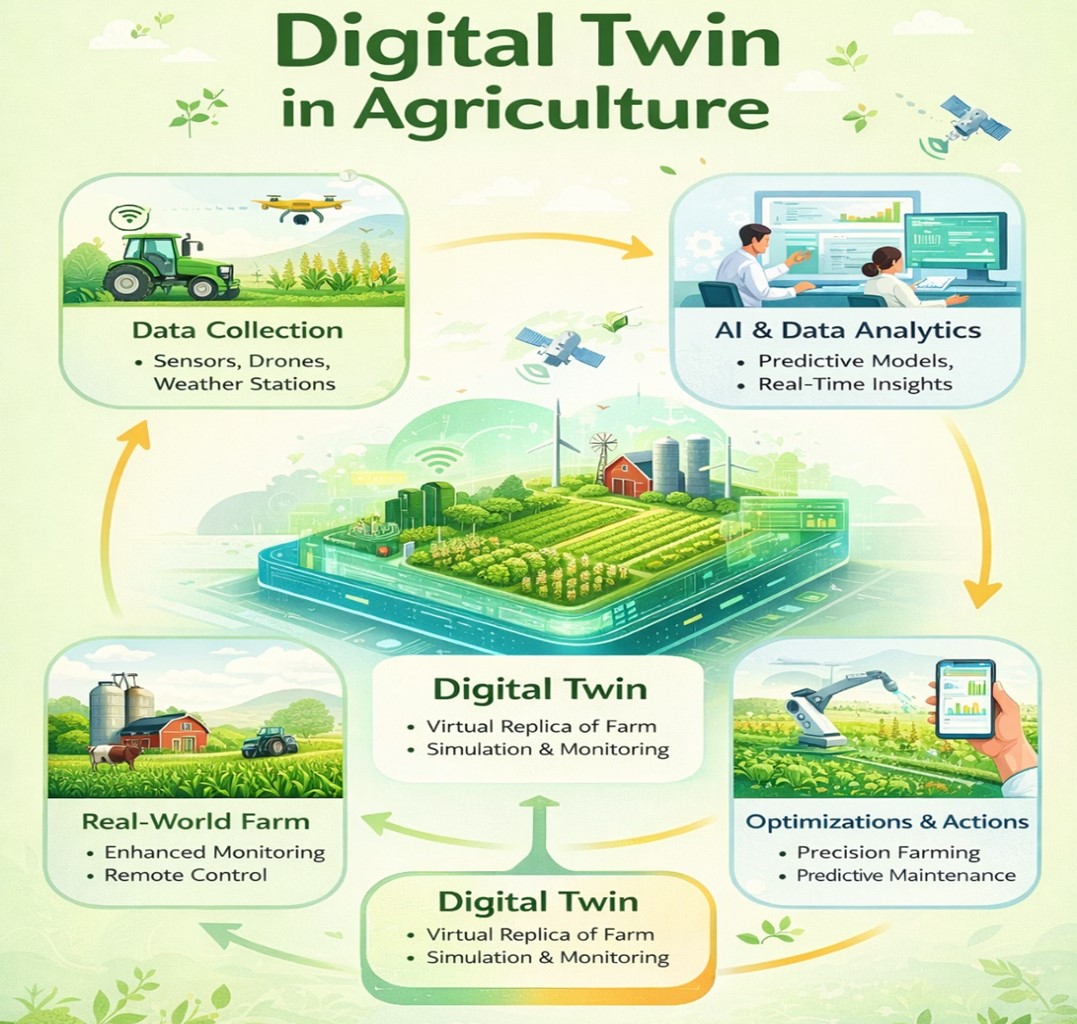
One of the most promising and modern technologies that has the potential to enhance agricultural productivity, sustainability, and management is the digital twin technology. A digital twin is the digital representation of a physical system that holds real-time data from sensors and monitoring devices to constantly update itself. A digital twin can be utilized by the farmers to evaluate agricultural procedure, crop conditions, and determine potential outcome Prior to making decisions about field-based management. This research determines the application of the digital twin technology in agriculture, emphasizing how it integrates data analytics, remote sensing technologies, artificial intelligence (AI), and the Internet of Things (IoT). IoT sensors collect environmental and crop data in real time and send it over communication networks to digital processors that create virtual models. Machine learning (ML) system make it possible to analyze data for crop monitoring, disease detection, irrigation control, and predictive modeling. Drones and remote sensing technologies provide geographic data that enhances the precision of digital twin models and assist how digital twins might improve sustainable farming methods, precision farming and optimize resources. It also reduces the difficulties of adopting digital twin systems in agriculture, including data integration, infrastructure requirements and system complexity. Overall, digital twin technology provides the basis for data-driven decision-making, with the potential to change traditional farming into an intelligent and sustainable agricultural system. The current research aims to critically evaluate the revolutize potential of AI-driven digital twin technology in agriculture, exploring how intelligent systems revolutionize crop and animal management and analyze the socio-technical factors influencing equitable adoption
Downloads
References
1. Grieves M. Digital twin: manufacturing excellence through virtual factory replication. White Paper. 2014. https://www.researchgate.net/publication/275211047_Digital_Twin_Manufacturing_Excellence_through_Virtual_Factory_Replication
Grieves (2014) introduced the concept of the Digital Twin as a virtual replica of a physical manufacturing system that enables real-time monitoring, simulation, and optimization. The paper highlights how virtual factory replication improves manufacturing excellence by enhancing decision-making, efficiency, and lifecycle management.
2. Wang J, Li X, Wang P, Liu Q. Bibliometric analysis of digital twin literature: a review of influencing factors and conceptual structure. Technol Anal Strateg Manag. 2022;36:1-15. https://doi.org/10.1080/09537325.2022.2026320
Wang et al. (2022) presented a bibliometric review of digital twin research, mapping key influencing factors, thematic evolution, and the conceptual structure of the field to identify research trends and future directions.
3. Wang L. Digital twins in agriculture: a review of recent progress and open issues. Electronics. 2024;13(11):e2209. https://doi.org/10.3390/electronics13112209
Wang (2024) reviewed recent advancements in agricultural digital twins, highlighting applications in smart farming while identifying key open challenges such as data integration, model accuracy, and scalability.
4. Inamdar A, van Driel WD, Zhan G. Digital twin technology—a review and its application model for prognostics and health management of microelectronics. Electronics. 2024;13(16):e3255. https://doi.org/10.3390/electronics13163255
This review synthesized the evolution of digital twin concepts, architectures, and modeling approaches, tracing their roots to early simulation and information technologies (e.g., NASA roadmaps and Grieves’s work) and discusses updated architectural models and roles of modeling & simulation in digital twin frameworks.
5. Leng J, Zhou M, Xiao G, Zhang H, Liu Q. Digital twins-based smart manufacturing system design in Industry 4.0: a comprehensive review. J Manuf Syst. 2021;60:119-139. https://doi.org/10.1016/j.jmsy.2021.05.004
This review by Leng et al. (2021) provided a comprehensive overview of digital twin applications in Industry 4.0, highlighting their role in smart manufacturing system design and integration.
6. Popa EO, Van Hilten M, Oosterkamp E, Bogaardt MJ. The use of digital twins in healthcare: socio-ethical benefits and socio-ethical risks. Life Sci Soc Policy. 2021;17:e6. https://doi.org/10.1186/s40504-021-00113-x
Tretter et al. examined the ethical implications of digital twins in healthcare, highlighting concerns related to privacy, responsibility, transparency, and patient autonomy in this emerging paradigm.
7. Yaqoob I, Salah K, Khan LU, Jayaraman R, Al-Fuqaha A, Omar M. Digital twins for smart cities: benefits, enabling technologies, applications, and challenges. In: Proc IEEE Future Netw World Forum (FNWF); 2023: Baltimore, MD, USA. https://doi.org/10.1109/FNWF58287.2023.10520349
Authors discussed digital twins as dynamic virtual representations of real-world systems, emphasizing their role in urban modeling, planning, and real-time decision-making.
8. Tagarakis AC, Benos L, Kyriakarakos G, Pearson S, Sørensen CG, Bochtis D. Digital twins in agriculture and forestry: a review. Sensors. 2024;24(10):e3117. https://doi.org/10.3390/s24103117
9. Zhang R, Zhu H, Chang Q, Mao Q. A comprehensive review of digital twins technology in agriculture. Agriculture. 2025;15(9):e903. https://doi.org/10.3390/agriculture15090903
Zhang et al. (2025) provided a comprehensive review of digital twin technologies in agriculture, summarizing current applications, enabling technologies, and future research challenges for sustainable and intelligent farming systems.
10. Bautista CJC, Gallegos RKB, Lampayan RM. Machine learning and digital twins in smart irrigation: optimising water use through agricultural data analytics. Smart Agric Technol. 2025;3(1):e2562418. https://doi.org/10.1080/27525783.2025.2562418
11. Ahsen R, Di Bitonto P, Novielli P, et al. Harnessing digital twins for sustainable agricultural water management: a systematic review. Appl Sci. 2025;15(8):e4228. https://doi.org/10.3390/app15084228
Ahsen et al (2025) systematically reviewed how digital twin technology can enhance sustainable agricultural water management by improving irrigation efficiency, real-time monitoring, and data-driven decision-making.
12. Gund R, Badgujar CM, Samiappan S, Jagadamma S. Application of digital twin technology in smart agriculture: a bibliometric review. Agriculture. 2025;15(17):e1799. https://doi.org/10.3390/agriculture15171799
Gund (2025) presented a bibliometric review highlighting global research trends, key technologies, and future directions of digital twin applications in smart agriculture for improving productivity and sustainability.
13. Verdouw C, Tekinerdogan B, Beulens A, Wolfert S. Digital twins in smart farming. Agric Syst. 2020;189:e103046. https://doi.org/10.1016/j.agsy.2020.103046
Verdouw et al. explored the use of digital twins in smart farming, highlighting how virtual representations of agricultural systems support data-driven decision-making, efficiency, and sustainability.
14. Gong J, Chen J, Chen Z, Chi H, Liu J. Overview of the application progress of digital twins in agriculture. Paper presented at: International Conference on Digital Management and Information Technology; March 14-16, 2025; Shenyang, China. https://doi.org/10.1145/3736 426.3736473
Gong et al. (2020) provided an overview of the progress of digital twin applications in manufacturing, emphasizing their role in improving production efficiency, system monitoring, and intelligent decision-making.
Published
How to Cite
Issue
Section
License
Copyright (c) 2025 Madieha Ambreen, Muhammad Talha Hassan, Maryam Khalid

This work is licensed under a Creative Commons Attribution 4.0 International License.





