Fraud Risk Management Practices in Emerging Markets: Empirical Evidence from Pakistan’s Textile Sector
DOI:
https://doi.org/10.32350/aar.62.01Keywords:
fraud risk assessment, fraud triangle, internal control, multiple correspondence analysis, Ward's hierarchical clusteringAbstract
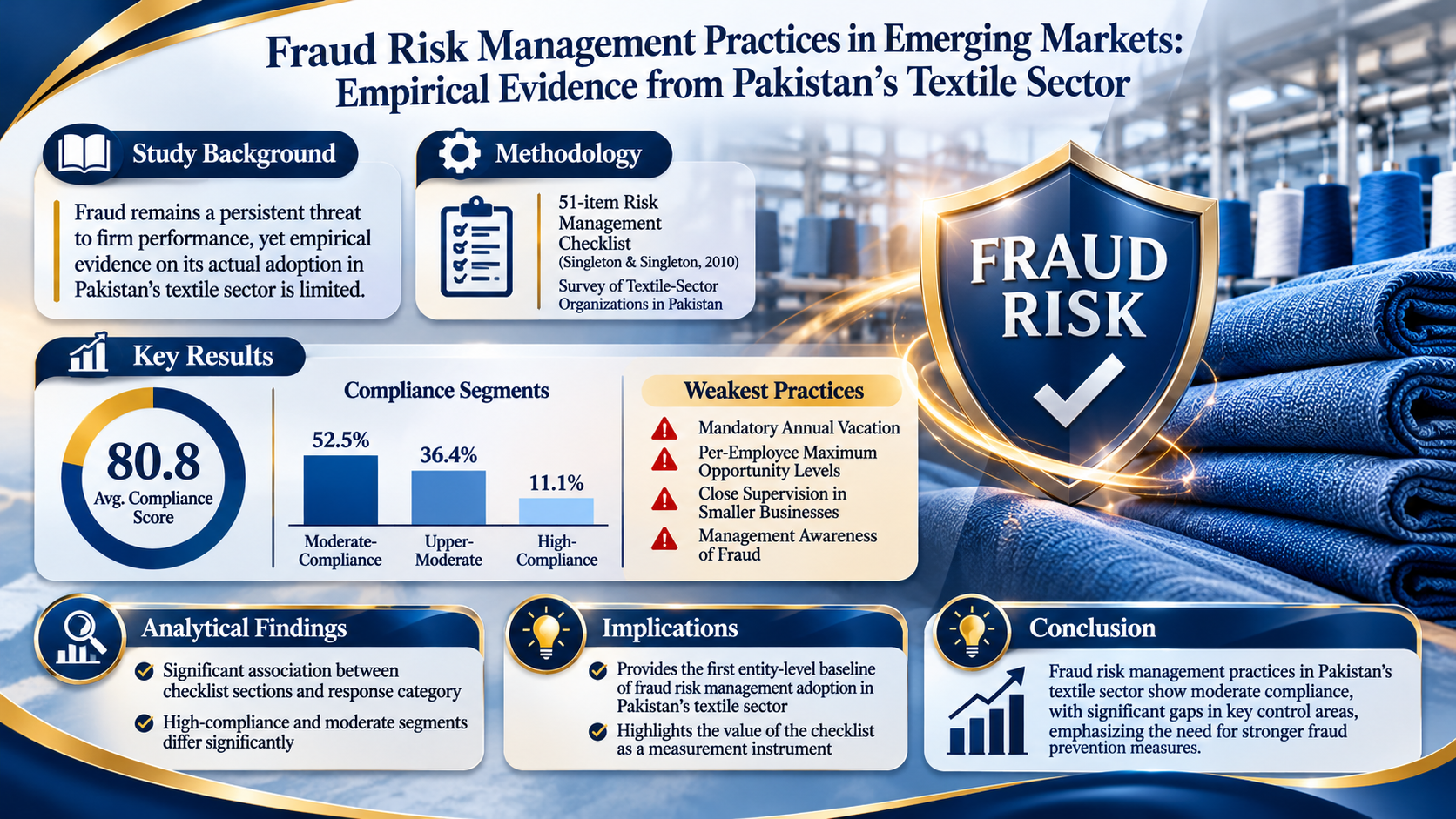
Purpose: Fraud remains a persistent threat to firm performance, yet empirical evidence on the actual adoption of fraud risk management practices at the entity level is scarce, particularly in Pakistan.
Design/methodology/approach: The current study administers the 51-item Risk Management Checklist of Singleton and Singleton (2010) to textile-sector organizations in Pakistan by using a survey design. Furthermore, the study also evaluates the compliance patterns using multiple correspondence analysis and Ward’s hierarchical cluster analysis.
Findings: Of the 5,049 responses, producing an average firm compliance score, and internal consistency was slightly above the threshold. The weakest practices were mandatory annual vacation, per-employee maximum opportunity levels, close supervision in smaller businesses, and management awareness of fraud. This indicates that opportunity-reducing controls lag behind awareness and policy measures. The association between checklist section and response category is statistically significant, and the high-compliance segment differs significantly from the moderate segment.
Originality: The study provides the first entity-level baseline of fraud risk management adoption for the Pakistani textile sector. Moreover, it also demonstrates the checklist's value as a measurement instrument.
Downloads
References
Achmad, T., Ghozali, I., & Pamungkas, I. D. (2022). Hexagon fraud: Detection of fraudulent financial reporting in state-owned enterprises in Indonesia. Economies, 10(1), Article e13. https://doi.org/10.3390/economies10010013
Al-Dhubaibi, A. A. S., & Sharaf-Addin, H. H. (2022). An analysis of external and internal auditors' use of ISA 240 red flags: The impact of auditors' estimation of fraud pervasiveness. Cogent Business & Management, 9(1), Article e2118209. https://doi.org/10.1080/23311975.2022.2118209
American Institute of Certified Public Accountants. (2023). Consideration of fraud in a financial statement audit (AU-C Section 240). Sawyer Assurance. https://www.sawyerassurance.com/audits/au-c-section-240-consideration-of-fraud-in-a-financial-statement-audit
Asare, S. K., & Wright, A. M. (2004). The effectiveness of alternative risk assessment and program planning tools in a fraud setting. Contemporary Accounting Research, 21(2), 325–352. https://doi.org/10.1506/l20l-7fum-fpcb-7be2
Association of Certified Fraud Examiners. (2022). Occupational fraud 2022: A report to the nations. https://acfepublic.s3-us-west-2.amazonaws.com/2022+Report+to+the+Nations.pdf
Association of Certified Fraud Examiners. (2023). Fraud risk management guide (2nd ed.). https://www.acfe.com/fraud-resources/fraud-risk-tools---coso/fraud-risk-management-guide
Association of Certified Fraud Examiners. (2024). Occupational fraud 2024: A report to the nations. https://www.acfe.com/en-us/-/media/files/acfe/pdfs/rttn/2024/2024-report-to-the-nations.pdf
Bao, Y., Ke, B., Li, B., Yu, Y. J., & Zhang, J. (2020). Detecting accounting fraud in publicly traded US firms using a machine learning approach. Journal of Accounting Research, 58(1), 199–235. https://doi.org/10.1111/1475-679X.12292
Biduri, S., & Tjahjadi, B. (2024). Determinants of financial statement fraud: the perspective of pentagon fraud theory (evidence on Islamic banking companies in Indonesia). Journal of Islamic Accounting and Business Research, 17(2), 392–422. https://doi.org/10.1108/JIABR-08-2022-0213
Bierstaker, J. L., Hanes Downey, D., Rose, J. M., & Thibodeau, J. C. (2022). Fraud risk assessment: A story-based approach outperforms the checklist. Current Issues in Auditing, 16(2), 9–16. https://doi.org/10.2308/CIIA-2022-002
Boyle, D. M., DeZoort, F. T., & Hermanson, D. R. (2015). The effects of internal audit report type and reporting relationship on internal auditors' risk judgments. Accounting Horizons, 29(3), 695–718. https://doi.org/10.2308/acch-51110
Brazel, J. F., Carpenter, T., Gimbar, C., Jenkins, J. G., & Jones, K. L. (2024). Recent research on the identification, assessment, and response to fraud risks: Implications for audit practice and topics for future research. Accounting Horizons, 38(3), 1–12. https://ssrn.com/abstract=4300535
Committee of Sponsoring Organizations of the Treadway Commission. (2013). Internal control: Integrated framework. https://www.como.gov/archive/2021/12/COSO-2013.pdf
Cressey, D. R. (1953). Other people's money: A study in the social psychology of embezzlement. Free Press.
Davis, J. H., Schoorman, F. D., & Donaldson, L. (1997). Toward a stewardship theory of management. Academy of Management Review, 22(1), 20–47. https://doi.org/10.2307/259223
Demirović, L., Isaković-Kaplan, Š., & Proho, M. (2021). Internal audit risk assessment in the function of fraud detection. Journal of Forensic Accounting Profession, 1(1), 35–49. https://doi.org/10.2478/jfap-2021-0003
Dewi, K. S., Raharjo, P., & Minarni, S. (2025). Auditor Professionalism and Fraud Prevention: Implications for Good Corporate Governance. Journal of Management Studies, 13(5), 3541–3552. https://doi.org/10.37641/jimkes.v13i5.3576
Donelson, D. C., Ege, M. S., & McInnis, J. M. (2017). Internal control weaknesses and financial reporting fraud. Auditing: A Journal of Practice & Theory, 36(3), 45–69. https://doi.org/10.2308/ajpt-51608
Dorminey, J., Fleming, A. S., Kranacher, M.-J., & Riley, R. A. (2012). The evolution of fraud theory. Issues in Accounting Education, 27(2), 555–579. https://doi.org/10.2308/iace-50131
Eining, M. M., & Jones, D. R. (1997). Reliance on decision aids: An examination of auditors' assessment of management fraud. Auditing: A Journal of Practice & Theory, 16(2), 1–19. https://doi.org/10.2308/ajpt-1302504
Fana, M., & Villani, D. (2023). Is it all the same? Types of innovation and their relationship with direct control, technical control and algorithmic management. European Journal of Industrial Relations, 29(4), 367–391. https://doi.org/10.1177/09596801231180399
Garrett, J. B., Hoitash, R., & Prawitt, D. F. (2022). Perceptions of tone at the top from the inside: Insights into audit pricing. Auditing: A Journal of Practice & Theory, 41(1), 115–141.
Greenacre, M. (2017). Correspondence analysis in practice (3rd ed.). Chapman & Hall/CRC. https://doi.org/10.1201/9781315369983
Hair Jr, J. F., Hult, G. T. M., Ringle, C. M., Sarstedt, M., Danks, N. P., & Ray, S. (2021). Partial least squares structural equation modeling (PLS-SEM) using R: A workbook. Springer Nature. https://doi.org/10.1007/978-3-030-80519-7
Hamid, N., Nabi, I., & Zafar, R. (2014). The textiles and garments sector: moving up the value chain. Lahore Journal of Economics, 19, 283-306. https://doi.org/10.35536/lje.2014.v19.isp.a12
Hussain, S. I., Hussain, A., & Alam, M. M. (2020). Determinants of export supply in Pakistan: A sector-wise disaggregated analysis. Cogent Economics & Finance, 8(1), Article e1732072. https://doi.org/10.1080/23322039.2020.1732072
International Auditing and Assurance Standards Board. (2024). The auditor's responsibilities relating to fraud in an audit of financial statements. https://www.iaasb.org/publications/proposed-international-standard-auditing-240-revised-auditor-s-responsibilities-relating-fraud-audit
International Monetary Fund. (2025). Pakistan: Technical assistance report - governance and corruption diagnostic assessment. https://doi.org/10.5089/9798229029759.019
Ishtiaq, Z., Ishtiaq, I., Tariq, A., & Ahsan, M. (2025). Financial statement fraud detection using fraud diamond theory: A study of manufacturing companies listed in Pakistan Stock Exchange. ACADEMIA International Journal for Social Sciences, 4(4), 5565–5576. https://doi.org/10.63056/ACAD.004.04.1377
Javaid, M.I, Aleem, M., Ramzan, M., Taha, R., Iqbal, M.R., Tahir, M.S., & Farooq, M.I. (2025). An effective fraud detection model for the auditors as an analytical tool: Application on Pakistan firms. Contemporary Journal of Social Science Review, 3(1), 1270–1289. https://doi.org/10.12345/aprx2727
Javed, A., & Atif, R. M. (2021). Global value chain: An analysis of Pakistan's textile sector. Global Business Review, 22(4), 879–892. https://doi.org/10.1177/0972150918822109
Jensen, M. C., & Meckling, W. H. (1979). Theory of the firm: Managerial behavior, agency costs, and ownership structure. In Brunner, K. (eds) Economics Social Institutions. Rochester Studies in Economics and Policy Issues (pp. 163–231). Springer. https://doi.org/10.1007/978-94-009-9257-3_8
Karim, M. R., & Kudapa, S. P. (2022). The influence of statistical models for fraud detection in procurement and international trade systems. American Journal of Interdisciplinary Studies, 3(04), 203–234. https://doi.org/10.63125/9htnv106
Kassem, R. (2023). Investigating the black box of external audit practice: The paradox of auditors' failure in detecting and reporting fraud. Journal of Accounting Literature, 45(2), 406–424. https://doi.org/10.1108/JAL-05-2022-0057
Khan, N. R., Rafay, A., & Shakeel, A. (2020). Attributes of internal audit and prevention, detection and assessment of fraud in Pakistan. Lahore Journal of Business, 9(1), 33–58. https://doi.org/10.35536/ljb.2020.v9.i1.a2
Lawson, B. P., Muriel, L., & Sanders, P. R. (2017). A survey on firms' implementation of COSO's 2013 Internal Control – Integrated Framework. Research in Accounting Regulation, 29(1), 30–43. https://doi.org/10.1016/j.racreg.2017.04.004
Le Roux, B., & Rouanet, H. (2010). Multiple correspondence analysis. Sage. https://doi.org/10.4135/9781412993906
Marais, A. (2024). Audit quality and financial statement manipulation: The moderating effect of tone at the top. International Journal of Economics and Financial Issues, 14(5), 220–232. https://doi.org/10.32479/ijefi.16409
McCartney, M. (2014). The political economy of industrial policy: A comparative study of the textiles industry in Pakistan. Lahore Journal of Economics, 19(Special Edition), 105–136. https://doi.org/10.35536/lje.2014.v19.isp.a6
Murphy, P. R., & Dacin, M. T. (2011). Psychological pathways to fraud: Understanding and preventing fraud in organizations. Journal of Business Ethics, 101(4), 601–618. https://doi.org/10.1007/s10551-011-0741-0
Murtagh, F., & Legendre, P. (2014). Ward’s hierarchical agglomerative clustering method: Which algorithms implement Ward’s criterion?. Journal of Classification, 31(3), 274–295. https://doi.org/10.1007/s00357-014-9161-z
Nazeer, N., & Rasiah, R. (2025). The textiles and clothing industry of Pakistan. In Industrial upgrading in the textiles and clothing industry (pp. 17–34). Oxford University Press. https://doi.org/10.1093/9780198961697.003.0002
Onesti, G., & Palumbo, R. (2023). Tone at the top for sustainable corporate governance to prevent fraud. Sustainability, 15(3), Article e2198. https://doi.org/10.3390/su15032198
Pincus, K. V. (1989). The efficacy of a red flags questionnaire for assessing the possibility of fraud. Accounting, Organizations and Society, 14(1–2), 153–163. https://doi.org/10.1016/0361-3682(89)90039-1
Rustiarini, N. W., Sutrisno, S., Nurkholis, N., & Andayani, W. (2019). Fraud triangle in public procurement: evidence from Indonesia. Journal of Financial Crime, 26(4), 951–968. https://doi.org/10.1108/JFC-11-2018-0121
Sanusi, A. R., Sanusi, I., Yinusa, S., & Abugh, I. (2025). Fraud risk management and organizational resilience: An empirical analysis controlling for organizational culture. World Journal of Advanced Research and Reviews, 26(2), 1038–1055. https://doi.org/10.30574/wjarr.2025.26.2.1512
Securities and Exchange Commission of Pakistan. (2019). Code of corporate governance. https://www.secp.gov.pk/document/listed-companies-code-of-corporate-governance-regulations-2019/
Singleton, T. W., & Singleton, A. J. (2010). Fraud auditing and forensic accounting (4th ed.). John Wiley & Sons. https://doi.org/10.1002/9781118269183
Soltani, B. (2014). The anatomy of corporate fraud: A comparative analysis of high-profile American and European corporate scandals. Journal of Business Ethics, 120(2), 251–274. https://doi.org/10.1007/s10551-013-1660-z
Tümmler, M., & Quick, R. (2026). How to detect fraud in an audit: A systematic review of experimental literature. Management Review Quarterly, 76(1), 287–332. https://doi.org/10.1007/s11301-024-00480-7
Vousinas, G. L. (2019). Advancing theory of fraud: The SCORE model. Journal of Financial Crime, 26(1), 372–381. https://doi.org/10.1108/JFC-12-2017-0128
Vutumu, A., Oshota, S. O., & Akinteye, A. S. (2025). Forensic accounting, internal control impact on Nigerian public sector fraud prevention: A descriptive analysis. Open Journal of Business and Management, 13(2), 781–808. https://doi.org/10.4236/ojbm.2025.132041
Wolfe, D. T., & Hermanson, D. R. (2024, May 29). The fraud diamond: Considering the four elements of fraud. CPA Journal. https://www.cpajournal.com/2024/05/01/the-fraud-diamond-considering-the-four-elements-of-fraud/
Zanzig, J. S., Collum, T., & Lowe, K. (2026, June 29). Fraud risk management practices. CPA Journal. https://www.cpajournal.com/2026/06/29/fraud-risk-management-practices/
Downloads
Published
How to Cite
Issue
Section
License
Copyright (c) 2026 Muhammad Irfan Javaid, Muhammad Imran Farooq, Muhammad Yahya

This work is licensed under a Creative Commons Attribution 4.0 International License.
Authors retain copyright and grant the journal right of first publication with the work simultaneously licensed under a Creative Commons Attribution (CC-BY) 4.0 License that allows others to share the work with an acknowledgement of the work’s authorship and initial publication in this journal.