Digitization of Land Title and Records of the Cooperative Housing Societies
DOI:
https://doi.org/10.32350/jarms.61.04Keywords:
digitization, efficiency, strengthening of cooperatives, better service delivery, governance, government interventionAbstract
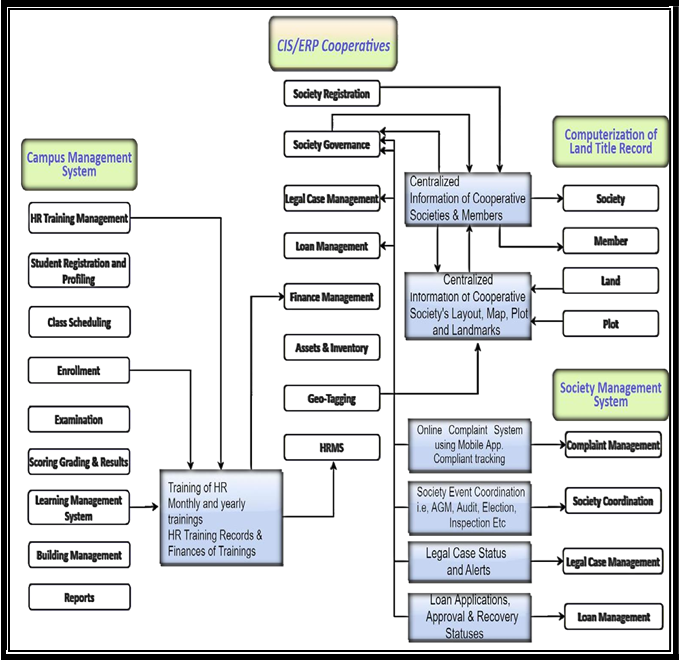
Cooperatives are autonomous, people centered and voluntary associations of persons efficaciously addressing the common economic, social, and cultural needs and aspirations of the members, aiming at their wellbeing through collective action. These organizations work democratically, in line with Cooperative Principles & Values to meet their objectives. Cooperatives have exhibited remarkable performance in almost all sectors of economic life. In housing, Cooperatives’ contribution is significant as it added to government’s affirmation of providing shelter to the shelter-less on self-help basis without any governmental financial implication. Cooperative Department Govt of Punjab has, time and again, been introducing different interventions to strengthen the Cooperative Societies so as to make them more vibrant player in national economy. Computerization of Landtitles and Records (CLTR) of Cooperative Housing Societies in Punjab is one of such initiative to ensure transparency, efficiency and strengthening of cooperative institutions through automation of processes. The focus of present study is to evaluate the working of the CLTR in institutionalizing the transparency, efficient service delivery and effective monitoring . The study, first ever of its kind, was conducted through qualitative approach by discourse analysis (organizational documents) and by semi structured interviews. The data so collected was thematically analyzed using Nvivo v 10 which indicated that implementation of this intervention was highly welcomed and is considered as a meaningful measure for enhancement in the performance of Cooperatives Department as well as of Cooperative Housing Societies as well as ensuring strengthening of the cooperative movement and creating employment opportunities in the society.
Downloads
References
Andjarwati, T., & Wulan, V. (2021). Technology transformation: Promoting sustainable Indonesia MSMEs and cooperatives by digitalization. JEJAK: Jurnal Ekonomi dan Kebijakan, 14(2), Article e31662. https://doi.org/10.15294/jejak.v14i2.31662
Anjanah, G. J., & Subhashini, S. (2024). Transformation of land records: The 21st century digital era. IJCRT Research Journal, 14(4), 50265–50273. https://doi.org/10.61359/2024050031
Astuti, Purwiyanta, & Udjianto, P. (2023). The impact of the digital economy on economic growth in Southeast Asia. International Journal of Advanced Economics, 5(1), 10–17.
Biraro, M., Zevenbergen, J., & Alemie, B. K. (2021). Good practices in updating land information systems that used unconventional approaches in systematic land registration. Land, 10, Article e437. https://doi.org/10.3390/land10040437
Borzaga, C., Calzaroni, M., Carini, C., & Lori, M. (2019). Structure and performance of Italian cooperatives: A quantitative analysis based on combined use of official data. Journal of Entrepreneurial and Organizational Diversity, 8(1), 65–83.
Boyatzis, R. E. (1998). Transforming qualitative information: Thematic analysis and code development. Sage Publications.
Bryman, A. (2004). Social research methods (2nd ed.). Oxford University Press.
Cassell, C., & Symon, G. (2006). Qualitative methods in industrial and organizational psychology. In G. P. Hodgkinson & J. K. Ford (Eds.), International review of industrial and organizational psychology 2006 (pp. 339–380). Wiley. https://doi.org/10.1002/9780470696378.ch8
Chambo, S. A. (2009, April 28–30). Agricultural co-operatives: Role in food security and rural development [Paper presentation]. Proceeding of the Expert Group Meeting on Cooperatives, United Nations, New York.
Chaudhuri, P. (2015, December 27–29). Role of digitization and e-commerce in Indian economic growth: An employment generation perspective [Paper presentation]. Proceedings of the 98th Annual Conference of the Indian Economic Association, Hyderabad, India,
Denzin, N. K., & Lincoln, Y. S. (2011). The SAGE handbook of qualitative research (4th ed.). Sage.
Hughes, A. K. (2022). Harnessing Technology to Advance Citizen-Centric Land Administration in Rwanda. African Journal of Land Policy and Geospatial Sciences, 5(2), 344–354.
Kaikini, A. A. (2020, January 23–24). Efficiency escalation in cooperatives through digitalization [Paper presentation]. Proceedings of the National Conference on Cooperatives in a Globalised Economy: Relevance, Issues and Challenges, Marcela, Goa.
Khan, S., Khan, S., & Aftab, M. (2015). Digitization and its impact on economy. International Journal of Digital Library Services, 5(2), 138–149.
Maratdaevna, S. (2019). Stages of digital economy development and problems of use of modern ICT on Uzbekistan enterprises. International Journal of Innovative Technology and Exploring Engineering, 9(2), 2097–2101.
Philippon, T. (2017). The FinTech opportunity. National Bureau of Economic Research. https://www.nber.org/system/files/working_papers/w22476/w22476.pdf
Priyowidodo, G. (2021). E-government organizational governance, policy communication and digitalization of land ownership identity. Journal of Southwest Jiaotong University, 56(4), 564–580. https://doi.org/10.35741/issn.0258-2724.56.4.48
Skurnik, S. (2002). The role of cooperative entrepreneurship and firms in organizing economic activities: Past, present and future. The Finnish Journal of Business Economics, 1(2), 103–124.
Taylor, S. A., Celuch, K., & Goodwin, S. (2004). The importance of brand equity to customer loyalty. Journal of Product & Brand Management, 13(4), 217–227.
Yilmaz, K. (2013). Comparison of quantitative and qualitative research traditions: Epistemological, theoretical, and methodological differences. European Journal of Education, 48, 311–325. https://doi.org/10.1111/ejed.12014