
Metacognitive Awareness and Academic Achievement: The Mediating Role of Students' Engagement
DOI:
https://doi.org/10.32350/uer.82.03Keywords:
academic achievement, awareness, metacognitive knowledge, secondary school students, student engagementAbstract
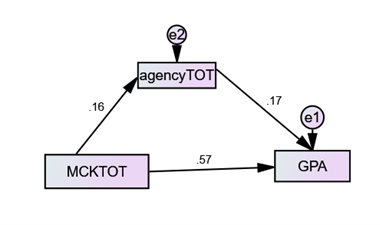
Despite an ongoing reform and improvement of education in Ethiopia, quite a significant number of secondary students have been challenged by poor academic performance, which is often exhibited in low examination results and a higher school dropout rate. The purpose of this study was to examine the role of student engagement in the relationship between metacognitive awareness and academic achievement among secondary school students. The study utilized a correlational research design. Data were collected from 180 participants (male=79; female=101) selected through simple random sampling. Metacognitive awareness inventory and student engagement scale were used as a means of data collection. Descriptive analysis, correlation, stepwise multiple regression, and mediation analysis were carried out to respond to research questions. The results of the study showed that both metacognitive knowledge and regulation portrayed a statistically significant and positive correlation with academic achievement. This suggests that students with higher levels of metacognitive awareness (knowledge and regulation) tend to achieve higher academic success. The findings also indicated that metacognitive knowledge was significant and a main predictor of academic achievement among secondary school students. Moreover, findings from mediation analysis indicated that agency partially mediated the relationship between metacognitive knowledge and academic achievement. This implies that improving students’ knowledge of cognition, connection with their school, and curiosity about their learning tasks can improve their academic achievement.
Downloads
References
Abidin, Z., Aiyub, & Jarmita, N. (2025). Correlation of mathematics achievement and metacognitive awareness of Indonesian high school students. Multidisciplinary Reviews, 9(5), Article e2026221. https://doi.org/10.31893/multirev.2026221
Al-Jarrah, T., Mansor, N., Talafhar, R., & Al-Jarrah, J. (2018). A review of research into metacognitive strategies in the process of education: Teaching and learning of English skills. International Journal of Current Research, 10(12), 76832–76838. https://doi.org/10.24941/ijcr.33608.12.20
Amerstorfer, C. M., & Freiin von Münster-Kistner, C. (2021). Student perceptions of academic engagement and student–teacher relationships in problem-based learning. Frontiers in Psychology, 12, Article e4978. https://doi.org/10.3389/fpsyg.2021.713057
Astin, A. W. (1993). Diversity and multiculturalism on the campus: How are students affected? Change: The Magazine of Higher Learning, 25(2), 44–49. https://doi.org/10.1080/00091383.1993.9940617
Baron, R. M., & Kenny, D. A. (1986). The moderator–mediator variable distinction in social psychological research: Conceptual, strategic, and statistical considerations. Journal of Personality and Social Psychology, 51(6), 1173–1182. https://doi.org/10.1037/0022-3514.51.6.1173
Chase, P. A., Hilliard, L. J., Geldhof, G. J., Warren, D. J., & Lerner, R. M. (2014). Academic achievement in the high school years: The changing role of school engagement. Journal of Youth and Adolescence, 43(6), 884–896. https://doi.org/10.1007/s10964-013-0085-4
Damayanti, A. M., Syamsiyah, N., Astuti, E., Dania, U., & Kusumaningtyas, P. (2021). The role of metacognitive skills in developing 21st century skills. Educational Studies: Conference Series, 1(1), 26–30. https://doi.org/10.30872/escs.v1i1.856
Dogan, U. (2015). Student engagement, academic self-efficacy, and academic motivation as predictors of academic performance. Anthropologist, 20(3), 553–561. https://doi.org/10.1080/09720073.2015.11891759
Dangin, D. (2020). Students’ awareness of metacognitive reading strategies in academic reading. Journal of English Teaching and Learning Issues, 3(1), 33–42. https://doi.org/10.21043/jetli.v3i1.7145
Eskandari, M., Amini, M., Delavari, S., Mokhtarpour, S., & Jaafari, M. (2020). The effect of metacognitive skills and academic motivation on academic performance. Research Sequare. https://doi.org/10.21203/rs.2.20995/v1
Ewing, R. (2020). The Australian curriculum: The arts—A critical opportunity. Curriculum Perspectives, 40, 75–81. https://doi.org/10.1007/s41297-019-00098-w
Flavell, J. H. (1979). Metacognition and cognitive monitoring: A new area of cognitive-developmental inquiry. American Psychologist, 34(10), 906–911. https://doi.org/10.1037/0003-066X.34.10.906
Fredricks, J. A., Filsecker, M., & Lawson, M. A. (2016). Student engagement, context, and adjustment: Addressing definitional, measurement, and methodological issues. Learning and Instruction, 43, 1–4. https://doi.org/10.1016/j.learninstruc.2016.02.002
Gaylo, D. N., & Dales, Z. I. (2017). Metacognitive strategies: Their effects on students’ academic achievement and engagement in mathematics. World Review of Business Research, 7(2), 35–55.
Geleta, A. (2017). School climate and student achievement in secondary schools of Ethiopia. European Scientific Journal, 13(17), 239–261. https://doi.org/10.19044/esj.2017.v13n17p239
Getachew, B. (2018). Analysis of factors affecting students’ academic performance in Gubalafto Woreda. Journal of Education and Practice, 9(4), 1–9.
Günüç, S. (2014). The relationships between student engagement and their academic achievement. International Journal on New Trends in Education and Their Implications, 5(4), 216–231.
Günüç, S., & Kuzu, A. (2014). Factors influencing student engagement and the role of technology in higher education. Turkish Online Journal of Qualitative Inquiry, 5(4), 86–113. https://doi.org/10.17569/tojqi.44261
Horvathova, M. (2021). Study on employability skills in the IB diploma programme. Center for Curriculum Redesign.
Hughes, A. J. (2017). Educational complexity and professional development: Teachers’ need for metacognitive awareness. Journal of Technology Education, 29(1), 25–44. https://doi.org/10.21061/jte.v29i1.a.2
Iqbal, S., Akram, R., Gohar, B., Mahmood, A., Naz, N., & Mudasar, S. (2019). Metacognitive awareness and academic achievement of medical students in Lahore. International Journal of Contemporary Medical Research, 6(9), 14–18. https://doi.org/10.21276/ijcmr.2019.6.9.32
Kim, E., & Hargrove, D. T. (2013). Deficient or resilient: A review of Black male academic success. The Journal of Negro Education, 82(3), 300–311. https://doi.org/10.2307/3516060
Kisac, I., & Budak, Y. (2014). Metacognitive strategies of university students. Procedia—Social and Behavioral Sciences, 116, 3336–3339. https://doi.org/10.1016/j.sbspro.2014.01.759
Krejcie, R. V., & Morgan, D. W. (1970). Determining sample size for research activities. Educational and Psychological Measurement, 30(3), 607–610. https://doi.org/10.1177/001316447003000308
Kuh, G. D. (2009). What student affairs professionals need to know about student engagement. Journal of College Student Development, 50(6), 683–706. https://doi.org/10.1353/csd.0.0099
Lei, H., Cui, Y., & Zhou, W. (2018). Relationships between student engagement and academic achievement: A meta-analysis. Social Behavior and Personality, 46(3), 517–528. https://doi.org/10.2224/sbp.7054
Li, Y., & Lerner, R. M. (2011). Trajectories of school engagement during adolescence. Developmental Psychology, 47(1), 233–247. https://doi.org/10.1037/a0021307
Levchyk, I., Adamska, Z., & Yankovych, O. (2022). Formation of sustainable development competencies. International Journal of Sustainability in Higher Education, 25(4), 744–766. https://doi.org/10.1108/IJSHE-07-2023-0306
Molenberghs, P., Trautwein, F. M., Böckler, A., Singer, T., & Kanske, P. (2016). Neural correlates of metacognitive ability. Social Cognitive and Affective Neuroscience, 11(12), 1942–1951. https://doi.org/10.1093/scan/nsw093
Muturi, G. G., Mwaniki, E. W., & Mutua, J. (2025). Metacognitive strategies as a predictor of mathematics performance. Interdisciplinary Education and Psychology, 4(1), Article e5.
Mwangi, E. W., Mwaniki, E. W., & Mutua, J. N. (2024). Metacognition as a correlate of academic achievement. Psychology, 4(1), Article e2.
Ohamobi, I. N., & Ezeaku, S. N. (2018). Student engagement variables as correlates of achievement. International Journal of Science and Research, 5(5), 473–478. https://doi.org/10.21275/v5i5.6051602
Owo, W. J., & Ikwut, E. F. (2015). Relationship between metacognition and academic achievement. IOSR Journal of Research & Method in Education, 5(6), 6–12.
Reeve, J., & Lee, W. (2014). Students’ classroom engagement and motivation. Journal of Educational Psychology, 106(2), 527–540. https://doi.org/10.1037/a0034934
Rivas, S. F., Saiz, C., & Ossa, C. (2022). Metacognitive strategies and critical thinking. Frontiers in Psychology, 13, Article e913219. https://doi.org/10.3389/fpsyg.2022.913219
Rodgers, T., & Ghosh, D. (2001). Determinants of quality in UK higher education. Quality Assurance in Education, 9(3), 121–126. https://doi.org/10.1108/09684880110399059
Schraw, G., & Dennison, R. S. (1994). Assessing metacognitive awareness. Contemporary Educational Psychology, 19, 460–475. https://doi.org/10.1006/ceps.1994.1033
Scott, B. M., & Berman, A. F. (2013). Examining the domain-specificity of metacognition. Australian Journal of Educational & Developmental Psychology, 13, 28–43.
Scott, C. (2015). The futures of learning 3: What kind of pedagogies for the 21st century. UNESDOC Digital Library. https://hdl.handle.net/20.500.12799/3747
Schunk, P. (2017). Self-sufficient learners make successful workers. In Talent Development, 71(4), 42–46.
Stangor, C. (2011). Research methods for the behavioral sciences. Cengage.
Tadesse, T., & Edo, B. (2021). Student engagement and learning outcomes. Journal of Applied Research in Higher Education, 13(1), 48–62. https://doi.org/10.1108/JARHE-01-2019-0017
Teferra, T., Asgedom, A., Oumer, J., Dalelo, A., & Assefa, B. (2018). Ethiopian education development roadmap. Ministry of Education Strategy Center.
Tessema, M. G., & Rao, T. (2018). University students’ engagement. International Journal of Research in Humanities, Arts and Literature, 6(12), 193–202.
Veiga, F. H. (2016). Assessing student engagement in school. Procedia—Social and Behavioral Sciences, 217, 813–819. https://doi.org/10.1016/j.sbspro.2016.02.153
Wang, M. T., & Eccles, J. S. (2012). Adolescent engagement trajectories. Journal of Research on Adolescence, 22(1), 31–39. https://doi.org/10.1111/j.1532-7795.2011.00753.x
Wara, E., Aloka, P. J., & Odongo, B. C. (2018). Emotional engagement and academic achievement. Academic Journal of Interdisciplinary Studies, 7(1), 107–118. https://doi.org/10.2478/ajis-2018-0011
Woolfolk, A., & Kapur, P. (2019). Educational psychology. Pearson.
Xie, Y., Zeng, F., & Yang, Y. (2024). Relationship between metacognition and academic achievement in mathematics. Acta Psychologica, 249, Article e104486. https://doi.org/10.1016/j.actpsy.2024.104486
York, T. T., Gibson, C., & Rankin, S. (2015). Defining and measuring academic success. Practical Assessment, Research, and Evaluation, 20(1), Article e5. https://doi.org/10.7275/hz5x-tx03
Zhao, L., & Mo, S. (2016). The impact of metacognitive awareness on class performance. Academy of Educational Leadership Journal, 20(2), 78–88.
Published
How to Cite
Issue
Section
License

This work is licensed under a Creative Commons Attribution 4.0 International License.
UER follows an open-access publishing policy and full text of all published articles is available free, immediately upon publication of an issue. The journal’s contents are published and distributed under the terms of the Creative Commons Attribution 4.0 International (CC-BY 4.0) license. Thus, the work submitted to the journal implies that it is original, unpublished work of the authors (neither published previously nor accepted/under consideration for publication elsewhere). On acceptance of a manuscript for publication, a corresponding author on the behalf of all co-authors of the manuscript will sign and submit a completed Copyright and Author Consent Form.
Copyright (c) The Authors