Examining Sexual Orientation Subtypes and Their Moderating Effects Among Transgender Individuals in Pakistan
DOI:
https://doi.org/10.32350/ccpr.81.01Keywords:
Gender Dysphoria, Gender Nonconforming, Mental Health Outcomes, Minority Stress, Sexual OrientationAbstract
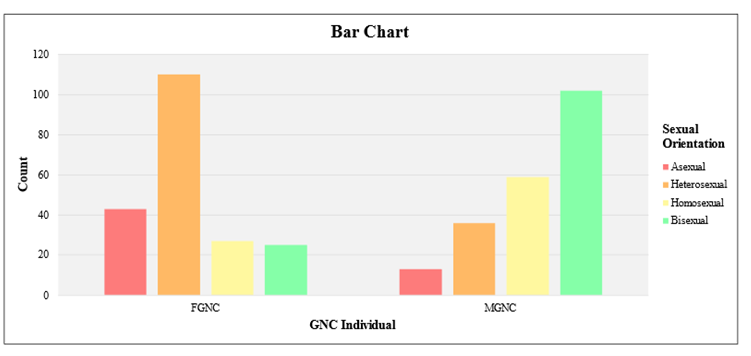
The purpose of the study was to examine gender nonconforming (GNC) individuals in Pakistan with regards to their mental health outcomes while exploring the moderating role of sexual orientation within the Gender Minority Stress and Resilience (GMSR) framework. A total of 420 individuals made up the sample including 205 female gender nonconforming (FGNC) individuals (M=25.93, SD = 6.31), and 215 male gender nonconforming (MGNC) individuals (M = 22.68, SD= 5.40). Higher levels of gender dysphoria and childhood non-conforming behavior was reported by FGNC participants as compared to their MGNC peers. Sex assigned at birth demarcated sexual orientation, wherein FGNC participants were mostly labelled as heterosexual or asexual, while MGNC participants were generally identified as bisexual or homosexual. Moderation analyses highlighted that the negative impacts of gender dysphoria on mental health outcomes are often shielded by heterosexual orientation, whereas asexual orientation was linked with better quality of life and reduced anxiety across both groups. Homosexual and bisexual orientations, however, in contrast, were associated with greater vulnerability, exhibiting the compounding effects of multiple minority stressors. These findings highlight the interplay of gender identity and sexual orientation in forming psychosocial outcomes among GNC populations. The results emphasize the value of culturally tailored assessment tools and interventions which cater for both distal and proximal minority stressors. Augmenting resilience through individual, family, and community-level backing can enhance quality of life and mental health for gender nonconforming individuals. Recognizing sexual orientation as a key moderator within the minority stress process is critical for developing inclusive, evidence-based frameworks that are attuned to Pakistan’s sociocultural context.
Downloads
References
American Psychiatric Association. (2022). Diagnostic and statistical manual of mental disorders (5th ed., text rev.; DSM-5-TR). American Psychiatric Association Publishing. https://doi.org/10.1176/appi.books.9780890425787
American Psychological Association. (2017). Ethical principles of psychologists and code of conduct. https://www.apa.org/ethics/code
Aslam, N. (2009). Urdu translation of the DASS21 [Measurement instrument]. National Institute of Psychology, Quaid-i-Azam University. https://dass.psy.unsw.edu.au/Urdu/Aslam.htm
Bariola, E., Lyons, A., Leonard, W., Pitts, M., Badcock, P., & Couch, M. (2015). Demographic and psychosocial factors associated with psychological distress and resilience among transgender individuals. American Journal of Public Health, 105(10), 2108–2116. https://doi.org/10.2105/AJPH.2015.302763
Bouman, W. P., Claes, L., Brewin, N., Crawford, J. R., Millet, N., Fernandez-Aranda, F., & Arcelus, J. (2017). Transgender and anxiety: A comparative study between transgender people and the general population. International Journal of Transgenderism, 18(1), 16–26. https://doi.org/10.1080/15532739.2016.1258352
Breslow, A. S., Brewster, M. E., Velez, B. L., Wong, S., Geiger, E., & Soderstrom, B. (2015). Resilience and collective action: Exploring buffers against minority stress for transgender individuals. Psychology of Sexual Orientation and Gender Diversity, 2(3), 253–265. https://doi.org/10.1037/sgd0000117
Brislin, R. W. (1970). Back-translation for cross-cultural research. Journal of Cross-Cultural Psychology, 1(3), 185–216. https://doi.org/10.1177/135910457000100301
Coghlan, K. P. (2024). Sexual minority stress, structural stigma, and intersectional identities: An interpretive phenomenological analysis (Publication no. 30992700). ProQuest Dissertations & Theses.
Coleman, E., Radix, A. E., Bouman, W. P., Brown, G. R., de Vries, A. L. C., Deutsch, M. B., Ettner, R., Fraser, L., Goodman, M., Green, J., Hancock, A. B., Johnson, T. W., Karasic, D. H., Knudson, G. A., Leibowitz, S. F., Meyer-Bahlburg, H. F. L., Monstrey, S. J., Motmans, J., Nahata, L., . . . Arcelus, J. (2022). Standards of care for the health of transgender and gender diverse people, Version 8. International Journal of Transgender Health, 23(Suppl. 1), S1–S259. https://doi.org/10.1080/26895269.2022.2100644
Dennis, M. T., & Davis, C. G. (2026). Out of sight but on my mind: Distal stressors, identity concealment, proximal stress, and mental health among sexual or gender minorities. Sexuality Research and Social Policy, 23(1), 153–168. https://doi.org/10.1007/s13178-025-01131-6
Fatima, A., & Jami, H. (2025). Experiences of transformation: The challenges of gender transition for transgender women in Pakistan. Archives of Sexual Behavior, 54(4), 1375–1390. https://doi.org/10.1007/s10508-025-03098-2
Fatima, A., Jami, H., & Muzzaffer, K. (2022). Translation and validation of Gender Minority Stress & Resilience Scale. Pakistan Journal of Social Research, 4(3), 530–540. https://doi.org/10.52567/pjsr.v4i03.743
Fazeel, M., Gill, Q. S., & Mustafa, G. (2024). Transgender rights in Pakistan: Navigating legal framework, practices and challenges. Global Legal Studies Review, 9(2), 1–13. https://doi.org/10.31703/glsr.2024(IX-II).01
Feinstein, B. A. (2020). The rejection sensitivity model as a framework for understanding sexual minority mental health. Archives of Sexual Behavior, 49, 2247–2258. https://doi.org/10.1007/s10508-019-1428-3
Fine, S. L., Willis, K., Lucas, I. L., Siebach, K. F., Glick, J. L., Valentine-Graves, M., Winter, S., Smith, M., Waltz, T., Herring, G. B., Hannah, M., Wilcox, H. C., Sanchez, T., Baral, S. D., & Murray, S. M. (2025). Investigating mental health disparities in rural sexual and gender minority adults: Protocol for the rural exploration and approaches to LGBTQ+ mental health (REALM) prospective cohort study. BMC Public Health, 25, Article e487. https://doi.org/10.1186/s12889-024-21151-y
Hossain, M. I., & Ferdous, G. K. (2020). Social exclusion of transgender people in Bangladesh: Implication for social work practice. In Conference proceedings on social work and sustainable development (pp. 89–109). https://doi.org/10.13140/RG.2.2.28700.94088
Irshad, U., Hashmi, A. M., & Aamer, I. (2020). Between a rock and a hard place: Gender dysphoria and comorbid depression in a young, low-income individual. Cureus, 12(9), Article e10205. https://doi.org/10.7759/cureus.10205
Jones, A. K., Wehner, C. L., Andrade, I. M., Jones, E. M., Wooten, L. H., & Wilson, L. C. (2024). Minority stress and posttraumatic growth in the transgender and nonbinary community. Psychology of Sexual Orientation and Gender Diversity, 11(3), 488–497. https://doi.org/10.1037/sgd0000610
Khalid, A., & Kausar, R. (2006). Quality of life in patients with schizophrenia in Pakistan. Pakistan Journal of Psychological Research, 21(3–4), 121–136.
Lodhi, F. S., Raza, O., Montazeri, A., Nedjat, S., Yaseri, M., & Holakouie-Naieni, K. (2017). Psychometric properties of the Urdu version of the World Health Organization’s quality of life questionnaire (WHOQOL-BREF). Medical Journal of the Islamic Republic of Iran, 31, 853–859. https://doi.org/10.14196/mjiri.31.129
Lovibond, S. H., & Lovibond, P. F. (1995). Manual for the Depression Anxiety Stress Scales (2nd ed.). Psychology Foundation.
Manzoor, I., Khan, Z. H., Tariq, R., & Shahzad, R. (2022). Health problems and barriers to healthcare services for the transgender community in Lahore, Pakistan. Pakistan Journal of Medical Sciences, 38(1), 138–144. https://doi.org/10.12669/pjms.38.1.4375
Meyer, I. H. (2015). Resilience in the study of minority stress and health of sexual and gender minorities. Psychology of Sexual Orientation and Gender Diversity, 2(3), 209–213. https://doi.org/10.1037/sgd0000132
Miller-Perusse, M., Horvath, K. J., Kahle, E., & Stephenson, R. (2024). Gender minority stress, resilience, and psychological distress: The role of resilience among transgender and gender diverse youth. Transgender Health, 9(4), 307–316. https://doi.org/10.1089/trgh.2022.0117
Najafipour, M., & Najafipour, F. (2018). Transsexualism in Iran. International Journal of Scientific & Engineering Research, 9(1), 1–5. https://www.ijser.org/researchpaper/Transsexualism-in-Iran.pdf
Puckett, J. A., DuBois, L. Z., Kimball, D., Huynh, K., & McCauley, H. L. (2025). Development and validation of novel measures of gender minority stress for transgender and nonbinary people. International Journal of Transgender Health, 27(2), 795–813. https://doi.org/10.1080/26895269.2024.2447756
Redding, J. A. (2019). The Pakistan Transgender Persons (Protection of Rights) Act of 2018 and its impact on the law of gender in Pakistan. Australian Journal of Asian Law, 20(1), 103–126.
Riaz, A., Kamal, S., & Butt, N. S. (2013). Psychometric analysis of depression, anxiety and stress among women of Wazirabad City. Caspian Journal of Applied Sciences Research, 2(10), 61–68. https://doi.org/10.2139/ssrn.2485173
Roberts, C. E. (2020). Emotional experiences of transgender individuals undergoing medical transitioning (Publication no. 28023998). ProQuest Dissertations & Theses.
Sell, R. L. (1996). The Sell Assessment of Sexual Orientation: Background and scoring. Journal of Gay, Lesbian, and Bisexual Identity, 1(4), 295–310. https://doi.org/10.1007/BF03372244
Singh, D., Deogracias, J. J., Johnson, L. L., Bradley, S. J., Kibblewhite, S. J., Owen-Anderson, A., & Zucker, K. J. (2010). The Gender Identity/Gender Dysphoria Questionnaire for Adolescents and Adults: Further validity evidence. The Journal of Sex Research, 47(1), 49–58. https://doi.org/10.1080/00224490902898728
van der Star, A. (2024). The socioecology of sexual minority stigma: Advancing theory on stigma-based mechanisms underlying sexual orientation-based disparities in health. Social Science & Medicine, 363, Article e117484. https://doi.org/10.1016/j.socscimed.2024.117484
Szymanski, D. M., & Mikorski, R. (2016). External and internalized heterosexism, meaning in life, and psychological distress. Psychology of Sexual Orientation and Gender Diversity, 3(3), 265–274. https://doi.org/10.1037/sgd0000182
Testa, R. J., Habarth, J., Peta, J., Balsam, K., & Bockting, W. (2015). Development of the Gender Minority Stress and Resilience Measure. Psychology of Sexual Orientation and Gender Diversity, 2(1), 65–77. https://doi.org/10.1037/sgd0000081
The WHOQOL Group. (1998). Development of the World Health Organization WHOQOL-BREF quality of life assessment. Social Science & Medicine, 46(12), 1569–1585. https://doi.org/10.1016/S0277-9536(98)00009-4
United Nations. (2020). Report of the Independent Expert on protection against violence and discrimination based on sexual orientation and gender identity (A/75/258). https://digitallibrary.un.org/record/3883083/files/A_75_258-EN.pdf
Wilson, L. C., Newins, A. R., Kassing, F., & Casanova, T. (2024). Gender minority stress and resilience measure: A meta-analysis of the associations with mental health in transgender and gender diverse individuals. Trauma, Violence, & Abuse, 25(3), 2552–2564. https://doi.org/10.1177/15248380231218288
World Health Organization. (1998). Programme on mental health: WHOQOL user manual (WHO/MNH/MHP/98.3). https://iris.who.int/handle/10665/77932
Zucker, K. J. (2018). Epidemiology of gender dysphoria and transgender identity. Sexual Health, 15(5), 404–411. https://doi.org/10.1071/SH18023
Zucker, K. J., Mitchell, J. N., Bradley, S. J., Tkachuk, J., Cantor, J. M., & Allin, S. M. (2006). The recalled childhood gender identity/gender role questionnaire: Psychometric properties. Sex Roles, 54(7–8), 469–483. https://doi.org/10.1007/s11199-006-9019-x
Downloads
Published
How to Cite
Issue
Section
License
Copyright (c) 2026 Arooj Fatima, Humaira Jami, Uzma Ilyas

This work is licensed under a Creative Commons Attribution 4.0 International License.
CCPR follows an open-access publishing policy and full text of all published articles is available free, immediately upon publication of an issue. The journal’s contents are published and distributed under the terms of the Creative Commons Attribution 4.0 International (CC-BY 4.0) license. Thus, the work submitted to the journal implies that it is original, unpublished work of the authors (neither published previously nor accepted/under consideration for publication elsewhere). On acceptance of a manuscript for publication, a corresponding author on the behalf of all co-authors of the manuscript will sign and submit a completed the Copyright and Author Consent Form.