Enhancing English Language Skills Through Audio-Visual Technology in Higher Education: A Sequential Exploratory Study
DOI:
https://doi.org/10.32350/jarms.72.02Keywords:
audio-visual aids, cognitive theory, ELT pedagogy, higher education, mixed-methods, PakistanAbstract
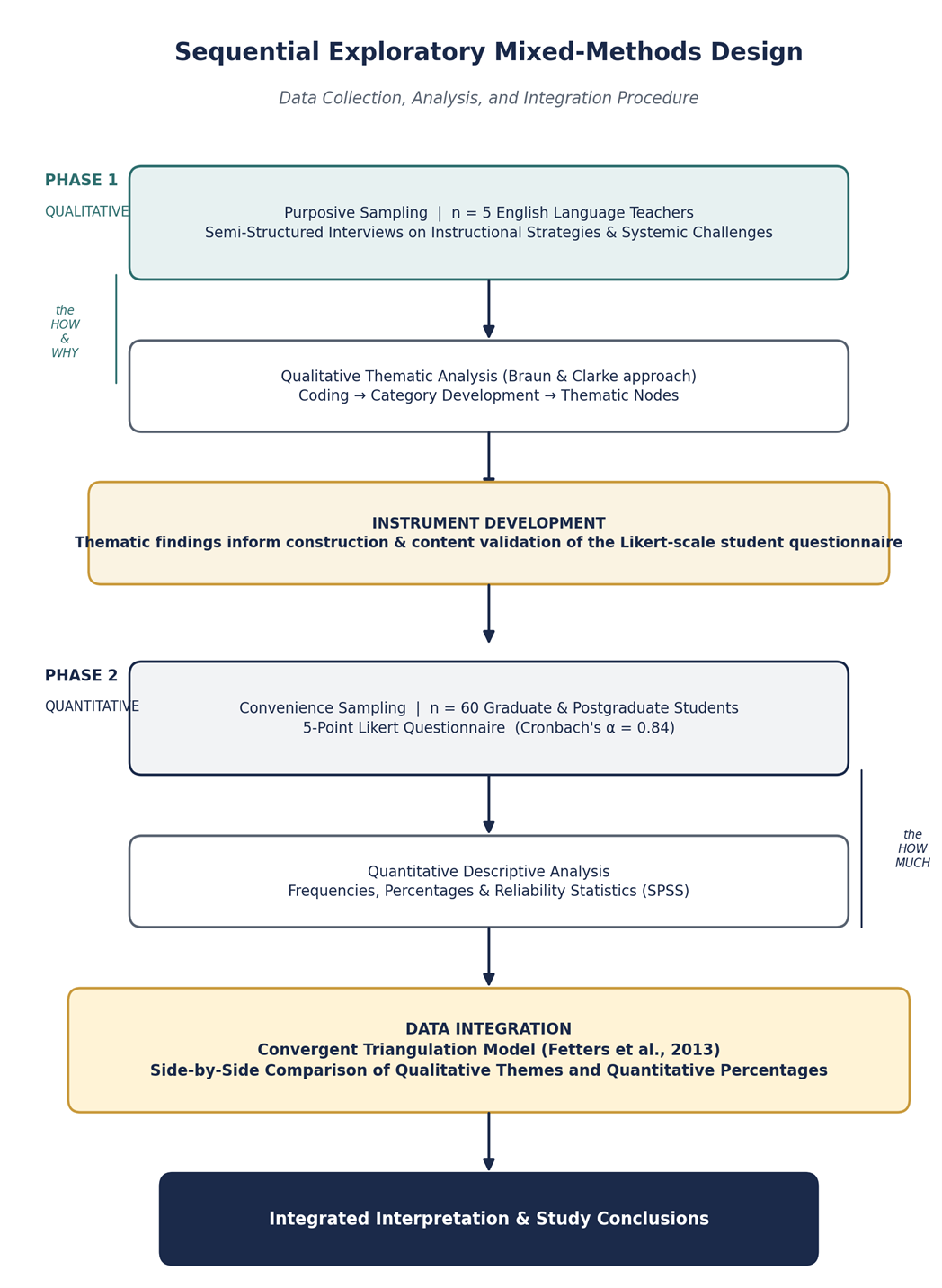
This study examines the perceived effectiveness of audio-visual (AV) materials in enhancing English language skills among university students in Lahore, Pakistan. This research takes a sequential exploratory mixed-methods approach, where the researcher first collects data using a qualitative approach with a descriptive design, and then a quantitative approach with an experimental design. The initial phase involved a qualitative analysis of five English language teachers' responses gathered through semi-structured interviews. A qualitative phase comprising of interviews was followed by a quantitative phase with 60 graduate and postgraduate students. Thematic analysis was used to analyse the qualitative data, and descriptive statistics were used for quantitative data. The results showed that AV supports were found to have a significant impact on improving learner engagement, comprehension and motivation in all four language skills. Students reported that multimedia tools provided better learning that was more accessible and interactive. The study also found no environmental benefits for the participants, when compared with the traditional teaching approach. However, the study shows that the usefulness of these tools relies greatly on the competence of the teacher and the pedagogical use of them. The study suggests that AV aids are very useful supplementary tools, but not substitutes for the conventional textbook.
Downloads
References
Ahmed, T., Shafi, S., & Mahmood, H. (2024). Enhancing vocabulary acquisition in EFL classes: The effectiveness of audio-visual aids. Annals of Human and Social Sciences, 5(2), 711–724. https://doi.org/10.35484/ahss.2024(5-II-S)67
Al Aqad, M. H., Al-Saggaf, M. A., & Muthmainnah, M. (2021). The impact of audio-visual aids on learning English among MSU third-year students. English Franca: Academic Journal of English Language and Education, 5(2), 201–214. https://doi.org/10.29240/ef.v5i2.3329
Az-Zuhriyah, A., & Irmayani, I. (2025). Audiovisual media in EFL listening: A meta-analysis of 21st century learning resources. Jurnal Ilmu Pendidikan dan Humaniora, 14(3), 247–257. https://doi.org/10.35335/jiph.v14i3.208
Boone, H. N., Jr., & Boone, D. A. (2012). Analyzing Likert data. Journal of Extension, 50(2), Article e48. https://doi.org/10.34068/joe.50.02.48
Creswell, J. W., & Creswell, J. D. (2018). Research design: Qualitative, quantitative, and mixed methods approaches (5th ed.). SAGE Publications.
Etikan, I., Musa, S. A., & Alkassim, R. S. (2016). Comparison of convenience sampling and purposive sampling. American Journal of Theoretical and Applied Statistics, 5(1), 1–4. https://doi.org/10. 11648/j.ajtas.20160501.11
Fetters, M. D., Curry, L. A., & Creswell, J. W. (2013). Achieving integration in mixed methods designs—Principles and practices. Health Services Research, 48(6 Pt 2), 2134–2156. https://doi.org/ 10.1111/1475-6773.12117
Flick, U. (2023). An introduction to qualitative research (7th ed.). SAGE Publications. https://doi.org/10.4135/9781036231712
George, D., & Mallery, P. (2024). IBM SPSS Statistics 29 step by step: A simple guide and reference (18th ed.). Routledge. https://doi.org/10.4324/9781032622156
Greene, J. C. (2007). Mixed methods in social inquiry. Jossey-Bass.
Guetterman, T. C., Fetters, M. D., & Creswell, J. W. (2015). Integrating quantitative and qualitative results in health science mixed methods research through joint displays. The Annals of Family Medicine, 13(6), 554–561. https://doi.org/10.1370/afm.1865
Hamzah, M. H., Jeryo, R. A., & Obaid, H. M. (2024). The impact of using audio-visual aids and authentic materials on learners’ performance in English classes. Manar Elsharq Journal for Literature and Language Studies, 2(2), 19–25. https://doi.org/10.56961/mejlls.v2i2.650
Hossain, K. I. (2024). Reviewing the role of culture in English language learning: Challenges and opportunities for educators. Social Sciences & Humanities Open, 9, Article e100781. https://doi.org/10.1016/ j.ssaho.2023.100781
Khan, I. U., & Shah, L. H. (2024). Role of English textbooks in language skills development: A case study of Khyber Pakhtunkhwa. Pakistan Languages and Humanities Review, 8(3), 339–347. https://doi.org/10.47205/plhr.2024(8-III)31
Maulida, S., & Hadi, M. S. (2022). Using audio visual media to improve English learning outcomes. Jurnal Studi Guru dan Pembelajaran, 5(1), 11–15. https://doi.org/10.30605/jsgp.5.1.2022.1297
Nasab, Z. H., & Rahimi, M. (2023). The impact of multimedia-enhanced STEAM activities on foreign language learners’ development of oracy skills and willingness to communicate. Bulletin of Education and Research, 45(2), 67–92.
Nuraini, R., Rambe, M. S., Irwanto, I., Moha, L., & Fiidznillah, R. (2024). The effectiveness of the use of audio visual as a learning media for speaking skills and reading skills of Tsanawiyah students. Lughawiyah: Journal of Arabic Education and Linguistics, 6(1), 81–99. https://doi.org/10.31958/lughawiyah.v6i1.13176
Oktapiani, I. U., Ilham, I., Humaira, H., Bafadal, F., Adebayo, M., & Fasih, P. (2024). The effectiveness of English-subtitled videos in enhancing speaking, listening and vocabulary skills: A meta-analysis. Journal of Languages and Language Teaching, 12(1), 56–71. https://doi.org/ 10.33394/jollt.v12i1.9501
Patton, M. Q. (2015). Qualitative research & evaluation methods: Integrating theory and practice (4th ed.). SAGE Publications.
Priya, P., Sharma, S., Shanampoodi, G. B., Rajeswari, T. S., Sri Nidhya, G., & Srikanta, M. (2025). Role of technology-based audio-visual aids in English language teaching. South Eastern European Journal of Public Health, 25(S2), 4169–4176.
Qadeer, M., Naz, S., Waseem, S., & Asghar, Z. (2024). Technological lag in Pakistan’s education system. International Research Journal of Arabic and Islamic Studies, 4(1), 167–182.
Rahmanu, I. W. E. D., & Molnár, G. (2024). Multimodal immersion in English language learning in higher education: A systematic review. Heliyon, 10(19), Article e38357. https://doi.org/10.1016/ j.heliyon.2024.e38357
Sánchez-Auñón, E., Férez-Mora, P. A., & Monroy-Hernández, F. (2023). The use of films in the teaching of English as a foreign language: A systematic literature review. Asian-Pacific Journal of Second and Foreign Language Education, 8(1), Article e10. https://doi.org/10.1186/s40862-022-00183-0
Scheel, L., Vladova, G., & Ullrich, A. (2022). The influence of digital competences, self-organization, and independent learning abilities on students’ acceptance of digital learning. International Journal of Educational Technology in Higher Education, 19(1), Article e44. https://doi.org/10.1186/s41239-022-00350-w
Serrano, R. (2023). Extensive reading and science vocabulary learning in L2: Comparing reading-only and reading-while-listening. Education Sciences, 13(5), Article e493. https://doi.org/10.3390/educsci13050493
Shannon-Baker, P. (2016). Making paradigms meaningful in mixed methods research. Journal of Mixed Methods Research, 10(4), 319–334. https://doi.org/10.1177/1558689815575861
Snigdha, S. S., & Akter, M. (2023). Effectiveness of audio-visual materials in teaching reading for young EFL learners in Bangladesh: An experimental study. EIKI Journal of Effective Teaching Methods, 1(4), 65–82. https://doi.org/10.59652/jetm.v1i4.84
Ulya, N. L., & Saraswati, G. P. D. (2026). EFL university students’ perceptions of TED Talks as authentic materials for listening comprehension: A qualitative descriptive study. FOSTER: Journal of English Language Teaching, 7(1), 208–224. https://doi.org/10. 24256/foster-jelt.v7i1.342
Wang, Y., Yasmin, F., & Akbar, A. (2023). Impact of the internet on English language learning among university students: Mediating role of academic self-efficacy. Frontiers in Psychology, 14, Article e1184185. https://doi.org/10.3389/fpsyg.2023.1184185
Wong, W. L., Muhammad, M. M., Ya Shak, M. S., Abdul Rahman, M., Lee, M. C., & Pandian, V. (2024). Employing the smart interactive whiteboard to teach guided writing vocabulary. Issues in Language Studies, 13(1), 112–130. https://doi.org/10.33736/ils.5643.2024
Downloads
Published
How to Cite
Issue
Section
License
Copyright (c) 2026 Shelva Shareen

This work is licensed under a Creative Commons Attribution 4.0 International License.