
BIM-based Energy Efficiency Analysis on Regional Architecture of Pakistan
DOI:
https://doi.org/10.32350/jaabe.91.04Keywords:
building information modelling, energy analysis, insight360, revitAbstract
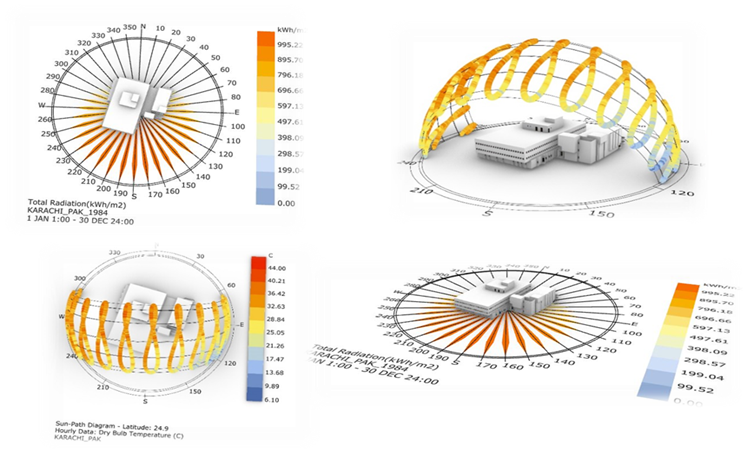
Adopting sustainable building practices is necessary due to Pakistan's growing energy demand and environmental concerns. The building structure must guarantee occupant safety. Furthermore, it should also ensure effective, thermal, and visual comfort. However, the buildings usually lack the above parameters. Therefore, there is a considerable need to use sustainable design techniques, especially in Asian countries. The current study investigated the application of Building Information Modelling (BIM) for energy efficiency analysis in Pakistani regional architecture. Additionally, the study analyzed the building of Shell House, Karachi and its head office as well as the warehouse building in Vehari through different software. These included Formit Pro, Revit, Insight360, and Ladybug. The study looked at how BIM-based simulation tools can be used to optimize climate-responsive design elements, such as orientation, materials, shading, and natural ventilation. Several design scenarios were assessed in various climatic zones using energy modeling platforms to determine their effects on thermal performance and energy consumption. The findings showed that combining BIM with passive design techniques can greatly lower energy consumption and enhance building performance. The study emphasized how traditional architectural knowledge and contemporary digital technologies can be combined to create sustainable, energy-efficient solutions that are specific to Pakistani regional contexts.
Downloads
References
Ahmad, K., & Butt, S. B. (2014). A simulated case study of an office building in Pakistan to improve energy efficiency. International Journal of Engineering and Advanced Technology, 4(2), 7–9.
Ahsan, M. M. (2019). Reducing the operational energy consumption in buildings by passive cooling techniques using building information modelling tools. International Journal of Renewable Energy Research, 9(1), 343–353.
Alam, M. J. (2014, December 25–26). Energy simulation to estimate building energy consumption using EnergyPlus [Paper presentation]. Proceedings of International Conference on Mechanical, Industrial and Energy Engineering Khulna, Bangladesh.
Bhatti, O. S., & Iftakhar, N. (2023). Sustainable built environmental design optimization of renewable energy resources to reduce climate change burden: A case of solar energy in selected educational institutions in Islamabad. Journal of ISOSS, 9(1), 163–182.
Borrmann, A., König, M., Koch, C., & Beetz, J. (2004). Virtual building environments (VBE). Lawrence Berkeley National Laboratory, University of California. https://simulationresearch.lbl.gov/sites/all/files/56072.pdf
Gondal, I. A., Syed Athar, M., & Khurram, M. (2021). Role of passive design and alternative energy in building energy optimization. Indoor and Built Environment, 30(2), 278–289. https://doi.org/10.1177/1420326X19887486
Khan, M. S., Adil, M., Khalil, F., & Jamil, I. (2018, October 24–25). BIM Based Energy Simulation for Assessment of Buildings: Energy Wastage for Pakistan [Paper presentation]. Proceedings of the 4th Conference on Sustainability in Process Industry, Peshawar, Pakistan.
Khan, F., Bhatti, O. S., Mujahid, S., & Nadeem, H. M. A. (2024). Sustainable building envelopes: A solution for energy crisis in buildings in Pakistan. International Journal of Social Science Archives, 7(2), 594–602.
Kymmell, W. (2007). Top criteria for BIM solutions. McGraw-Hill.
León, I., Sagarna, M., Mora, F., & Otaduy, J. P. (2021). BIM application for sustainable teaching environment and solutions in the context of COVID-19. Sustainability, 13(9), Article e4746. https://doi.org/10.3390/su13094746
Masood, R., Kharal, M. K. N., & Nasir, A. R. (2014). Is BIM adoption advantageous for construction industry of Pakistan? Procedia Engineering, 77, 229–238.
Salahuddin, S., Bhatti, O. S., Chauhan, M. K., & Jaffri, Y. A. (2024). Why BIM is not standardized by LDA for submission documentation? A review. International Journal of Politics Social Sciences Review, 3(3), 44–54.
Shoaib, A., & Islam, H. S. (2024). Urban sustainability and green spaces: A comprehensive analysis of spatiotemporal variations and residents' perspective in Lahore, Pakistan. Journal of Geovisualization and Spatial Analysis, 8(2), Article e28. https://doi.org/10.1007/s41651-024-00190-4
Wang, S. (2006). Parameter estimation of internal thermal mass of building dynamic models using genetic algorithms. Energy Conversion and Management, 47(13–14), 1927–1941. https://doi.org/10.1016/j.enconman.2005.09.011
Wang, S. (2011). New concepts and approach for developing energy-efficient buildings: Ideal specific heat for building internal thermal mass. Energy and Buildings, 43(5), 1081–1090. https://doi.org/10.1016/j.enbuild.2010.08.035
Downloads
Published
How to Cite
Issue
Section
License
Copyright (c) 2026 Rifza Zahid, Muhammad Gulraiz Zahid Awan, Umair Hassan

This work is licensed under a Creative Commons Attribution 4.0 International License.
JAABE follows an open-access publishing policy and full text of all published articles is available free, immediately upon publication of an issue. The journal’s contents are published and distributed under the terms of the Creative Commons Attribution 4.0 International (CC-BY 4.0) license. Thus, the work submitted to the journal implies that it is original, unpublished work of the authors (neither published previously nor accepted/under consideration for publication elsewhere). On acceptance of a manuscript for publication, a corresponding author on the behalf of all co-authors of the manuscript will sign and submit a completed Copyright and Author Consent Form.
Copyright (c) The Authors