
Antimicrobial Activity of Spunlace Nonwovens 100% Bleached Cotton Fabric, Against Selected Pathogenic Microorganisms
DOI:
https://doi.org/10.32350/sir.101.04Keywords:
anti-microbial, non-woven fabrics, Salmonella, Staphylococcus aureusAbstract
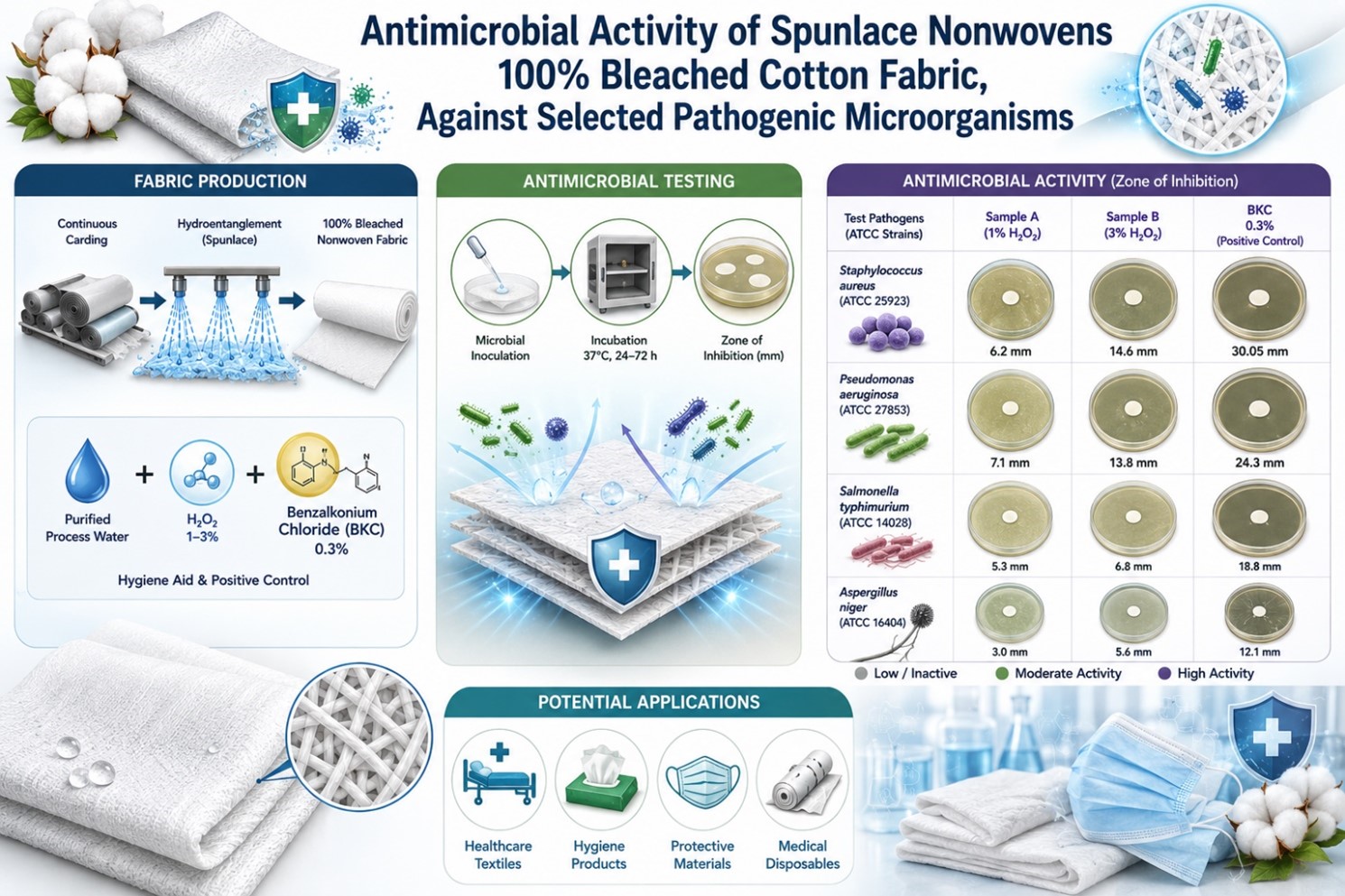
The development of antibacterial textiles has attracted an increasing attention due to growing demands for hygienic and protective materials in medical and cosmetic applications. Nonwoven fabrics are widely used in hygiene and medical applications where antibacterial performance is critical for controlling microbial contamination. Unlike previous studies that investigated mechanically antimicrobial coating and chemically treating the fabrics for disinfection, this study evaluated the intrinsic antimicrobial property against some specific pathogenic microbes in industrially produced bleached nonwoven fabrics. Therefore, the objective of this study was to evaluate the antimicrobial activity of the nonwoven fabrics using standard antimicrobial testing method against selected bacterial and fungal strains. In this study, 100% bleached cotton Spunlace nonwovens fabric was produced by continuous carding and hydroentanglement without binders. For this purpose, purified processed water and hydrogen peroxide (H2O2) (1–3 %) were used solely as a hygiene aid, with Benzalkonium Chloride (BKC, 0.3 %) as a positive antimicrobial control. The resulting uniform, defect-free fabrics provided a controlled platform for systematic evaluation of inherent and comparative antibacterial performance. American Type Culture Collection (ATCC) test pathogens, Staphylococcus aureus (ATCC 25923), Pseudomonas aeruginosa (ATCC 27853), Salmonella typhimurium (ATCC 14028), and Aspergillus niger (ATCC 16404) were subjected to the antimicrobial properties of the developed fabrics. Sample B treated with 3% H2O2 inhibited the visible growth of Staphylococcus aureus and Pseudomonas aeruginosa. While, BKC was very active forming 18.8mm zone of inhibition against Salmonella typhimurium and 30.05mm against Staphylococcus aureus. The antimicrobial activity observed suggested that the nonwoven fabrics may have potential applications in healthcare and hygiene. The results underscored the antimicrobial retaining and disseminating properties of the fabrics. Furthermore, the results highlighted the possible use of BKC for the development of fabrics having potential applicability in healthcare.
Downloads
References
1. Saha SK, Alam MR, Repon MR, Siddique AB, Ali A, Chowdhury TA. Development of antimicrobial textile using in-situ AgNPs and evaluation of comfort performance for biomedical applications. SPE Polym. 2025;6(2):e70001. https://doi.org/10.1002/pls2.70001.
This study explores the sustainable in-situ incorporation of silver nanoparticles onto single jersey knit fabrics, evaluating both microbial suppression and comfort performance for biomedical wound dressing applications.
2. Ziklo N, Yuli I, Bibi M, Salama P. The influence of physical characteristics of wet wipe fabrics on the microbial biomass accumulation. Cosmetics. 2024;11(4):e106. https://doi.org/10.3390/cosmetics11040106.
This research assesses how physicochemical properties such as pore size, density, and hydrophobicity in nonwoven wet wipe fabrics affect microbial attachment and contamination risks.
3. Mirhaj M, Labbaf S, Tavakoli M, Seifalian A. An overview on the recent advances in the treatment of infected wounds: Antibacterial wound dressings. Macromol Biosci. 2022;22(7):e2200014. https://doi.org/10.1002/mabi.202200014.
This review highlights modern antibacterial wound dressings and nano-based strategies to manage chronic and infected wound healing processes.
4. Sadaf S, Hassan K, Saeed A, Ahmad Z. Effect of antimicrobial finish on mechanical property of cotton fabric. J Innov Sci. 2022;8(2):277–284. https://doi.org/10.17582/journal.jis/2022/8.2.277.284.
This article investigates the alterations in tensile, tear strength, and durability parameters of cotton fabrics treated with eco-friendly plant-derived antimicrobial finishes.
5. Pironti C, Motta O, Proto A. Development of a new vapour phase methodology for textiles disinfection. Clean Eng Technol. 2021;4:e100170. https://doi.org/10.1016/j.clet.2021.100170.
This study presents an innovative vapor-phase disinfection methodology for treating textile matrices to achieve microbial reduction without liquid chemical degradation.
6. Hoek EMV, Weigand TM, Edalat A. Reverse osmosis membrane biofouling: Causes, consequences and countermeasures. NPJ Clean Water. 2022;5:e45. https://doi.org/10.1038/s41545-022-00183-0.
7. Alp D, Bulantekin Ö. The microbiological quality of various foods dried by applying different drying methods: a review. Eur Food Res Technol. 2021;247(6):1333–1343. https://doi.org/10.1007/s00217-021-03731-z.
8. Hinchliffe DJ, De Lucca A, Condon B, et al. A pilot-scale nonwoven roll goods manufacturing process reduces microbial burden to pharmacopeia acceptance levels for non-sterile hygiene applications. Text Res J. 2014;84(5):546–558. https://doi.org/10.1177/0040517513507369.
9. Chruściel JJ, Olczyk J, Kudzin MH, Kaczmarek P, Król P, Tarzyńska N. Antibacterial and antifungal properties of polyester, polylactide, and cotton nonwovens and fabrics, by means of stable aqueous dispersions containing copper silicate and some metal oxides. Materials (Basel). 2023;16(16):e5647. https://doi.org/10.3390/ma16165647.
10. Dutra MJ. Analysis of the antimicrobial efficacy, in vitro, of oral antiseptics on fungi and bacteria. Open Access J Dent Oral Surg. 2021;2:1–6. https://doi.org/10.54026/OAJDOS/1019.
11. Ajmeri JR, Ajmeri CJ. Developments in nonwoven materials for medical applications. In: Kellie G, ed. Advances in Technical Nonwovens. Woodhead Publishing; 2016:227–256. https://doi.org/10.1016/B978-0-08-100575-0.00008-5.
12. Ogunleye C, Anandjiwala R. Development of hydroentangled nonwoven fabrics for the protective garments. J Ind Text. 2016;46(2):335–360. https://doi.org/10.1177/1528083715580520.
13. Amar NB, Kechaou N, Palmeri J, Deratani A, Sghaier A. Comparison of tertiary treatment by nanofiltration and reverse osmosis for water reuse in denim textile industry. J Hazard Mater. 2009;170(1):111–117. https://doi.org/10.1016/j.jhazmat.2009.04.130.
14. Edwards JV, Prevost NT, Hinchliffe DJ, Nam S, Madison CA. Advancements in functional dressings and a case for cotton fiber technology: Protease modulation, hydrogen peroxide generation, and ESKAPE pathogen antibacterial activity. Int J Mol Sci. 2026;27(2):e610. https://doi.org/10.3390/ijms27020610.
15. Kampf G. Benzalkonium chloride. In: Kampf G, ed. Antiseptic Stewardship: Biocide Resistance and Clinical Implications. Springer International Publishing; 2024:407–566. https://doi.org/10.1007/978-3-319-98785-9_10
16. Ajmeri JR, Ajmeri CJ. Nonwoven materials and technologies for medical applications. In: Bartels VT, ed. Handbook of Medical Textiles. Woodhead Publishing; 2011:106–131. https://doi.org/10.1533/9780857093691.1.106.
17. Lydon ME, Ritter JP, Comeau JK. Trace analysis of hydrogen peroxide contamination. In: Proceedings of the 2015 26th Annual SEMI Advanced Semiconductor Manufacturing Conference; May 3–6, 2015; Saratoga Springs, USA; 2015:228-231. https://doi.org/10.1109/ASMC.2015.7164476.
18. Lenher V, Crawford WG. A new colorimetric method for titanium. J Am Chem Soc. 1913;35(2):138–145. https://doi.org/10.1021/ja02191a005.
19. Edwards JV, Prevost NT, Nam S, Hinchliffe D, Condon B, Yager D. Induction of low-level hydrogen peroxide generation by unbleached cotton nonwovens as potential wound dressing materials. J Funct Biomater. 2017;8(1):9. https://doi.org/10.3390/jfb8010009.
20. Fakoori E, Karami H. Preparation and characterization of ZnO-PP nanocomposite fibers and non-woven fabrics. J Text Inst. 2018;109(9):1152–1158. https://doi.org/10.1080/00405000.2017.1417681.
21. Bonev B, Hooper J, Parisot J. Principles of assessing bacterial susceptibility to antibiotics using the agar diffusion method. J Antimicrob Chemother. 2008;61(6):1295–1301. https://doi.org/10.1093/jac/dkn090.
22. Henry MC, Wheeler J, Mofenson HC, et al. Hydrogen peroxide 3% exposures. J Toxicol Clin Toxicol. 1996;34(3):323–327. https://doi.org/10.3109/15563659609013797.
23. Watson JA, Schubert J. Action of hydrogen peroxide on growth inhibition of Salmonella typhimurium. J Gen Microbiol. 1969;57(1):25–34. https://doi.org/10.1099/00221287-57-1-25.
24. Lineback CB, Nkemngong CA, Wu ST, Li X, Teska PJ, Oliver HF. Hydrogen peroxide and sodium hypochlorite disinfectants are more effective against Staphylococcus aureus and Pseudomonas aeruginosa biofilms than quaternary ammonium compounds. Antimicrob Resist Infect Control. 2018;7:e154. https://doi.org/10.1186/s13756-018-0447-5.
25. Aksoy A, El Kahlout KEM, Yardimci H. Comparative evaluation of the effects of binzalkonium chloride, iodine, gluteraldehyde and hydrogen peroxide disinfectants against avian Salmonellae focusing on genotypic resistance pattern of the Salmonellae serotypes toward benzalkonium chloride. Braz J Poult Sci. 2020;22(1):eRBCA-2019-1055. https://doi.org/10.1590/1806-9061-2019-1055.
26. Nawaz R, Naqvi STR, Fatima B, et al. Cost-effective fabrication, antibacterial application and cell viability studies of modified nonwoven cotton fabric. Sci Rep. 2022;12:2493. https://doi.org/10.1038/s41598-022-06391-5.
Downloads
Published
How to Cite
Issue
Section
License
Copyright (c) 2026 Syed Ahmad, Shahid Nawaz, Muhammad Nadeem Raza

This work is licensed under a Creative Commons Attribution 4.0 International License.