
Performance Evaluation of Indeterminate Tomato Hybrid Varieties under Walk-In Tunnel in the Agro-climatic Condition of DI Khan, Pakistan
DOI:
https://doi.org/10.32350/sir.102.05Keywords:
growth parameters, indeterminate tomato varieties, off season tomato cultivation, yield parametersAbstract
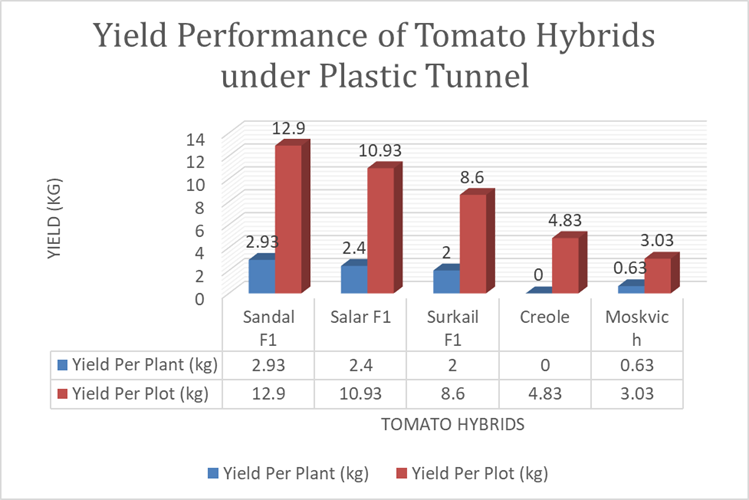
This study assessed the yield and yield components of eight indeterminate tomato hybrids—Salar F1 (H1), Sandal F1 (H2), Surkhail F1 (H3), Kormescvije (H4), Stupice (H5), Creole (H6), Moskvich (H7), and Black Prince (H8)—under plastic tunnel conditions in DI Khan, Pakistan during the years 2021-2022. Randomized Complete Block Design (RCBD) was used with three replications. The study measured days to flowering, days to fruiting, plant height, leaf length, number of fruits per plant, average fruit weight, yield per plant, and yield per plot. Sandal F1 had the shortest time to flowering and fruiting (40 and 60 days, respectively), followed by Surkhail and Salar F1 with intermediate values (43 and 63-64 days). Plant height was the highest in Kormescvije (226.63 cm) and lowest in Creole (157.77 cm), with Salar F1, Black Prince, and Stupice in between them. Stupice had the longest leaf length (14.03 cm), followed closely by Sandal F1, while Surkhail had the shortest leaf length (8.93 cm). Stupice produced the most fruits per plant (153.00), significantly more than Salar F1 and Sandal F1 (83.00 and 94.00, respectively), while Kormescvije produced the fewest (14.00). Kormescvije had the highest average fruit weight (114.2 g), followed by Creole and Moskvich (106.03 g and 98.20 g, respectively), with Salar F1, Sandal F1, and Surkhail F1 showing intermediate average fruit weights. Whereas, Stupice had the smallest fruits (20.20 g). Yield per plant was the highest in Sandal F1 (2.93 kg), followed by Salar F1 (2.40 kg) and Surkhail (2.00 kg), with Moskvich giving the lowest yield (0.63 kg). Overall, Sandal F1 achieved the highest yield per plot (12.90 kg), followed by Salar F1 (10.93 kg) and Surkhail (8.60 kg), while Moskvich and Creole gave the lowest yield (3.03 kg and 4.83 kg, respectively). The study concluded with Sandal F1 as the most productive hybrid under the given conditions, significantly outperforming other varieties, whereas Moskvich showed the lowest performance across most parameters. The means were significantly different at 5% level of significance, indicating distinct performance among the evaluated varieties.
Downloads
References
1. Willcox JK, Catignani GL, Lazarus S. Tomatoes and cardiovascular health. Crit Rev Food Sci Nutr. 2003;43(1):1–18. https://doi.org/10.1080/10408690390826437
2. Food and Agriculture Organization of the United Nations. FAOSTAT: Crops and livestock products—crop production, yield and harvested area. Accessed October 14, 2026. https://www.fao.org/faostat/
3. Ministry of National Food Security and Research, Government of Pakistan. Agricultural Statistics of Pakistan 2021–22. Government of Pakistan; 2022. https://mnfsr.gov.pk/PublicationDetail/NmRl YjkzNDMtZGY1NS00Y2RjLTljZmItNmY0ODM4MmVhYWY0
4. Banoo A, Hussain S, Hussain N, Hussain A, Khan FAS, Dar SR. Tomato performance in a protected structure: A review. Adv Res. 2024;25(5):29–37. https://doi.org/10.9734/air/2024/v25i51134
5. Sotelo-Cardona P, Lin MY, Srinivasan R. Growing tomato under protected cultivation conditions: Overall effects on productivity, nutritional yield, and pest incidences. Crops. 2021;1(2):97–110. https://doi.org/10.3390/crops1020010
This study evaluates the effects of protected cultivation on tomato productivity, nutritional yield, and pest incidence, providing insights into its potential benefits for tomato production.
6. Mngoma MF, Magwaza LS, Sithole NJ, et al. Effects of stem training on the physiology, growth, and yield responses of indeterminate tomato (Solanum lycopersicum) plants grown in protected cultivation. Heliyon. 2022;8(5). https://doi.org/10.1016/j.heliyon.2022.e09343
7. Adams SR, Cockshull KE, Cave CRJ. Effect of temperature on the growth and development of tomato fruits. Ann Bot. 2001;88(5):869–877. https://doi.org/10.1006/anbo.2001.1524
8. Van der Ploeg A, Heuvelink E. Influence of sub-optimal temperature on tomato growth and yield: A review. J Hortic Sci Biotechnol. 2005;80(6):652–659. https://doi.org/10.1080/14620316.2005. 11511994
This review examines how sub-optimal temperatures affect tomato growth and yield, highlighting the impact of temperature stress on crop development and productivity.
9. Rasheed A, Ilyas M, Khan TN, et al. Study of genetic variability, heritability, and genetic advance for yield-related traits in tomato (Solanum lycopersicon Mill.). Front Genet. 2023;13:1030309. https://doi.org/10.3389/fgene.2022.1030309
10. Kumar D, Kumar R, Kumar S, et al. Genetic variability, correlation and path coefficient analysis in tomato. Int J Veg Sci. 2013;19(4):313–323. https://doi.org/10.1080/19315260.2012.726701
11. Saravanan KR, Vishnupriya V, Prakash M, Anandan R. Variability, heritability and genetic advance in tomato genotypes. Indian J Agric Res. 2019;53(1):92–95. https://doi.org/10.18805/IJARe.A-5030
12. Kumar N, Bhardwaj ML, Kumari S, Sharma A. Studies on genetic variability, heritability and genetic advance in tomato. J Hill Agric. 2017;8(4):361–365. https://doi.org/10.5958/2230-7338.2017.00071.4
13. Kumari K, Akhtar S, Kumari S, et al. Genetic variability and heritability studies in diverse tomato genotypes. J Pharmacogn Phytochem. 2020;9(3):1011–1014.
This study assesses genetic variability and heritability among diverse tomato genotypes, providing insights into the selection of desirable traits for tomato breeding and crop improvement.
14. Sinha A, Singh P, Bhardwaj A, Kumar R. Evaluation of tomato (Solanum lycopersicum L.) genotypes for morphological, qualitative and biochemical traits for protected cultivation. Curr J Appl Sci Technol. 2020;39(2):105–111. https://doi.org/10.9734/CJAST/2020/ v39i230503
15. Sinha A, Singh P, Bhardwaj A, Kumar R. Genetic variability and character association analysis for yield and attributing traits in tomato (Solanum lycopersicum L.) genotypes for protected cultivation. J Pharmacogn Phytochem. 2020;9(1):2078–2082. https://doi.org/10. 22271/phyto.2020.v9.i1ai.10772
Downloads
Published
How to Cite
Issue
Section
License
Copyright (c) 2026 Rashid khan, Mohammad Arif, Sheheryar Hafeez Khan, Adil Rahman Khan, Imranullah Khan, Farkhanda Khan, Basit Ali Afridi, Aamir Khan Khalil, Riaz Ahmad Afridi, Faiza Khan Khalil, Albarr Afridi, Hamza Ahmad Khan

This work is licensed under a Creative Commons Attribution 4.0 International License.