
In silico Analysis of Non-Synonymous Single Nucleotide Polymorphisms (nsSNPs) in the SLC40A1 Gene Associated with Hemochromatosis Type 4
DOI:
https://doi.org/10.32350/bsr.83.03Keywords:
ferroportin (FPN), hemochromatosis type 4, In-silico analysis, non-synonymous single nucleotide polymorphisms (nsSNPs), protein modelling, SLC40A1Abstract
Background. Variants in SLC40A1, which encodes ferroportin (FPN), the only known mammalian cellular iron exporter, cause hemochromatosis type 4 (HH4), or ferroportin disease, a rare autosomal dominant disorder of iron metabolism. Non-synonymous single nucleotide polymorphisms (nsSNPs) in SLC40A1 may impair FPN folding, membrane localization, iron efflux or hepcidin responsiveness. Yet, researchers have not functionally annotated most catalogued variants. This in silico study systematically screened all coding-region nsSNPs of SLC40A1 using an integrated bioinformatics pipeline to priorities high-confidence deleterious candidates for experimental validation.
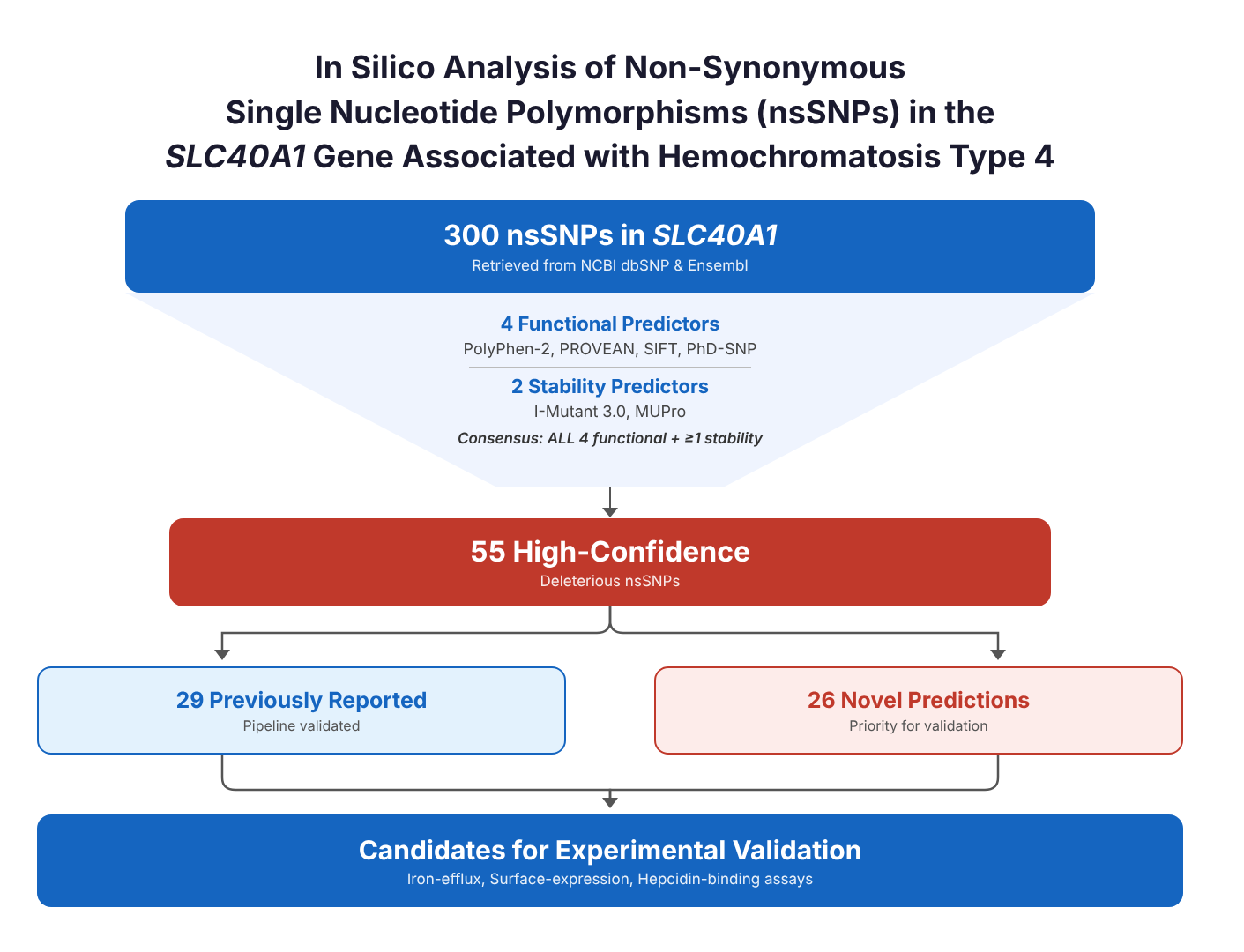
Methodology. The study retrieved 300 coding-region nsSNPs (RefSeq NM_014585.6; UniProt Q9NP59; dbSNP build 156) from NCBI dbSNP and Ensembl. Furthermore, the study assessed functional impact with PolyPhen-2, PROVEAN, SIFT and PhD-SNP; thermodynamic stability with I-Mutant 3.0 and MUpro; residue-level effects with Project HOPE; and secondary/tertiary structure with PSIPRED, I-TASSER and GalaxyRefine. We retained variants that all four functional predictors called deleterious and that at least one stability tool called destabilising.
Results. PolyPhen-2 classified 32.6% of nsSNPs as probably damaging, PROVEAN 33.6% as deleterious, SIFT 31.3% as not tolerated, and PhD-SNP 22.0% as disease-associated. I-Mutant 3.0 and MUpro predicted destabilisation for 32.3% and 33.7% of variants, respectively. Consensus filtering yielded 55 high-confidence deleterious nsSNPs; HOPE indicated that 38 substantially perturb FPN structure/function and 17 produced moderate effects. A total of 29 candidates corresponded to previously-reported variants; 26 were novel predictions.
Conclusion. The study concluded that 55 prioritized nsSNPs were computationally predicted candidates for experimental validation, not confirmed pathogenic mutations. Biochemical follow-up may accelerate genotype–phenotype understanding in this.
Highlights
- A total of 300 coding-region non-synonymous single nucleotide polymorphisms (nsSNPs) in SLC40A1 (ferroportin) were systematically screened in silico using four functional, two stability, and four structural prediction tools.
- Consensus-based filtering identified 55 high-confidence deleterious nsSNPs, comprising 29 previously reported variants and 26 novel predictions.
- Analysis using Project HOPE and I-TASSER indicated that 38 of the 55 prioritized variants may disrupt conserved transmembrane or functional domains of ferroportin.
- The prioritized variants were proposed as potential candidates for experimental validation through cellular iron-efflux and hepcidin-binding assays.
Downloads
References
1. Kowdley DS, Kowdley KV. Appropri-ate clinical genetic testing of hemo-chromatosis type 2–4, including fer-roportin disease. Appl Clin Genet. 2021;14:353–361. https://doi.org/10.2147/TACG.S269622
2. Girelli D, Busti F, Brissot P, Cabant-chik I, Muckenthaler MU, Porto G. Hemochromatosis classification: up-date and recommendations by the BIOIRON Society. Blood. 2022;139(20):3018–3029. https://doi.org/10.1182/blood.2021011338
3. Brissot P, Cavey T, Ropert M, Gug-genbuhl P, Loréal O. Genetic hemo-chromatosis: pathophysiology, diag-nostic and therapeutic management. Presse Med. 2017;46(12 Pt 2):e288–e295. https://doi.org/10.1016/j.lpm.2017.05.037
4. Ferbo L, Manzini PM, Badar S, et al. Detection of a rare mutation in the ferroportin gene through targeted next generation sequencing. Blood Trans-fus. 2016;14(6):531–534. https://doi.org/10.2450/2016.0286-15
5. Pietrangelo A. Hereditary hemochro-matosis: pathogenesis, diagnosis, and treatment. Gastroenterology. 2010;139(2):393–408.e2. https://doi.org/10.1053/j.gastro.2010.06.013
6. Choi EK, Nguyen TT, Iwase S, Seo YA. Ferroportin disease mutations in-fluence manganese accumulation and cytotoxicity. FASEB J. 2019;33(2):2228–2240. https://doi.org/10.1096/fj.201800831R
7. Qiao B, Sugianto P, Fung E, et al. Hepcidin-induced endocytosis of fer-roportin is dependent on ferroportin ubiquitination. Cell Metab. 2012;15(6):918–924. https://doi.org/10.1016/j.cmet.2012.03.018
8. Ka C, Guellec J, Pepermans X, et al. The SLC40A1 R178Q mutation is a recurrent cause of hemochromatosis and is associated with a novel patho-genic mechanism. Haematologica. 2018;103(11):1796–1805. https://doi.org/10.3324/haematol.2018.189845
9. Yamakawa N, Oe K, Yukawa N, et al. A novel phenotype of hereditary he-mochromatosis type 4 with ferro-portin-1 mutation, presenting with ju-venile cataracts. Intern Med. 2016;55(18):2697–2701. https://doi.org/10.2169/internalmedicine.55.6565
10. Majore S, Di Patti MCB, Valiante M, et al. Characterization of three novel pathogenic SLC40A1 mutations and genotype/phenotype correlations in 7 Italian families with type 4 hereditary hemochromatosis. Biochim Biophys Acta Mol Basis Dis. 2018;1864(2):464–470. https://doi.org/10.1016/j.bbadis.2017.11.006
11. Chen SR, Yang LQ, Chong YT, et al. Novel gain-of-function mutation in the SLC40A1 gene associated with hereditary haemochromatosis type 4. Intern Med J. 2015;45(6):672–676. https://doi.org/10.1111/imj.12764
12. Awais M, Wattoo JI, Zafar R, Khan N. Computational analysis of non-synonymous single nucleotide poly-morphism in UROD gene linked with familial porphyria cutanea tarda. Gene Rep. 2021;25:101413. https://doi.org/10.1016/j.genrep.2021.101413
13. Adzhubei I, Jordan DM, Sunyaev SR. Predicting functional effect of human missense mutations using PolyPhen-2. Curr Protoc Hum Genet. 2013;76(1):7.20.1–7.20.41. https://doi.org/10.1002/0471142905.hg0720s76
14. Choi Y, Chan AP. PROVEAN web server: a tool to predict the functional effect of amino acid substitutions and indels. Bioinformatics. 2015;31(16):2745–2747. https://doi.org/10.1093/bioinformatics/btv195
15. Sim NL, Kumar P, Hu J, Henikoff S, Schneider G, Ng PC. SIFT web server: predicting effects of amino acid sub-stitutions on proteins. Nucleic Acids Res. 2012;40(W1):W452–W457. https://doi.org/10.1093/nar/gks539
16. Kumar P, Henikoff S, Ng PC. Predict-ing the effects of coding non-synonymous variants on protein function using the SIFT algorithm. Nat Protoc. 2009;4(7):1073–1081. https://doi.org/10.1038/nprot.2009.86
17. Capriotti E, Fariselli P. PhD-SNPg: a webserver and lightweight tool for scoring single nucleotide variants. Nu-cleic Acids Res. 2017;45(W1):W247–W252. https://doi.org/10.1093/nar/ gkx369
18. Cheng J, Randall A, Baldi P. Predic-tion of protein stability changes for single-site mutations using support vector machines. Proteins. 2006;62(4):1125–1132. https://doi.org/10.1002/prot. 20810
19. Kepp KP. Towards a “golden stand-ard” for computing globin stability: stability and structure sensitivity of myoglobin mutants. Biochim Biophys Acta Proteins Proteom. 2015;1854(10):1239–1248. https://doi.org/10.1016/j.bbapap.2015.06.002
20. Venselaar H, te Beek TAH, Kuipers RKP, Hekkelman ML, Vriend G. Pro-tein structure analysis of mutations causing inheritable diseases: an e-Science approach with life scientist friendly interfaces. BMC Bioinformat-ics. 2010;11:548. https://doi.org/10.1186/1471-2105-11-548
21. Buchan DWA, Minneci F, Nugent TCO, Bryson K, Jones DT. Scalable web services for the PSIPRED Protein Analysis Workbench. Nucleic Acids Res. 2013;41(W1):W349–W357. https://doi.org/10.1093/nar/gkt381
22. Yang J, Yan R, Roy A, Xu D, Poisson J, Zhang Y. The I-TASSER Suite: pro-tein structure and function prediction. Nat Methods. 2015;12(1):7–8. https://doi.org/10.1038/nmeth.3213
23. Meyer MJ, Lapcevic R, Romero AE, et al. mutation3D: cancer gene predic-tion through atomic clustering of cod-ing variants in the structural proteo-me. Hum Mutat. 2016;37(5):447–456. https://doi.org/10.1002/humu.22963
24. Ko J, Park H, Heo L, Seok C. Gal-axyWEB server for protein structure prediction and refinement. Nucleic Acids Res. 2012;40(W1):W294–W297. https://doi.org/10.1093/nar/gks493
25. Ekanayake D, Roddick C, Powell LW. Recent advances in hemochromato-sis: a 2015 update: a summary of proceedings of the 2014 conference held under the auspices of Hemo-chromatosis Australia. Hepatol Int. 2015;9(2):174–182. https://doi.org/10.1007/s12072-015-9608-2
26. Abboud S, Haile DJ. A novel mam-malian iron-regulated protein in-volved in intracellular iron metabo-lism. J Biol Chem. 2000;275(26):19906–19912. https://doi.org/10.1074/jbc.M000713200
27. Mayr R, Janecke AR, Schranz M, et al. Ferroportin disease: a systematic meta-analysis of clinical and molecu-lar findings. J Hepatol. 2010;53(5):941–949. https://doi.org/10.1016/j.jhep.2010.05.016
28. Wallace DF, Subramaniam VN. Non-HFE hemochromatosis. In: Anderson GJ, McLaren GD, eds. Iron Physiolo-gy and Pathophysiology in Humans. Springer; 2012:399–416. https://doi.org/10.1007/978-1-60327-485-2_20
29. Pietrangelo A. Ferroportin disease: pathogenesis, diagnosis and treat-ment. Haematologica. 2017;102(12):1972–1984. https://doi.org/10.3324/haematol.2017.170720
Downloads
Published
How to Cite
Issue
Section
License
Copyright (c) 2026 Rimsha Zafar, Naveera Khan, Muhammad Awais, Zartash Butt

This work is licensed under a Creative Commons Attribution 4.0 International License.
BSR follows an open-access publishing policy and full text of all published articles is available free, immediately upon publication of an issue. The journal’s contents are published and distributed under the terms of the Creative Commons Attribution 4.0 International (CC-BY 4.0) license. Thus, the work submitted to the journal implies that it is original, unpublished work of the authors (neither published previously nor accepted/under consideration for publication elsewhere). On acceptance of a manuscript for publication, a corresponding author on the behalf of all co-authors of the manuscript will sign and submit a completed the Copyright and Author Consent Form.