
Prevalence of Hepatitis C Virus (HCV) in the Region of Central Punjab
DOI:
https://doi.org/10.32350/bsr.82.06Keywords:
Central Punjab, genotype, Hepatitis C virus (HCV), PCR, prevalenceAbstract
Background. Hepatitis C infection (HCV) continues to be a key contributor to liver cirrhosis and a major global health concern. The purpose of this study was to present a current summary of HCV infection and its genotypic distribution in Punjab, Pakistan's various cities.
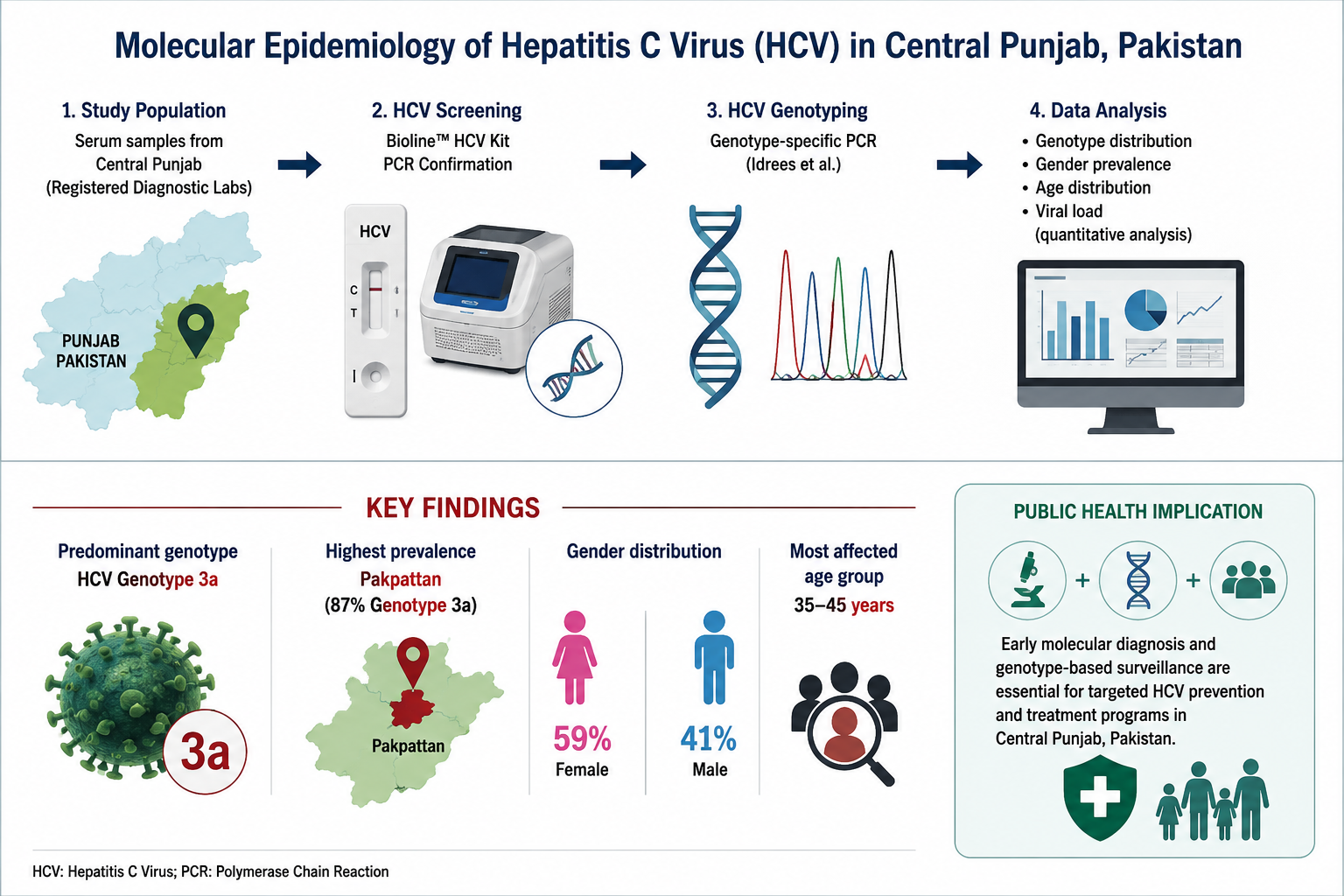
Methodology. Serum samples were collected from different regions of Central Punjab in collaboration with registered diagnostic laboratories. Early detection of samples was done by Bioline™ HCV kit and then further confirmed by PCR. Genotyping was done by genotype specific primers of HCV designed by Idrees et al. [1]. After completing diagnosis and genotyping, the percentage of male and female affected individuals, the ratio at which people were being affected, the age-frequency of affected individuals, and quantitative data of patients was presented.
Results. The 3a genotype of HCV was identified to be more prevalent among the HCV patients in regions of Central Punjab. Females showed a higher prevalence of HCV infection compared to their male counterparts (females 59% and males 41%). People between the ages of 35 and 45 were most vulnerable to HCV infection.
Conclusion. The Pakpattan population in the Central Punjab region was most afflicted by HCV, with 87% of cases having the 3a genotype. Patients aged 35 to 45 were also more at risk, as were females.
Downloads
References
1. Idrees M, Riazuddin S. Frequency distribution of hepatitis C virus geno-types in different geographical regions of Pakistan and their possible routes of transmission. BMC Infect Dis. 2008;8:e69. https://doi.org/10.1186/1471-2334-8-69
2. Stroffolini T, Stroffolini G. Prevalence and modes of transmission of hepati-tis C virus infection: a historical worldwide review. Viruses. 2024;16(7):e1115. https://doi.org/10.3390/v16071115
3. Daw MA. Hepatitis C virus among patients with mental disorders. Men-tal Disorder; 2014.
4. de la Fuente C, Goodman Z, Rice CM. Genetic and functional charac-terization of the N-terminal region of the hepatitis C virus NS2 protein. J Vi-rol. 2013;87(8):4130-4145. https://doi.org /10.1128/JVI.03174-12
5. Ghias M, Pervaiz MK. Identification of epidemiological risk factors for hepatitis C in Punjab, Pakistan. J Ayub Med Coll Abbottabad. 2009;21(2):156-161.
6. Giannelli F, Moscarella S, Giannini C, et al. Effect of antiviral treatment in patients with chronic HCV infection and t(14;18) translocation. Blood. 2003;102(4):1196-1201. https://doi.org/10.1182/blood-2002-05-1537
7. Kargarfard F, Sami A, Mohammadi-Dehcheshmeh M, Ebrahimie E. Novel approach for identification of influ-enza virus host range and zoonotic transmissible sequences by determi-nation of host-related associative po-sitions in viral genome segments. BMC Genomics. 2016;17(1):1-10. https://doi.org/10.1186/s12864-016-3250-9
8. Arshad A, Ashfaq UA. Epidemiology of hepatitis C infection in Pakistan: current estimate and major risk fac-tors. Crit Rev Eukaryot Gene Expr. 2017;27(1):63-77. https://doi.org/10.1615/CritRevEukaryotGeneExpr.2017018953
9. Haqqi A, Munir R, Khalid M, et al. Prevalence of hepatitis C virus geno-types in Pakistan: current scenario and review of literature. Viral Immu-nol. 2019;32(9):402-413. https://doi.org/10.1089/vim.2019.0058
10. Khurram M, Irshad A, Alamgir M, Awan UA, Syed A, Sadia H. Epidemi-ological survey of the prevalence of HCV and HBV among the factory workers in the periphery of Lahore. BioSci Rev.2021;3(1):25-33.
https://doi.org/10.32350/BSR.0301.03
11. Waheed U, Khokhar OK, Saba N, et al. The national burden of hepatitis C among blood donors in Pakistan: A systematic review and meta-analysis (1996-2024). Ann PIMS Shaheed Zulfiqar Ali Bhutto Med Univ. 2024;20(suppl 2):848-863.
12. Saleem U, Aslam N, Siddique R, Iqbal S, Manan M. Hepatitis C virus: Its prevalence, risk factors and genotype distribution in Pakistan. Eur J In-flamm. 2022;20:1-20. https://doi.org/10.1177/1721727X221144391
13. Waqar M, Khan AU, Rehman HU, et al. Determination of hepatitis C virus genotypes circulating in different dis-tricts of Punjab (Pakistan). Eur J Gas-troenterol Hepatol. 2014;26(1):59-64. https://doi.org/10.1097/MEG.0b013e328362dc3f
14. Khattak MS, Ali S. Assessment of temperature and rainfall trends in Punjab province of Pakistan for the period 1961-2014. J Himal Earth Sci. 2015;48(2):e42.
15. Idrees M, Rafique S, Rehman I, et al. Hepatitis C virus genotype 3a infec-tion and hepatocellular carcinoma: Pakistan experience. World J Gastro-enterol. 2009;15(40):5080-5085. https://doi.org/10.3748/wjg.15.5080
16. Umer M, Iqbal M. Hepatitis C virus prevalence and genotype distribution in Pakistan: comprehensive review of recent data. World J Gastroenterol. 2016;22(4):1684-1700. https://doi.org/10.3748/wjg.v22.i4.1684
17. Sallam M, Khalil R. Contemporary insights into hepatitis C virus: A com-prehensive review. Microorganisms. 2024;12(6):e1035. https://doi.org/10.3390/microorganisms12061035
18. Khan A, Nadir A, Mushtaq MH, et al. Molecular epidemiology and geno-type distribution of hepatitis C in Pa-kistan: a multicenter cross-sectional study. Infect Genet Evol. 2020;84:e104372. https://doi.org/10.1016/j.meegid.2020.104372
19. Gizamba JM, Finch BK, Wang S, Klausner JD. Insights into the spatial epidemiology of hepatitis C infection: systematic synthesis of area-level de-terminants and spatiotemporal anal-yses. BMC Public Health. 2025;25(1):e687. https://doi.org/10.1186/s12889-025-21668-w
20. Uwimbabazi JC, Mutesa L, Mennechet FJ, et al. Diversity, geo-graphical distribution and predictive factors of hepatitis C virus genotypes and subtypes in Rwanda. Acta Trop. 2024;260:e107433.
https://doi.org/10.1016/j.actatropica.2024.107433
21. Kuo I, Galai N, Thomas DL, Zafar T, Ahmed MA, Strathdee SA. High HCV seroprevalence and HIV drug use risk behaviors among injection drug users in Pakistan. Harm Reduct J. 2006;3(1):e26. https://doi.org/10.1186/1477-7517-3-26
22. Yousaf A, Ghafoor A, Fatima N, et al. Gender-specific frequency distribution of hepatitis C virus genotypes in Pun-jab province, Pakistan: a clinically significant descriptive cross-sectional study. Cureus. 2021;13(8):e17480. https://doi.org/10.7759/cureus.17480
23. Bagheri S, Fard GB, Talkhi N, et al. Laboratory biochemical and hemato-logical parameters: early predictive biomarkers for diagnosing hepatitis C virus infection. J Clin Lab Anal. 2024;38(24):e25127. https://doi.org/10.1002/jcla.25127
Downloads
Published
How to Cite
Issue
Section
License
Copyright (c) 2026 Sadia Zahid, Jahanzeb Ali, Mishal Fatima, Huma Javed, Sobia Rani

This work is licensed under a Creative Commons Attribution 4.0 International License.
BSR follows an open-access publishing policy and full text of all published articles is available free, immediately upon publication of an issue. The journal’s contents are published and distributed under the terms of the Creative Commons Attribution 4.0 International (CC-BY 4.0) license. Thus, the work submitted to the journal implies that it is original, unpublished work of the authors (neither published previously nor accepted/under consideration for publication elsewhere). On acceptance of a manuscript for publication, a corresponding author on the behalf of all co-authors of the manuscript will sign and submit a completed the Copyright and Author Consent Form.