
Research Article Genetic Association of AGT rs699 with Hypertension in a Population from Rawalpindi, Pakistan
DOI:
https://doi.org/10.32350/bsr.82.05Keywords:
AGT rs699 , Hypertension, genomic DNA , ARMS-PCR, M268T substitutionAbstract
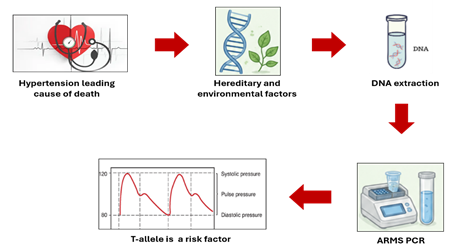
Background. Hypertension is a widespread chronic illness, and ranks as one of the leading causes of death. Some complications of having chronic hypertension include cardiovascular diseases (CVDs), strokes, and chronic renal diseases. Evidence from epidemiological studies represent that hereditary factors and genes are involved in the etiology of hypertension. Therefore, the current study aimed to discuss the association of rs699 point mutation of AGT gene, which results in the M268T substitution (Methionine>Threonine). The objective of this study was to investigate the association of hypertension with the SNP rs699 of AGT gene.
Methods. A total of 80 participants were included in this case-control study, with 50 hypertension patients and 30 controls. The blood samples were collected from multiple hospitals in Rawalpindi district. The genomic DNA was isolated. Amplification Refractory Mutation System-Polymerase Chain Reaction (ARMS-PCR) method was used to find allele frequencies.
Results. Genotypic analysis indicated a strong association of T allele of rs699 with hypertension. For T allele, both heterozygotes and homozygotes were found to have an elevated risk of hypertension. The study found that the odds ratio of TT genotype was 3.5 times higher for patients than those who had the CC genotype (OR=3.5), 95% Confidence Interval (CI) indicating a higher risk of hypertension. Whereas, the odds of disease in individuals with the "CT" genotype were lower than those with the "CC" genotype (OR=0.5), 95% CI."
Conclusion. These findings demonstrated that rs699 polymorphism of AGT gene is significantly associated with the susceptibility to hypertension.
Downloads
References
1. Stanaway JD, Afshin A, Gakidou E, et al. Global, regional, and national comparative risk assessment of 84 behavioural, environmental and occupational, and metabolic risks or clusters of risks for 195 countries and territories, 1990-2017: a systematic analysis for the Global Burden of Disease Study. Lancet. 2018;392(10159):1923-1994. https://doi.org/10.1016/S0140-6736(18)32225-6
2. Mills KT, Bundy JD, Kelly TN, et al. Global disparities of hypertension prevalence and control: a systematic analysis of population-based studies from 90 countries. Circulation. 2016;134(6):441-450.
https://doi.org/10.1161/CIRCULATIONAHA.115.018912
3. Iqbal M, Akram M, Rashid A, et al. Prevalence of hypertension and associated co-morbidities in Pakistan. Mathews J Nurs Health Care. 2023;5:1-7. https://doi.org/10.30654 /MJNH.100011
4. Singh RB, Suh IL, Singh VP, et al. Hypertension and stroke in Asia: prevalence, control and strategies in developing countries for prevention. J Hum Hypertens. 2000;14(10-11):749-763.
https://doi.org/10.1038/sj.jhh.1001058
5. Soomro MA, Abro GY, Shah SIA. Frequency of hyperlipidemia in patients of hypertension in Chandka Medical College Hospital Larkana. Med Channel. 2013;19:e26.
6. Ahmed N, Abdul Khaliq M, Shah SH, Anwar W. Compliance to antihypertensive drugs, salt restriction, exercise and control of systemic hypertension. J Ayub Med Coll Abbottabad. 2008;20(2):66-69.
7. Kearney PM, Whelton M, Reynolds K, Muntner P, Whelton PK, He J. Global burden of hypertension: analysis of worldwide data. Lancet. 2005;365(9455):217-223. https://doi.org/10.1016/S0140-6736(05) 17741-1
8. Ghaffar A, Reddy KS, Singhi M. Burden of non-communicable diseases in South Asia. BMJ. 2004;328(7443):807-810. https://doi.org/10.1136/bmj.328.7443.807
9. Ryuzaki M, Miyashita K, Sato M, et al. Activation of the intestinal tissue renin-angiotensin system by transient sodium loading in salt-sensitive rats. J Hypertens. 2022;40(1):33-45. https://doi.org/10.1097/HJH.0000000000002989
10. Olowoyo P, Barango P, Moran A, Williams B, Whelton PK, Owolabi M. Priorities to reduce the burden of hypertension in Africa through ACHIEVE. Lancet Glob Health. 2024;12(2):e192-e193.
https://doi.org/10.1016/S2214-109X(23)00558-2
11. Mills KT, Stefanescu A, He J. The global epidemiology of hypertension. Nat Rev Nephrol. 2020;16(4):223-237. https://doi.org/10.1038/s41581-019-0244-2
12. Mishra SR, Satheesh G, Khanal V, et al. Closing the gap in global disparities in hypertension control. Hypertension. 2025;82:407-416. https://doi.org/10.1161/HYPERTENSIONAHA.124.24137
13. Oparil S, Zaman MA, Calhoun DA. Pathogenesis of hypertension. Ann Intern Med. 2003;139(9):761-776. https://doi.org/10.7326/0003-4819-139-9-200311040-00011
14. Adeyemo A, Gerry N, Chen G, et al. A genome-wide association study of hypertension and blood pressure in African Americans. PLoS Genet. 2009;5(7):e1000564. https://doi.org/10.1371/journal.pgen.1000564
15. Oliveros E, Patel H, Kyung S, et al. Hypertension in older adults: assessment, management, and challenges. Clin Cardiol. 2020;43(2):99-107. https://doi.org/10.1002/clc.23303
16. Ashraf T, Sultana R, Sachdewani R. Pakistan's silent threat: the escalating crisis of hypertension and probable recommendations. Pak Heart J. 2025;58(3):281-283. https://doi.org/10.47144/phj.v58i3.3327
17. Yeo WJ, Abraham R, Surapaneni AL, et al. Sex differences in hypertension and its management throughout life. Hypertension. 2024;81(10):2263-2274. https://doi.org/10.1161/HYPERTENSIONAHA.123.21369
18. Manosroi W, Williams GH. Genetics of human primary hypertension: focus on hormonal mechanisms. Endocr Rev. 2019;40(3):825-856. https://doi.org/10.1210/er.2018-00071
19. Maamor NH, Ismail J, Abd Malek K, Yusoff K, Boon-Peng H. AGT, CYP11B2 & ADRB2 gene polymorphism & essential hypertension: a meta-analysis. Indian J Med Res. 2024;159(5-6):619-628. https://doi.org/10.25259/IJMR_520_23
20. Gopi Chand M, Srinath J, Rao RS, Lakkakula BV, Kumar S, Rao VR. Association between the M268T polymorphism in the angiotensinogen gene and essential hypertension in a South Indian population. Biochem Genet. 2011;49(7-8):474-482. https://doi.org/10.1007/s10528-011-9423-y
21. Shamaa MM, Fouad H, Haroun M, Hassanein M, Hay MAA. Association between the angiotensinogen (AGT) gene (M235T) polymorphism and essential hypertension in Egyptian patients. Egypt Heart J. 2015;67(1):1-5. https://doi.org/10.1016/j.ehj.2013.10.001
22. Baig F, Baig A, Khan N. Association study of AGT gene polymorphism rs699 with hypertension in a Pakistani population. J Med Health Sci Rev. 2025;2:4911-4919. https://doi.org/10.62019/f3pdee61
23. Ahmed ST, Nasir MI, Amir KF, Siddiqui PQR. Spectrum of AGT (M235T) rs699 and AGTR1 (A1166C) rs5186 gene variants and its association with coronary artery disease in Pakistani patients. Pak J Med Sci. 2025;41(4):1151-1158. https://doi.org/10.12669/pjms.41.4.9993
24. Miller SA, Dykes DD, Polesky HF. A simple salting out procedure for extracting DNA from human nucleated cells. Nucleic Acids Res. 1988;16(3):e1215. https://doi.org/10.1093/nar/16.3.1215
25. Dairawan M, Shetty PJ. The evolution of DNA extraction methods. Am J Biomed Sci Res. 2020;8(1):39-45. https://doi.org/10.34297/AJBSR.2020.08.001234
26. Haroon F, Maqbool A, Rafiq R, Azhar F. Characterization of inhibin alpha gene in patients of polycystic ovary syndrome. J Bioeng Biomed Sci. 2019;9:e259.
27. Kunz R, Kreutz R, Beige J, Distler A, Sharma AM. Association between the angiotensinogen 235T-variant and essential hypertension in whites: a systematic review and methodological appraisal. Hypertension. 1997;30(6):1331-1337. https://doi.org/10.1161/01.HYP.30.6.1331
28. Say YH, Ling KH, Duraisamy G, Isaac S, Rosli R. Angiotensinogen M235T gene variants and its association with essential hypertension and plasma renin activity in Malaysian subjects: a case-control study. BMC Cardiovasc Disord. 2005;5:7. https://doi.org/10.1186/1471-2261-5-7
29. Sethi AA, Nordestgaard BG, Tybjaerg-Hansen A. Angiotensinogen gene polymorphism, plasma angiotensinogen, and risk of hypertension and ischemic heart disease: a meta-analysis. Arterioscler Thromb Vasc Biol. 2003;23(7):1269-1275. https://doi.org/10.1161/01.ATV.0000079007.40884.5C
30. Kurbanova D, Eliseyeva M. Genetic background of left ventricular hypertrophy in Uzbek hypertensive men. Turk Kardiyol Dern Ars. 2010;38:466-472.
31. Mehri S, Mahjoub S, Hammami S, et al. Renin-angiotensin system polymorphisms in relation to hypertension status and obesity in a Tunisian population. Mol Biol Rep. 2012;39(4):4059-4065. https://doi.org/10.1007/s11033-011-1187-2
32. Fang YJ, Deng HB, Thomas GN, et al. Linkage of angiotensinogen gene polymorphisms with hypertension in a sibling study of Hong Kong Chinese. J Hypertens. 2010;28(6):1203-1209. https://doi.org/10.1097/HJH.0b013e3283384b07
33. Melake A, Jegnie M. Angiotensinogen M235T gene polymorphism and risk of ischemic heart disease complication among patients with hypertension in the Ethiopian population. Ethiop J Health Sci. 2025;35(3):165-170. https://doi.org/10.4314/ejhs.v35i3.3
34. Repchuk Y, Sydorchuk LP, Sydorchuk AR, et al. Linkage of blood pressure, obesity and diabetes mellitus with angiotensinogen gene (AGT 704T>C/rs699) polymorphism in hypertensive patients. Bratisl Lek Listy. 2021;122(10):728-734. https://doi.org/10.4149/BLL_2021_114
35. El-Garawani IM, Shaheen EM, El-Seedi HR, et al. Angiotensinogen gene missense polymorphisms (rs699 and rs4762): the association of end-stage renal failure risk with type 2 diabetes and hypertension in Egyptians. Genes (Basel). 2021;12(3):e339. https://doi.org/10.3390/genes12030339
36. Kieć-Wilk B. Analysis of Genes SERCA2A and Angiotensinogen and Growth Factors in Patients with Left Ventricular Hypertrophy in Course of Essential Hypertension. Doctoral dissertation. Jagiellonian University Medical Colleges; 2006.
37. Mulerova TA, Ponasenko AV, Tsepokina AV, et al. Associations of the angiotensin gene polymorphism (AGT, rs699) with systemic hypertension and its risk factors in Gornaya Shoria inhabitants. Russ J Cardiol. 2017;(10):85-92. https://doi.org/10.15829/1560-4071-2017-10-85-92
38. Hu DC, Zhao XL, Shao JC, et al. Interaction of six candidate genes in essential hypertension. Genet Mol Res. 2014;13(4):8385-8395. https://doi.org/10.4238/2014.October.20.14
39. Nathaniel S, Nadeem T, Aslam S, et al. Association of angiotensinogen gene polymorphisms (M235T and T174M) with preeclampsia among Pakistani women. Discover Med. 2024;1:e135. https://doi.org/10.1007/s44337-024-00163-y
40. Makuc J, Šeruga M, Završnik M, Cilenšek I, Petrovič D. Angiotensinogen (AGT) gene missense polymorphisms (rs699 and rs4762) and diabetic nephropathy in Caucasians with type 2 diabetes mellitus. Bosn J Basic Med Sci. 2017;17(4):262-268. https://doi.org/10.17305/bjbms.2017.1823
41. Mondorf UF, Russ A, Wiesemann A, et al. Contribution of angiotensin I converting enzyme gene polymorphism and angiotensinogen gene polymorphism to blood pressure regulation in essential hypertension. Am J Hypertens. 1998;11(2):174-183. https://doi.org/10.1016/S0895-7061(97)00402-0
42. Touyz RM. Role of magnesium in the pathogenesis of hypertension. Mol Aspects Med. 2003;24(1-3):107-136. https://doi.org/10.1016/S0098-2997(02)00094-8
43. Siddu AH, Gadde S, Reddy BK, Samhitha K, Poreddy P. Study of effect of genetic polymorphism on response of antihypertensive drug. Eur J Cardiovasc Med. 2025;15:341-344.
Downloads
Published
How to Cite
Issue
Section
License
Copyright (c) 2026 Fazila Mumtaz, Ayesha Maqbool, Akhtar Ali, Mubin Mustafa Kiyani , Yasir Ali

This work is licensed under a Creative Commons Attribution 4.0 International License.
BSR follows an open-access publishing policy and full text of all published articles is available free, immediately upon publication of an issue. The journal’s contents are published and distributed under the terms of the Creative Commons Attribution 4.0 International (CC-BY 4.0) license. Thus, the work submitted to the journal implies that it is original, unpublished work of the authors (neither published previously nor accepted/under consideration for publication elsewhere). On acceptance of a manuscript for publication, a corresponding author on the behalf of all co-authors of the manuscript will sign and submit a completed the Copyright and Author Consent Form.