
Aspergillus terreus Alleviates Salinity-Induced Phytotoxicity and Improves Growth, Photosynthetic Pigment and Osmolyte Status in Barley (Hordeum vulgare L.)
DOI:
https://doi.org/10.32350/bsr.84.01Keywords:
Aspergillus terreus, Hordeum vulgare, osmolytes, rhizospheric fungi, salt toleranceAbstract
Background. Soil salinization remains one of the most persistent abiotic constraints on cereal productivity, worldwide. Barley (Hordeum vulgare L.), although ranked among the more salt-tolerant cereals, still incurs measurable physiological and biochemical penalties. Beneficial rhizospheric fungi have been proposed as a low-cost route to buffer this stress, yet the degree of protection they confer is isolate, host-specific, and needs to be demonstrated experimentally, rather than assumed. The present study investigated the novel use of a rhizospheric Aspergillus terreus isolate, originally obtained from the rhizosphere of Parthenium hysterophorus to enhance salinity tolerance in barley seedlings.
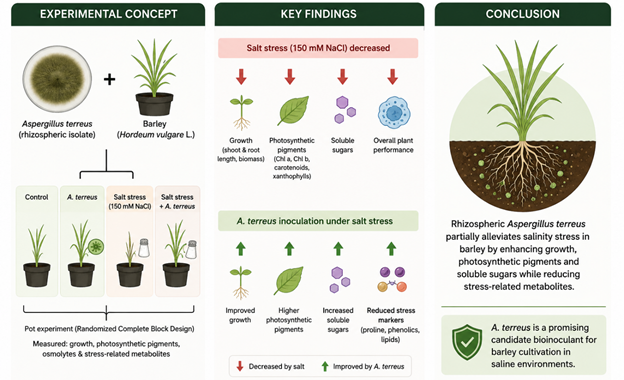
Methods. The study evaluated the capacity of a rhizospheric fungal isolate, identified as Aspergillus terreus and obtained from the Plant-Microbe-Interaction (PMI) Laboratory, Abdul Wali Khan University, Mardan to protect barley seedlings against 150 mM salinity in a pot trial. The trial was arranged as a completely randomized design with four treatments: untreated control, fungal inoculation alone, salinity alone, and salinity combined with fungal inoculation.
Results. Salinity sharply suppressed seedling emergence and vegetative growth, reducing shoot length by 14.3%, root length by 42.5%, fresh biomass by 28.1%, and dry biomass by 64.5% relative to the control, while chlorophyll a, chlorophyll b, carotenoid, and xanthophyll contents fell by 29.0%, 49.6%, 21.0% and 5.1%, respectively. Salt-stressed plants accumulated more total phenolics, flavonoids, and proline, while total lipid content declined and gained soluble sugars by approximately 46%, consistent with an osmotic and ionic stress response. Inoculation with A. terreus partially alleviated this damage: seedling emergence and shoot length recovered by approximately 11-25%, root length and dry biomass by 30-109%, and photosynthetic pigments by 2-32%. While, proline and phenolics declined toward the salt-only baseline by 9-17%, though remaining significantly different from the control (p ≤ 0.05). Further, total lipid content increased by approximately 43% and soluble sugars declined by approximately 14% relative to the salt-only treatments, both moving back toward control levels. Light microscopy confirmed the colonization of barley roots by the fungus.
Conclusions. These findings suggest that the Parthenium hysterophorus rhizosphere-derived A. terreus isolate is associated with reduced proline, phenolic and lipid accumulation, and increased soluble sugar and pigment content in salt-stressed barley. Further, they support A. terreus as a candidate inoculant for barley grown under saline conditions, pending validation in non-sterile soil under greenhouse and field conditions.
Highlights.
· A. terreus significantly reduces salinity-induced growth inhibition in barley.
· Fungal inoculation is associated with increased photosynthetic pigments and soluble sugar content.
· The isolate is an experimental candidate for salt-affected agricultural soils, pending strain-level biosafety testing, and validation in non-sterile field soil.
Downloads
References
1. Kristanti RA, Hadibarata T, Syafrudin M, Yılmaz M, Abdullah S. Microbiological contaminants in drinking water: Current status and challenges. Water Air Soil Pollut. 2022;233(8):299. https://doi.org/10.1007/s11270-022-05698-3
2. Rajput VD, Minkina T, Kumari A, et al. Coping with the challenges of abiotic stress in plants: New dimensions in the field application of nanoparticles. Plants (Basel). 2021;10(6):1221. https://doi.org/10.3390/plants10061221
3. Shabbir R, Singhal RK, Mishra UN, et al. Combined abiotic stresses: Challenges and potential for crop improvement. Agronomy. 2022;12(11):2795. https://doi.org/10.3390/agronomy12112795
4. Singh A. Soil salinity: A global threat to sustainable development. Soil Use Manag. 2022;38(1):39–67. https://doi.org/10.1111/sum.12772
5. Shokri N, Hassani A, Sahimi M. Multi-scale soil salinization dynamics from global to pore scale: A review. Rev Geophys. 2024;62(4):e2023RG000804. https://doi.org/10.1029/2023RG000804
6. Gutta A, Maity A, Bhattacharya P. Understanding soil formation: A comprehensive analysis of concepts, pedogenic processes, and factors. In: Sarkar T, Sengupta S, eds. Agriculture Re-imagined: Innovations and Strategies for Sustainable Growth. Bright Sky Publications; 2024:109–120.
7. Kaushal SS, Likens GE, Pace ML, et al. Freshwater salinization syndrome: From emerging global problem to managing risks. Biogeochemistry. 2021;154(2):255–292. https://doi.org/10.1007/s10533-021-00784-w
8. Tarolli P, Luo J, Park E, Barcaccia G, Masin R. Soil salinization in agriculture: Mitigation and adaptation strategies combining nature-based solutions and bioengineering. iScience. 2024;27(2):108830. https://doi.org/10.1016/j.isci.2024.108830
9. Balasubramaniam T, Shen G, Esmaeili N, Zhang H. Plants' response mechanisms to salinity stress. Plants (Basel). 2023;12(12):2253. https://doi.org/10.3390/plants12122253
10. Chaudhary MT, Majeed S, Rana IA, et al. Impact of salinity stress on cotton and opportunities for improvement through conventional and biotechnological approaches. BMC Plant Biol. 2024;24:20.
https://doi.org/10.1186/s12870-023-04558-4
11. Yu B, Chao DY, Zhao Y. How plants sense and respond to osmotic stress. J Integr Plant Biol. 2024;66(3):394–423. https://doi.org/10.1111/jipb.13622
12. Zhang X, Li H, Liu H, Wang J, Qiang X. Response of tomato quality parameters to water deficit under soil salinity and simulation based on stem water potential. Horticulturae. 2025;11(2):114.
https://doi.org/10.3390/horticulturae11020114
13. Sun L, Cao X, Du J, Wang Y, Zhang F. Canola (Brassica napus) enhances sodium chloride and sodium ion tolerance by maintaining ion homeostasis, higher antioxidant enzyme activity and photosynthetic capacity fluorescence parameters. Funct Plant Biol. 2024;51(8):FP23089. https://doi.org/10.1071/FP23089
14. Hussain T, Li J, Feng X, Asrar H, Gul B, Liu X. Salinity induced alterations in photosynthetic and oxidative regulation are ameliorated as a function of salt secretion. J Plant Res. 2021;134(4):779–796.
https://doi.org/10.1007/s10265-021-01285-5
15. Praveen A, Singh S. The role of potassium under salinity stress in crop plants. Cereal Res Commun. 2024;52(2):315–322. https://doi.org/10.1007/s42976-023-00393-3
16. Imtiaz H, Mir AR, Corpas FJ, Hayat S. Impact of potassium starvation on the uptake, transportation, photosynthesis, and abiotic stress tolerance. Plant Growth Regul. 2023;99(3):429–448. https://doi.org/10.1007/s10725-022-00925-7
17. Anil Kumar S, Kaniganti S, Hima Kumari P, et al. Functional and biotechnological cues of potassium homeostasis for stress tolerance and plant development. Biotechnol Genet Eng Rev. 2024;40(4):3527–3570. https://doi.org/10.1080/02648725.2022.2143317
18. Robin AHK, Ghosh S, Shahed MA. PEG-induced osmotic stress alters root morphology and root hair traits in wheat genotypes. Plants (Basel). 2021;10(6):1042. https://doi.org/10.3390/plants10061042
19. Dos Santos TB, Ribas AF, de Souza SGH, Budzinski IGF, Domingues DS. Physiological responses to drought, salinity, and heat stress in plants: A review. Stresses. 2022;2(1):113–135. https://doi.org/10.3390/stresses2010009
20. Hasanuzzaman M, Raihan MRH, Masud AAC, et al. Regulation of reactive oxygen species and antioxidant defense in plants under salinity. Int J Mol Sci. 2021;22(17):9326. https://doi.org/10.3390/ijms22179326
21. Hameed A, Ahmed MZ, Hussain T, et al. Effects of salinity stress on chloroplast structure and function. Cells. 2021;10(8):2023. https://doi.org/10.3390/cells10082023
22. Jadidi O, Etminan A, Azizi-Nezhad R, Ebrahimi A, Pour-Aboughadareh A. Physiological and molecular responses of barley genotypes to salinity stress. Genes (Basel). 2022;13(11):2040. https://doi.org/10.3390/genes13112040
23. Abdelrady WA, Ma Z, Elshawy EE, et al. Physiological and biochemical mechanisms of salt tolerance in barley under salinity stress. Plant Stress. 2024;11:100403. https://doi.org/10.1016/j.stress.2024.100403
24. Ekinci M, Turan M, Aydin M, et al. Chrysin alleviates salt stress in tomato by physiological, biochemical, and genetic mechanisms. Rhizosphere. 2024;32:100979. https://doi.org/10.1016/j.rhisph.2024.100979
25. Bello SK, Alayafi AH, Al-Solaimani SG, Abo-Elyousr KA. Mitigating soil salinity stress with gypsum and bio-organic amendments: A review. Agronomy. 2021;11(9):1735. https://doi.org/10.3390/agronomy11091735
26. Acharya BR, Gill SP, Kaundal A, Sandhu D. Strategies for combating plant salinity stress: The potential of plant growth-promoting microorganisms. Front Plant Sci. 2024;15:1406913. https://doi.org/10.3389/fpls.2024.1406913
27. Sun H, Jiang S, Jiang C, Wu C, Gao M, Wang Q. A review of root exudates and rhizosphere microbiome for crop production. Environ Sci Pollut Res Int. 2021;28(39):54497–54510. https://doi.org/10.1007/s11356-021-15838-7
28. Adedayo AA, Babalola OO. Fungi that promote plant growth in the rhizosphere boost crop growth. J Fungi (Basel). 2023;9(2):239. https://doi.org/10.3390/jof9020239
29. Pishchik VN, Chizhevskaya EP, Chebotar VK, et al. PGPB isolated from drought-tolerant plants help wheat plants to overcome osmotic stress. Plants (Basel). 2024;13(23):3381. https://doi.org/10.3390/plants13233381
30. Montejano-Ramírez V, Ávila-Oviedo JL, Campos-Mendoza FJ, Valencia-Cantero E. Microbial volatile organic compounds: Insights into plant defense. Plants (Basel). 2024;13(15):2013. https://doi.org/10.3390/plants13152013
31. Verma R, Singh A, Khare S, Kumar P. Alleviation of environmental stresses in crop plants by nanoparticles: Recent advances and future perspectives. J Plant Biochem Biotechnol. 2025;34(3):615–638.
https://doi.org/10.1007/s13562-024-00925-w
32. Yuan M, Zhang D, Wang Z, et al. Salt altered rhizosphere fungal community and induced soybean recruit specific species to ameliorate salt stress. Front Microbiol. 2023;14:1142780. https://doi.org/10.3389/fmicb.2023.1142780
33. Phour M, Sindhu SS. Arbuscular mycorrhizal fungi: An eco-friendly technology for alleviation of salinity stress and nutrient acquisition in sustainable agriculture. In: Parihar M, Rakshit A, Adholeya A, Chen Y, eds. Arbuscular Mycorrhizal Fungi in Sustainable Agriculture: Nutrient and Crop Management. Springer; 2024:223–267. https://doi.org/10.1007/978-981-97-0300-5_11
34. Fan W, Xiao Y, Dong J, Xing J, Tang F, Shi F. Variety-driven rhizosphere microbiome bestows differential salt tolerance to alfalfa for coping with salinity stress. Front Plant Sci. 2023;14:1324333. https://doi.org/10. 3389/fpls.2023.1324333
35. Chen Q, Song Y, An Y, Lu Y, Zhong G. Mechanisms and impact of rhizosphere microbial metabolites on crop health, traits, functional components: A comprehensive review. Molecules. 2024;29(24):5922.
https://doi.org/10.3390/molecules29245922
36. Dilawar N, Hamayun M, Iqbal A, et al. Rhizofungus Aspergillus terreus mitigates heavy metal stress-associated damage in Triticum aestivum L. Plants (Basel). 2024;13(18):2643. https://doi.org/10.3390/plants13182643
37. Ali H, Asad F, Dilawar N, Sharipova V, Ahmad I, Zeb A. Symbiotic Aspergillus terreus alleviates drought and waterlogged stress in Zea mays L. Turk J Bot. 2025;49(5):375–387. https://doi.org/10.55730/1300-008X.2870
38. Soror NH, Abdel-Rahman T, Ali DM, Ali EA. Adaptive behavior of Triticum aestivum L. to tolerate salinity and alkalinity: Growth, physiological, and ultrastructure responses to amendment with endophyte Aspergillus terreus. Egypt J Bot. 2025;65(3):235–253.
39. Saberi Riseh R, Ebrahimi-Zarandi M, Tamanadar E, Moradi Pour M, Thakur VK. Salinity stress: Toward sustainable plant strategies and using plant growth-promoting rhizobacteria encapsulation for reducing it. Sustainability (Basel). 2021;13(22):12758. https://doi.org/10.3390/su132212758
40. Kumar A, Behera I, Langthasa M, Prakash Naroju S. Effect of plant growth-promoting rhizobacteria on alleviating salinity stress in plants: A review. J Plant Nutr. 2023;46(10):2525–2550. https://doi.org/10.1080/01904167.2022.2155548
41. Arnon DI. Copper enzymes in isolated chloroplasts. Polyphenoloxidase in Beta vulgaris. Plant Physiol. 1949;24(1):1–15. https://doi.org/10.1104/pp.24.1.1
42. Pan W, Cheng X, Du R, Zhu X, Guo W. Detection of chlorophyll content based on optical properties of maize leaves. Spectrochim Acta A Mol Biomol Spectrosc. 2024;309:123843. https://doi.org/10.1016/j.saa.2024.123843
43. Li B, Fan R, Sun G, et al. Flavonoids improve drought tolerance of maize seedlings by regulating the homeostasis of reactive oxygen species. Plant Soil. 2021;461(1–2):389–405. https://doi.org/10.1007/s11104-020-04814-8
44. Pérez M, Dominguez-López I, Lamuela-Raventós RM. The chemistry behind the Folin-Ciocalteu method for the estimation of (poly)phenol content in food: Total phenolic intake in a Mediterranean dietary pattern. J Agric Food Chem. 2023;71(46):17543–17553. https://doi.org/10.1021/acs. jafc.3c04022
45. Khan P, Abdelbacki AM, Albaqami M, Jan R, Kim KM. Proline promotes drought tolerance in maize. Biology (Basel). 2025;14(1):41. https://doi.org/10.3390/biology14010041
46. Shen S, Ma S, Chen XM, et al. A transcriptional landscape underlying sugar import for grain set in maize. Plant J. 2022;110(1):228–242. https://doi.org/10.1111/tpj.15668
47. Xiao N, Ma H, Wang W, Sun Z, Li P, Xia T. Overexpression of ZmSUS1 increased drought resistance of maize (Zea mays L.) by regulating sucrose metabolism and soluble sugar content. Planta. 2024;259(2):43.
https://doi.org/10.1007/s00425-024-04336-y
48. Hu J, Li S, Zhang Y, Du D, Zhu X. Potential regulatory effects of arbuscular mycorrhizal fungi on lipid metabolism of maize in response to low-temperature stress. J Agric Food Chem. 2024;72(41):22574–22587. https://doi.org/10.1021/acs.jafc.4c06908
49. Zou Y, Zhang Y, Testerink C. Root dynamic growth strategies in response to salinity. Plant Cell Environ. 2022;45(3):695–704. https://doi.org/10.1111/pce.14205
50. Sarkar AK, Sadhukhan S. Impact of salinity on growth and development of plants with the central focus on glycophytes: An overview. Bull Environ Pharmacol Life Sci. 2023;12:235–266.
51. Tang Q, Li Z, Chen N, Luo X, Zhao Q. Natural pigments derived from plants and microorganisms: Classification, biosynthesis, and applications. Plant Biotechnol J. 2025;23(2):592–614. https://doi.org/10.1111/pbi.14522
52. Zulfiqar F, Ashraf M. Proline alleviates abiotic stress induced oxidative stress in plants. J Plant Growth Regul. 2023;42(8):4629–4651. https://doi.org/10.1007/s00344-022-10839-3
53. Sarker U, Hossain MN, Oba S, Ercisli S, Marc RA, Golokhvast KS. Salinity stress ameliorates pigments, minerals, polyphenolic profiles, and antiradical capacity in lalshak. Antioxidants (Basel). 2023;12(1):173.
https://doi.org/10.3390/antiox12010173
54. Saifullah M, Dilawar N, Rahman A, et al. Role of rhizofungus (Aspergillus terreus) in improving biochemical and physiological parameters affected by lead stress in Allium sativum L. BioSci Rev. 2025;7(3):78–93.
https://doi.org/10.32350/bsr.73.06
55. Chauhan P, Singh M, Sharma A, Chadha P, Kaur A. Plant growth promoting endophytic fungus Aspergillus niger VN2 enhances growth, regulates oxidative stress and protects DNA damage in Vigna radiata under salt stress. BMC Microbiol. 2025;25:585. https://doi.org/10.1186/s12866-025-04209-8
56. Asadi M, Rasouli F, Amini T, et al. Improvement of photosynthetic pigment characteristics, mineral content, and antioxidant activity of lettuce (Lactuca sativa L.) by arbuscular mycorrhizal fungus and seaweed extract foliar application. Agronomy. 2022;12(8):1943.
Downloads
Published
How to Cite
Issue
Section
License
Copyright (c) 2026 Naveen Dilawar, Hafiz Zeshan Wadood, Hira Bashir, Fayaz Asad, Maria Muhammad, Karishma Sahar, Muhammad Usman, Shakir Ullah, Rahid Khan, Habib Ullah

This work is licensed under a Creative Commons Attribution 4.0 International License.
BSR follows an open-access publishing policy and full text of all published articles is available free, immediately upon publication of an issue. The journal’s contents are published and distributed under the terms of the Creative Commons Attribution 4.0 International (CC-BY 4.0) license. Thus, the work submitted to the journal implies that it is original, unpublished work of the authors (neither published previously nor accepted/under consideration for publication elsewhere). On acceptance of a manuscript for publication, a corresponding author on the behalf of all co-authors of the manuscript will sign and submit a completed the Copyright and Author Consent Form.