
Psychometric Validation: The Self-Reflection and Insight Scale for Adults
DOI:
https://doi.org/10.32350/ccpr.81.02Keywords:
Insight, Psychometric Validation, Self-Reflection, SRIS, Urdu AdaptationAbstract
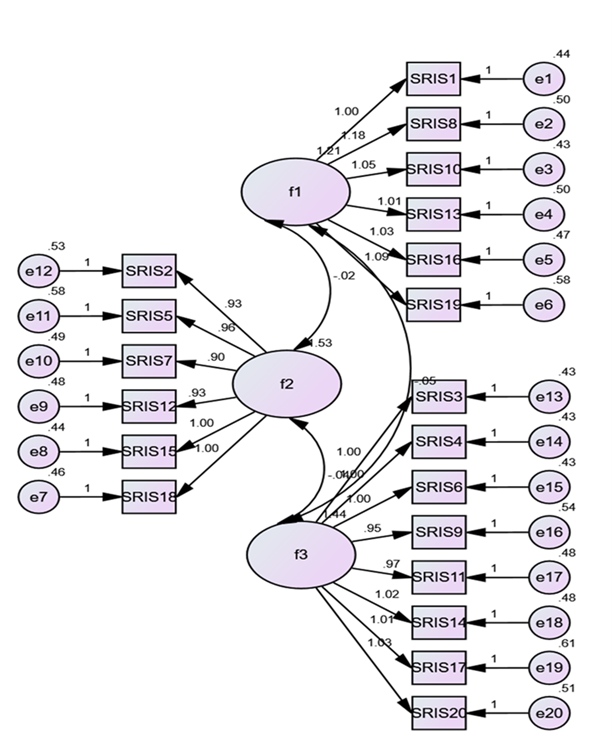
The original Self-Reflection and Insight Scale (SRIS; Grant et al., 2002) was translated into Urdu by using guidelines of Beaton et al.’s (2000) Cross-Cultural Adaptation of Self-Report Measures. It was given to a sample of 300 individuals (aged 18-30 years). Exploratory factor analysis (EFA) and confirmatory factor analysis (CFA) validated the scale's three-component model. A clean factor structure was produced by the analysis, and factor loadings for each item ranged from roughly .86 to .89, demonstrating high correlations between the factors and the items. The first factor explained 22.98% of the variation, and the extracted factors explained 78.11% of the cumulative variance. The model fit indices, which were χ²/df 1.180, GFI .940, AGFI .924, CFI .994, IFI .994, and RMSEA .025, displaying a good match to the data. The degree of internal consistency was great, .84 in total (α = .86 Engagement, α = .86 for Self-Reflection Need, and α = .87 for Insight). Additionally, the scale showed respectable levels of convergent validity and composite reliability. Strong criterion-related validity was demonstrated by the Urdu version of SRIS, which had significant negative correlations with measures of social anxiety and stress. The removal of language barrier contributed to inclusivity in testing and research. This validation of the scale provides a basis for conducting cross-cultural comparisons across different populations. In the areas like personality development, education, and counselling, the valid Urdu version will help in research. These results imply that the Urdu-translated SRIS is a reliable psychometric tool for self-awareness in Urdu-speaking communities.
Downloads
References
Aukes, L. C., Geertsma, J., Cohen-Schotanus, J., Zwierstra, R. P., & Slaets, J. P. J. (2007). The development of a scale to measure personal reflection in medical practice and education. Medical Teacher, 29(2–3), 177–182. https://doi.org/10.1080/01421590701299272
Aziz, A., Mahboob, U., & Saleem, T. (2020). Benefits of reflective writing in health care through the vivid lens of house officers. MedEdPublish, 9, Article e60. https://doi.org/10.15694/mep.2020.000060.1
Beaton, D. E., Bombardier, C., Guillemin, F., & Ferraz, M. B. (2000). Guidelines for the process of cross-cultural adaptation of self-report measures. Spine, 25(24), 3186–3191. https://doi.org/10.1097/00007632-200012150-00014
Beck, A. T., Baruch, E., Balter, J. M., Steer, R. A., & Warman, D. M. (2004). A new instrument for measuring insight: The Beck Cognitive Insight Scale. Schizophrenia Research, 68(2–3), 319–329. https://doi.org/10.1016/S0920-9964(03)00189-0
Brislin, R. W. (1976). Comparative research methodology: Cross-cultural studies. International Journal of Psychology, 11(3), 215–229. https://doi.org/10.1080/00207597608247359
Brown, K. W., & Ryan, R. M. (2003). The benefits of being present: Mindfulness and its role in psychological well-being. Journal of Personality and Social Psychology, 84(4), 822–848. https://doi.org/10.1037/0022-3514.84.4.822
Bucknell, K. J., Hoare, S., Kangas, M., Karin, E., & Crane, M. F. (2024). A mixed-methods study exploring coping self-insights associated with resilience. Behavioral Sciences, 14(11), Article e1018. https://doi.org/10.3390/bs14111018
Cabrera-Nguyen, P. (2010). Author guidelines for reporting scale development and validation results. Journal of the Society for Social Work and Research, 1(2), 99–103. https://doi.org/10.5243/jsswr.2010.8
Carr, S. E., & Johnson, P. H. (2013). Does self-reflection and insight correlate with academic performance in medical students? BMC Medical Education, 13, Article e113. https://doi.org/10.1186/1472-6920-13-113
Chen, F., Curran, P. J., Bollen, K. A., Kirby, J., & Paxton, P. (2008). An empirical evaluation of the use of fixed cutoff points in RMSEA test statistic in structural equation models. Sociological Methods & Research, 36(4), 462–494. https://doi.org/10.1177/0049124108314720
Cohen, S., Kamarck, T., & Mermelstein, R. (1983). A global measure of perceived stress. Journal of Health and Social Behavior, 24(4), 385–396. https://doi.org/10.2307/2136404
Eng, C.-J., & Pai, H.-C. (2015). Determinants of nursing competence of nursing students in Taiwan: The role of self-reflection and insight. Nurse Education Today, 35(3), 450–455. https://doi.org/10.1016/j.nedt.2014.11.021
Falon, S. L., Kangas, M., & Crane, M. F. (2021). The coping insights involved in strengthening resilience: The Self-Reflection and Coping Insight Framework. Anxiety, Stress, & Coping, 34(6), 734–750. https://doi.org/10.1080/10615806.2021.1910676
Fenigstein, A., Scheier, M. F., & Buss, A. H. (1975). Public and private self-consciousness: Assessment and theory. Journal of Consulting and Clinical Psychology, 43(4), 522–527. https://doi.org/10.1037/h0076760
Field, A. (2018). Discovering statistics using IBM SPSS statistics (5th ed.). SAGE Publications.
Grant, A. M., Franklin, J., & Langford, P. (2002). The Self-Reflection and Insight Scale: A new measure of private self-consciousness. Social Behavior and Personality: An International Journal, 30(8), 821–836. https://doi.org/10.2224/sbp.2002.30.8.821
Kumar, B., Shah, M. A. A., Kumari, R., Kumar, A., Kumar, J., & Tahir, A. (2019). Depression, anxiety, and stress among final-year medical students. Cureus, 11(3), Article e4257. https://doi.org/10.7759/cureus.4257
Lilienfeld, S. O., & Basterfield, C. (2020). Reflective practice in clinical psychology: Reflections from basic psychological science. Clinical Psychology: Science and Practice, 27(4), Article e12352. https://doi.org/10.1111/cpsp.12352
Lyke, J. A. (2009). Insight, but not self-reflection, is related to subjective well-being. Personality and Individual Differences, 46(1), 66–70. https://doi.org/10.1016/j.paid.2008.09.010
Majolo, M., Gomes, W. B., & DeCastro, T. G. (2023). Self-consciousness and self-awareness: Associations between stable and transitory levels of evidence. Behavioral Sciences, 13(2), Article 117. https://doi.org/10.3390/bs13020117
Marques, D., Pinheiro, M. R., Matos, A. P., & Marques, C. (2014). Confirmatory factor analysis of the QRI father’s version in a Portuguese sample of adolescents. Procedia - Social and Behavioral Sciences, 165, 267–274. https://doi.org/10.1016/j.sbspro.2014.12.631
Mattick, R. P., & Clarke, J. C. (1998). Development and validation of measures of social phobia scrutiny fear and social interaction anxiety. Behaviour Research and Therapy, 36(4), 455–470. https://doi.org/10.1016/S0005-7967(97)10031-6
Moon, J. A. (2004). A handbook of reflective and experiential learning: Theory and practice. Routledge. https://doi.org/10.4324/9780203416150
Mufti, S., Jamil, B., Mufti, A. A., & Baseer, S. (2025). Reflective practices among postgraduate medical students to improve their learning outcomes: A qualitative exploratory study. Liaquat National Journal of Primary Care, 7(1), 46–50. https://doi.org/10.37184/lnjpc.2707-3521.7.28
Muhammad, Y., Waqar, Y., & Safdar, S. (2024). Evaluating the quality of student reflections in a peace education classroom taught with pedagogy of discomfort. Journal of Social Research Development, 5(2), 195–206. https://doi.org/10.53664/JSRD/05-02-2024-16-195-206
Ong, D. J., Aslam, S., & Amjad, A. I. (2024). Interactive tablets: Catalyzing engaged science learning in English instruction. World Journal of English Language, 14(5), 413–423. https://doi.org/10.5430/wjel.v14n5p413
Qamar, K., Kiran, F., Zubair, U. B., & Tayyab, A. (2022). Using Pensieve: Guiding and evaluating a learning session on reflections. Journal of the College of Physicians and Surgeons Pakistan, 32(1), 125–127. https://doi.org/10.29271/jcpsp.2022.01.125
Roberts, C., & Stark, P. (2008). Readiness for self-directed change in professional behaviours: Factorial validation of the Self-Reflection and Insight Scale. Medical Education, 42(11), 1054–1063. https://doi.org/10.1111/j.1365-2923.2008.03156.x
Rice, K., Schutte, N. S., Cosh, S. M., Rock, A. J., Banner, S. E., & Sheen, J. (2022, June). The utility and development of the competencies of professional psychology rating scales (COPPR). In Frontiers in Education, 7, Article e818077.
Rodolico, A., Cutrufelli, P., Brondino, N., Caponnetto, P., Catania, G., Concerto, C., Fusar-Poli, L., Mineo, L., Sturiale, S., Signorelli, M. S., & Petralia, A. (2023). Mental pain correlates with mind wandering, self-reflection, and insight in individuals with psychotic disorders: A cross-sectional study. Brain Sciences, 13(11), Article e1557. https://doi.org/10.3390/brainsci13111557
Sathyanarayana, S., & Mohanasundaram, T. (2024). Fit indices in structural equation modeling and confirmatory factor analysis: Reporting guidelines. Asian Journal of Economics, Business and Accounting, 24(7), 561–577. https://doi.org/10.9734/ajeba/2024/v24i71430
Scheier, M. F., & Carver, C. S. (1985). The Self-Consciousness Scale: A revised version for use with general populations. Journal of Applied Social Psychology, 15(8), 687–699. https://doi.org/10.1111/j.1559-1816.1985.tb02268.x
Schumacker, R. E., & Lomax, R. G. (2010). A beginner’s guide to structural equation modeling (3rd ed.). Routledge.
Silvia, P. J. (2022). The Self-Reflection and Insight Scale: Applying item response theory to craft an efficient short form. Current Psychology, 41(12), 8635–8645. https://doi.org/10.1007/s12144-020-01299-7
Tabachnick, B. G., & Fidell, L. S. (2019). Using multivariate statistics (7th ed.). Pearson.
Wang, L. (2023). How self-reflection and resilience can affect pre-competition anxiety? Evidence from national competitive table tennis in adolescent players. Current Psychology, 42, 12034–12044. https://doi.org/10.1007/s12144-021-02473-1
Wild, D., Grove, A., Martin, M., Eremenco, S., McElroy, S., Verjee-Lorenz, A., & Erikson, P. (2005). Principles of good practice for the translation and cultural adaptation process for patient-reported outcomes (PRO) measures: Report of the ISPOR Task Force for Translation and Cultural Adaptation. Value in Health, 8(2), 94–104. https://doi.org/10.1111/j.1524-4733.2005.04054.x
Zia, F., Naseem, A., & Safdar, S. (2024). The role of critical reflection in online teaching. Pakistan Social Sciences Review, 8(3), 66–74. https://doi.org/10.35484/pssr.2024(8-III)05
Downloads
Published
How to Cite
Issue
Section
License
Copyright (c) 2026 Nida Munawar, Syeda Farhana Kazmi

This work is licensed under a Creative Commons Attribution 4.0 International License.
CCPR follows an open-access publishing policy and full text of all published articles is available free, immediately upon publication of an issue. The journal’s contents are published and distributed under the terms of the Creative Commons Attribution 4.0 International (CC-BY 4.0) license. Thus, the work submitted to the journal implies that it is original, unpublished work of the authors (neither published previously nor accepted/under consideration for publication elsewhere). On acceptance of a manuscript for publication, a corresponding author on the behalf of all co-authors of the manuscript will sign and submit a completed the Copyright and Author Consent Form.