
Gendered Mobility Constraints in Semi-Formal Urban Transport Systems: An Empirical Study of Para-Transit in Lahore
DOI:
https://doi.org/10.32350/jaabe.82.03Keywords:
gendered mobility, women's safety, Para-transit, urban transport, theory of planned behavior, transport equity, gender-responsive planningAbstract
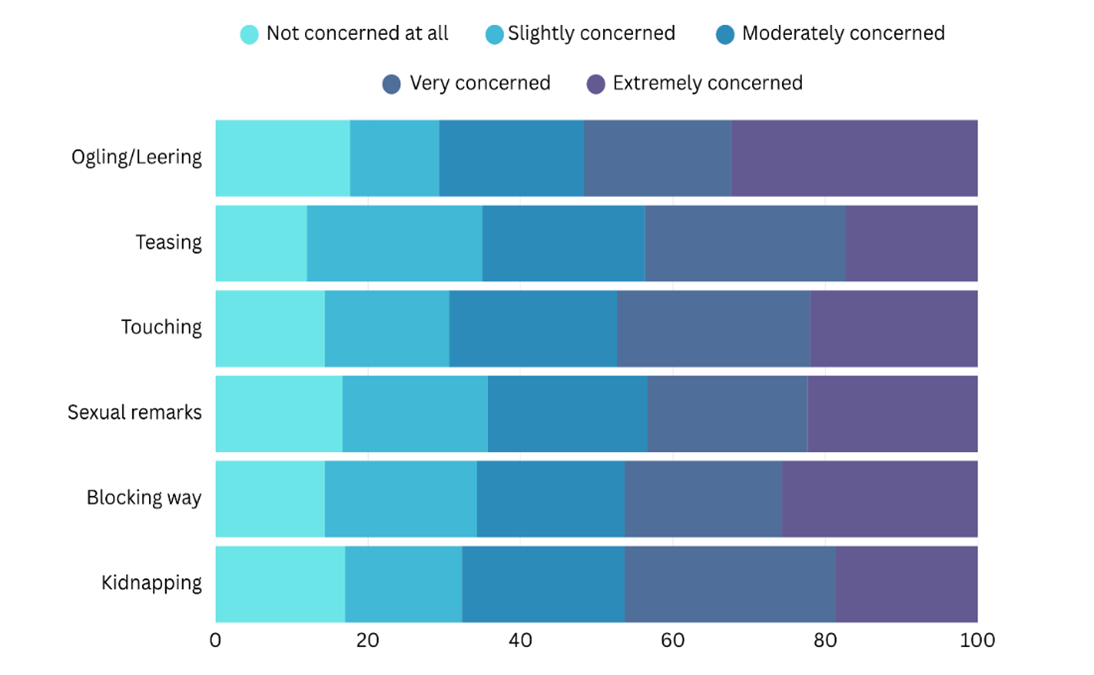
The findings of this study disclose a very harassing environment where a significant majority reported frequent experiences of harassment in the forms of verbal intimidation and physical intimidation both at the time of waiting, while on travel, and upon arrival. These safety concerns further worsen with poorly maintained and male-dominated waiting areas, coupled with a deep-seated institutional lack of trust. The paper concludes that such barriers considerably reduce the mobility of women to access education, employment, and civic engagement and thereby undermine the urban autonomy of women. It argues that only an integrated intervention-a regulatory, infrastructural design and technological solution, along with deep-seated social attitudes-can bring about change in paratransit from a source of risk to a pillar for equitable mobility through participatory, gender-responsive planning.
Downloads
References
Adu-Gyamfi, A. (2020). Planning for peri urbanism: Navigating the complex terrain of transport services. Land Use Policy, 92, Article e104440. https://doi.org/10.1016/j.landusepol.2019.104440
Amber, H., Chichaibelu, B. B., & Hussain, A. (2023). Driving economic empowerment: Harnessing public and private transportation for women in Pakistan (International Growth Centre Working Paper No. C-89312-PAK-1). International Growth Centre. https://www.theigc.org/wp-content/uploads/2023/02/Amber-et-al-2023-Womens-transport-Pakistan.pdf
Arshad, E. (2024, December 31). Women’s mobility in Pakistan: Patterns, barriers and policy options. Centre for Development and Policy Research. https://www.cdpr.org.pk/womens-mobility-in-pakistan/
Berik, G. (2023). Capability approach to public-space harassment of women: Evidence from South Asia. Feminist Economics, 29(1), 45–72. https://doi.org/10.1080/13545701.2022.2144327
Clark, T. (2020). Gritty city life: Reframing the ethics of urban ethnography. Qualitative Research, 20(1), 3–19. https://doi.org/10.1177/1468794119830066
Iqbal, S. (2020). The effects of gender transport poverty in Karachi. Transport Policy, 92, 1–12. https://doi.org/10.1016/j.tranpol.2020.02.001
Javid, M. A., Hussain, S., & Anwaar, M. F. (2020). Passenger’s perceptions on prospects of Qingqi paratransit public transport service in Lahore. Iranian Journal of Science and Technology, Transactions of Civil Engineering, 44(1), 185–195. https://doi.org/10.1007/s40996-019-00273-z
Mouratidis, K., Peters, S., & van Wee, B. (2021). Transportation technologies, sharing economy, and teleactivities: Implications for built environment and travel. Transportation Research Part D: Transport and Environment, 92, Article e102716. https://doi.org/10.1016/j.trd.2021.102716
Mowri, S., Bailey, A., Helbich, M., Ettema, D., & Hasan, M. M. U. (2024). Safety interventions for women in urban public transport of South Asia: A systematic review and synthesis. Transportation Research Part A: Policy and Practice, 179, 103–122. https://doi.org/10.1016/j.tra.2023.103122
Ng, W.-S., & Acker, A. (2018). Understanding urban travel behaviour by gender for efficient and equitable transport policies (International Transport Forum Policy Papers No. 56). OECD Publishing. https://doi.org/10.1787/eaf64f94-en
Saleemi, H. (2025). Analyzing women’s security in public transportation: Local evidence and policy implications. Safety Science, 11(3), Article e82. https://doi.org/10.3390/safety11030082
Shoaib, A. (2025). Addressing women’s mobility challenges in the public transport system of Lahore: A mixed-methods study. Journal of Transport Geography, 115, 103–118. https://doi.org/10.1016/j.jtrangeo.2025.103118
Tabassum, S. (2022). Sexual harassment on public transport: A survey study of Rawalpindi. Journal of Humanities & Social Sciences Research, 8(3), 145–162. https://doi.org/10.1080/12345678.2022.1234567
Taubenböck, H., Kraft, N. J., & Wurm, M. (2019). The morphology of the arrival city: A global categorization based on literature surveys and remotely sensed data. Applied Geography, 110, Article e102048. https://doi.org/10.1016/j.apgeog.2019.102048
UN Women. (2018). Women’s safety audit in public transport in Lahore: Findings and recommendations. UN Women Pakistan. https://asiapacific.unwomen.org/en/digital-library/publications/2018/10/womens-safety-audit-in-public-transport-in-lahore
Published
How to Cite
Issue
Section
License
Copyright (c) 2025 Manahal Fatima, Minahil Nasir, Muzaffar Aziz Iqbal

This work is licensed under a Creative Commons Attribution 4.0 International License.
JAABE follows an open-access publishing policy and full text of all published articles is available free, immediately upon publication of an issue. The journal’s contents are published and distributed under the terms of the Creative Commons Attribution 4.0 International (CC-BY 4.0) license. Thus, the work submitted to the journal implies that it is original, unpublished work of the authors (neither published previously nor accepted/under consideration for publication elsewhere). On acceptance of a manuscript for publication, a corresponding author on the behalf of all co-authors of the manuscript will sign and submit a completed Copyright and Author Consent Form.
Copyright (c) The Authors