
Shibuya Station as a Megastructure: Lessons for Future Urban Mobility
DOI:
https://doi.org/10.32350/jaabe.91.03Keywords:
compact city, megastructure, sustainable mobility, transportation hub, urban density, urban regenerationAbstract
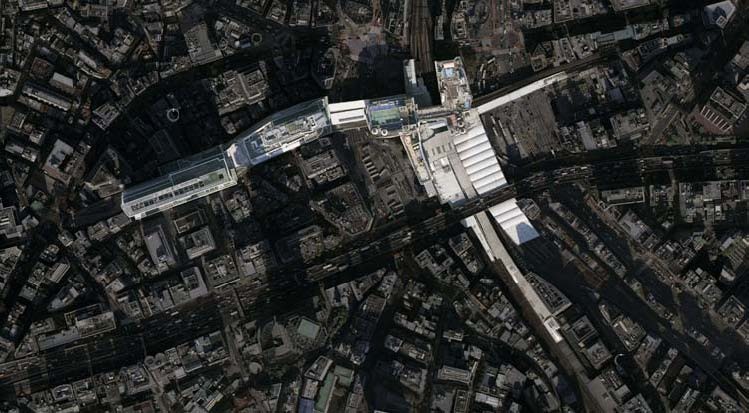
Shibuya Station is regarded as a highly complicated transportation space in modern day Tokyo. The complication stems from overlaying railway networks, underground networks, commercial projects, as well as highly-dense urban environment. Therefore, the current study aimed to analyze Shibuya Station in terms of megastructural assemblage, wherein the spatial arrangement of the station has undergone phases of growth and restructuring. The station was analyzed by performing a qualitative architectural reading of its infrastructural layering, integration of functions, and its connection with the environment in the city. Instead of suggesting a prescriptive model, the research established repetitive space conditions including incremental expansion, compromising of activities, and long-term adaptability, defining big metropolis mobility centers. The study situated Shibuya Station, in the context of the current discussions on the urban movement and large-scale infrastructures, to assume an important part in the critical comprehension of how large transport nodes are formed by dense urban landscapes.
Downloads
References
Ali, F., Bhatti, O. S., Iftakhar, N., & Nadeem, H. M. A. (2024). Evaluation of LEED certification potential for built environment pedagogy at undergraduate level in Pakistan: Case for architecture & design domains. International Journal of Human and Society, 4(2), 1061–1078. https://ijhs.com.pk/index.php/IJHS/article/view/772
Banham, R. (1976). Megastructure: Urban futures of the recent past. Thames & Hudson.
Bertolini, L., & Spit, T. (2019). Cities on rails: The redevelopment of railway station areas. Routledge.
Calimente, J. (2012). Rail integrated communities in Tokyo. Journal of Urban Design, 17(1), 53–73. https://doi.org/10.1080/13574809.2011.639435
Cook, P. (2003). The city seen as a garden of ideas. The Monacelli Press.
Gerkan, M. von. (1997). Transportation architecture. Birkhäuser.
Imai, K., & Tokyo Institute of Technology Tsukamoto. (Eds.). (2002). Pet architecture guidebook. World Photo Press.
Maki, F. (1964). Investigations in collective form. Washington University. https://doi.org/10.7936/3r0q-4715
Newman, P., & Kenworthy, J. (2015). The end of automobile dependence: How cities are moving beyond car-based planning. Island Press.
Sadler, S. (2005). Archigram: Architecture without architecture. MIT Press.
Salat, S., & Ollivier, G. (2017). Transforming the urban space through transit-oriented development: The 3V approach. World Bank. https://openknowledge.worldbank.org/entities/publication/c66e4233-79c8-5cd2-acd5-e3d803a5e9a2
Shah, F. H., Bhatti, O. S., & Ahmed, S. (2023a). A review of the effects of project management practices on cost overrun in construction projects. Engineering Proceedings, 44(1), 1–5. https://doi.org/10.3390/engproc2023044001
Shah, F. H., Bhatti, O. S., & Ahmed, S. (2023b). Project management practices in construction projects and their roles in achieving sustainability: A comprehensive review. Engineering Proceedings, 44(1), 1–5. https://doi.org/10.3390/engproc2023044002
Sheller, M. (2018). Mobility justice: The politics of movement in an age of extremes. Verso Books.
Sorensen, A., & Okata, J. (Eds.). (2011). Megacities: Urban form and sustainability. Springer.
Zahra, F. R., Tariq, F., Bhatti, O. S., & A. A. (2025). From crisis to prevention: Documenting and highlighting the missing role of architect in post-pandemic healthcare of Pakistan. Multidisciplinary Surgical Research Annals, 3(2), 34–45.
Zainab, A., Iftakhar, A. N., & Bhatti, O. S. (2023). Community perception of urban open spaces and quality of life: A case study of selected urban parks in twin cities of Pakistan. International Journal of Contemporary Issues in Social Sciences, 2(4), 1335–1351.
Downloads
Published
How to Cite
Issue
Section
License
Copyright (c) 2026 Antonio Luque Aranda

This work is licensed under a Creative Commons Attribution 4.0 International License.
JAABE follows an open-access publishing policy and full text of all published articles is available free, immediately upon publication of an issue. The journal’s contents are published and distributed under the terms of the Creative Commons Attribution 4.0 International (CC-BY 4.0) license. Thus, the work submitted to the journal implies that it is original, unpublished work of the authors (neither published previously nor accepted/under consideration for publication elsewhere). On acceptance of a manuscript for publication, a corresponding author on the behalf of all co-authors of the manuscript will sign and submit a completed Copyright and Author Consent Form.
Copyright (c) The Authors