
Role of Curcumin in Prevention of NAFLD Pathogenesis: Insights into Key Metabolic and Inflammatory Signaling Pathways
DOI:
https://doi.org/10.32350/sir.102.02Keywords:
curcumin, inflammation, liver, Non-alcoholic Fatty Liver Disease (NAFLD), treatment strategiesAbstract
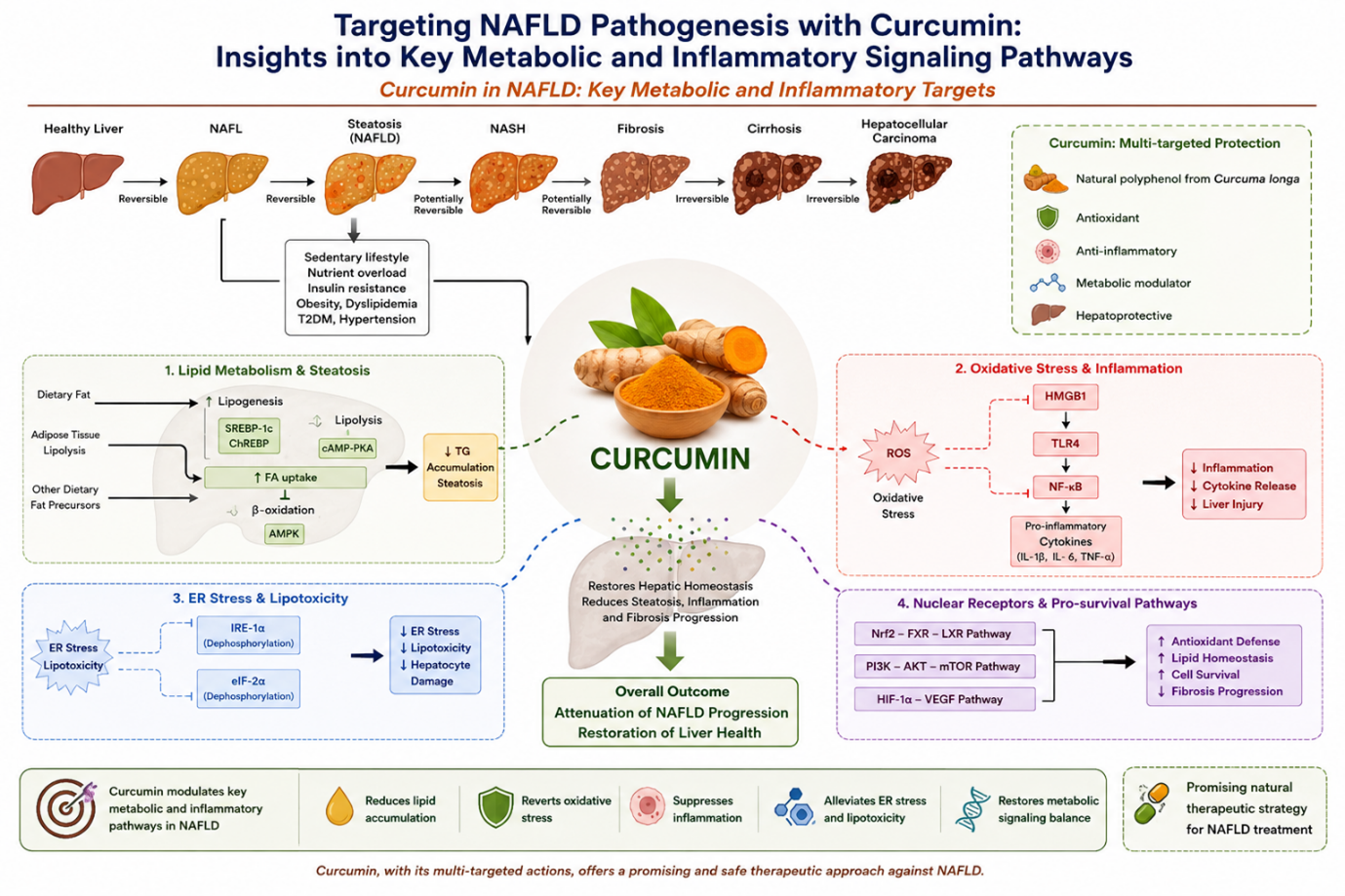
Non-alcoholic Fatty Liver Disease (NAFLD), characterized by an elevated level of lipid accumulation in the liver, is the most widespread form of hepatic disorders, affecting 32% of the global population. In certain people, NAFLD may progress to the more advanced form, Non-alcoholic Steatohepatitis NASH (reversible), by developing inflammation and, in some cases, liver cirrhosis (irreversible). In turn, both NASH and cirrhotic livers have an increased chance of developing Hepatocellular Carcinoma (HCC) within the affected parenchyma. NAFLD, resulting from nutrient overload and a sedentary lifestyle, has a complex pathogenesis. This includes metabolic dysfunctions, such as insulin resistance, atherosclerosis, obesity, dyslipidemia, and hypertension. Resultantly, this leads towards oxidative stress, Endoplasmic Reticulum (ER) stress, and inflammatory response, consequently causing liver injury and inflammation. NAFLD is predicted to become the most common indication for liver transplantation by 2030. Currently, lifestyle modification strategies with few pharmacological options are available to control the progression of this disease. A few drugs resmetirom (FDA approved), statins, metformin, and fibrates, are currently in the market but they have notable side effects (osteoporosis and secondary infections). Hence, there is a dire need for a novel drug candidate with high efficiency and fewer side effects. This review focused on the therapeutic potential of curcumin, extracted from Curcuma longa, in preventing and modulating the key pathways involved in the pathogenesis of NAFLD as an innovative treatment candidate. The study conducted a comprehensive and collective analysis of the available literature to create a single document covering all the pathogenic aspects of NAFLD and explored the treatment strategies using curcumin. It should be noted that the current data on curcumin has been predominantly derived from preclinical sources, such as in-vitro, animal, and in-silico studies, with human trial evidences on curcumin remaining comparatively limited.
Downloads
References
1. Zhang Y, Luo M, Ming Y. Global burden of cirrhosis and other chronic liver diseases caused by specific etiologies from 1990 to 2021. BMC Gastroenterol. 2025;25:e641. https://doi.org/10.1186/s12876-025-04264-5
2. Loomba R, Friedman SL, Shulman GI. Mechanisms and disease consequences of nonalcoholic fatty liver disease. Cell. 2021;184(10):2537–2564. https://doi.org/10.1016/j.cell.2021.04.015
3. Riazi K, Azhari H, Charette JH, et al. The prevalence and incidence of NAFLD worldwide: A systematic review and meta-analysis. Lancet Gastroenterol Hepatol. 2022;7(9):851–861. https://doi.org/10.1016/S2468-1253(22)00165-0
4. Sukare JG. Pathology of Experimentally Induced Fatty Liver Disease in Chicken [thesis]. Maharashtra Animal and Fishery Sciences University; 2023.
5. Bessone F, Razori MV, Roma MG. Molecular pathways of nonalcoholic fatty liver disease development and progression. Cell Mol Life Sci. 2019;76(1):99–128. https://doi.org/10.1007/s00018-018-2947-0
6. Leoni S, Tovoli F, Napoli L, Serio I, Ferri S, Bolondi L. Current guidelines for the management of non-alcoholic fatty liver disease: A systematic review with comparative analysis. World J Gastroenterol. 2018;24(30):3361–3373. https://doi.org/10.3748/wjg.v24.i30.3361
7. Guo X, Yin X, Liu Z, Wang J. Non-alcoholic fatty liver disease (NAFLD) pathogenesis and natural products for prevention and treatment. Int J Mol Sci. 2022;23(24):e15489. https://doi.org/10.3390/ijms232415489
8. Marchesini G, Bugianesi E, Forlani G, et al. Nonalcoholic fatty liver, steatohepatitis, and the metabolic syndrome. Hepatology. 2003;37(4):917–923. https://doi.org/10.1053/jhep.2003.50161
9. Pouwels S, Sakran N, Graham Y, et al. Non-alcoholic fatty liver disease (NAFLD): A review of pathophysiology, clinical management and effects of weight loss. BMC Endocr Disord. 2022;22:e63. https://doi.org/10.1186/s12902-022-00980-1
10. Idilman IS, Ozdeniz I, Karcaaltincaba M. Hepatic steatosis: Etiology, patterns, and quantification. Semin Ultrasound CT MR. 2016;37(6):501–510. https://doi.org/10.1053/j.sult.2016.08.003
11. Harrison SA, Bedossa P, Guy CD, et al. A phase 3, randomized, controlled trial of resmetirom in NASH with liver fibrosis. N Engl J Med. 2024;390(6):497–509. https://doi.org/10.1056/NEJMoa2309000
12. Madrigal Pharmaceuticals, Inc. Madrigal Pharmaceuticals reports second-quarter 2024 financial results and provides corporate updates. Madrigal Pharmaceuticals. Published August 7, 2024. Accessed September 10, 2026. https://ir.madrigalpharma.com/news-releases/news-release-details/madrigal-pharmaceuticals-reports-second-quarter-2024-financial
13. US Food and Drug Administration. FDA approves first treatment for patients with liver scarring due to fatty liver disease. US Food and Drug Administration. Published March 14, 2024. Accessed September 10, 2026. https://www.fda.gov/news-events/press-announcements/fda-approves-first-treatment-patients-liver-scarring-due-fatty-liver-disease
14. Byrne CD, Targher G. NAFLD: A multisystem disease. J Hepatol. 2015;62(1 suppl):S47–S64. https://doi.org/10.1016/j.jhep.2014.12.012
15. Sookoian S, Pirola CJ. Precision medicine in nonalcoholic fatty liver disease: New therapeutic insights from genetics and systems biology. Clin Mol Hepatol. 2020;26(4):461–475. https://doi.org/10.3350/cmh.2020.0136
16. Nobili V, Alisi A, Valenti L, Miele L, Feldstein AE, Alkhouri N. NAFLD in children: New genes, new diagnostic modalities and new drugs. Nat Rev Gastroenterol Hepatol. 2019;16(9):517–530. https://doi.org/10.1038/s41575-019-0169-z
17. Chen Q, Wang T, Li J, et al. Effects of natural products on fructose-induced nonalcoholic fatty liver disease (NAFLD). Nutrients. 2017;9(2):e96. https://doi.org/10.3390/nu9020096
18. Reimer KC, Wree A, Roderburg C, Tacke F. New drugs for NAFLD: Lessons from basic models to the clinic. Hepatol Int. 2020;14(1):8–23. https://doi.org/10.1007/s12072-019-10001-4
19. Afshari AR, Jalili-Nik M, Abbasinezhad-Moud F, et al. Anti-tumor effects of curcuminoids in glioblastoma multiforme: An updated literature review. Curr Med Chem. 2021;28(39):8116–8138. https://doi.org/10.2174/0929867327666201111145212
20. Shakeri A, Cicero AFG, Panahi Y, Mohajeri M, Sahebkar A. Curcumin: A naturally occurring autophagy modulator. J Cell Physiol. 2019;234(5):5643–5654. https://doi.org/10.1002/jcp.27404
21. Machado MV, Cortez-Pinto H. Non-alcoholic fatty liver disease: What the clinician needs to know. World J Gastroenterol. 2014;20(36):12956–12980. https://doi.org/10.3748/wjg.v20.i36.12956
22. Zechner R, Kienesberger PC, Haemmerle G, Zimmermann R, Lass A. Adipose triglyceride lipase and the lipolytic catabolism of cellular fat stores. J Lipid Res. 2009;50(1):3–21. https://doi.org/10.1194/jlr.R800031-JLR200
23. Chen Z, Tian R, She Z, Cai J, Li H. Role of oxidative stress in the pathogenesis of nonalcoholic fatty liver disease. Free Radic Biol Med. 2020;152:116–141. https://doi.org/10.1016/j.freeradbiomed.2020.02.025
24. Ameer F, Scandiuzzi L, Hasnain S, Kalbacher H, Zaidi N. De novo lipogenesis in health and disease. Metabolism. 2014;63(7):895–902. https://doi.org/10.1016/j.metabol.2014.04.003
25. Begriche K, Igoudjil A, Pessayre D, Fromenty B. Mitochondrial dysfunction in NASH: Causes, consequences and possible means to prevent it. Mitochondrion. 2006;6(1):1–28. https://doi.org/10.1016/j.mito.2005.10.004
26. Marra F, Svegliati-Baroni G. Lipotoxicity and the gut-liver axis in NASH pathogenesis. J Hepatol. 2018;68(2):280–295. https://doi.org/10.1016/j.jhep.2017.11.014
27. Fan JG, Kim SU, Wong VWS. New trends on obesity and NAFLD in Asia. J Hepatol. 2017;67(4):862–873. https://doi.org/10.1016/j.jhep.2017.06.003
28. Sakurai Y, Kubota N, Yamauchi T, Kadowaki T. Role of insulin resistance in MAFLD. Int J Mol Sci. 2021;22(8):e4156. https://doi.org/10.3390/ijms22084156
29. Basaranoglu M, Basaranoglu G, Sabuncu T, Sentürk H. Fructose as a key player in the development of fatty liver disease. World J Gastroenterol. 2013;19(8):1166–1172. https://doi.org/10.3748/wjg.v19.i8.1166
30. Todisco S, Santarsiero A, Convertini P, et al. PPAR alpha as a metabolic modulator of the liver: Role in the pathogenesis of nonalcoholic steatohepatitis (NASH). Biology (Basel). 2022;11(5):e792. https://doi.org/10.3390/biology11050792
31. Li W, Cao T, Luo C, et al. Crosstalk between ER stress, NLRP3 inflammasome, and inflammation. Appl Microbiol Biotechnol. 2020;104(14):6129–6140. https://doi.org/10.1007/s00253-020-10614-y
32. Tabas I, Ron D. Integrating the mechanisms of apoptosis induced by endoplasmic reticulum stress. Nat Cell Biol. 2011;13(3):184–190. https://doi.org/10.1038/ncb0311-184
33. van Meer G. Membrane lipids, where they are and how they behave: Sphingolipids on the move. FASEB J. 2010;24(suppl 1):e312.1. https://doi.org/10.1096/fasebj.24.1_supplement.312.1
34. Pan D, Yang Y, Nong A, Tang Z, Li QX. GRP78 activity moderation as a therapeutic treatment against obesity. Int J Environ Res Public Health. 2022;19(23):e15965. https://doi.org/10.3390/ijerph192315965
35. Flamment M, Kammoun HL, Hainault I, Ferré P, Foufelle F. Endoplasmic reticulum stress: A new actor in the development of hepatic steatosis. Curr Opin Lipidol. 2010;21(3):239–246. https://doi.org/10.1097/MOL.0b013e3283395e5c
36. Puri P, Mirshahi F, Natarajan R, Maher JW, Kellum JM, Sanyal AJ. Differential activation and dysregulation of unfolded protein response (UPR) in nonalcoholic fatty liver disease (NAFLD): Implications for pathogenesis. Hepatology. 2006;44(suppl 1):e213A.
37. Gentile CL, Frye M, Pagliassotti MJ. Endoplasmic reticulum stress and the unfolded protein response in nonalcoholic fatty liver disease. Antioxid Redox Signal. 2011;15(2):505–521. https://doi.org/10.1089/ars.2010.3790
38. Rong L, Zou J, Ran W, et al. Advancements in the treatment of non-alcoholic fatty liver disease (NAFLD). Front Endocrinol (Lausanne). 2023;13:e1087260. https://doi.org/10.3389/fendo.2022.1087260
39. Buzzetti E, Pinzani M, Tsochatzis EA. The multiple-hit pathogenesis of non-alcoholic fatty liver disease (NAFLD). Metabolism. 2016;65(8):1038–1048. https://doi.org/10.1016/j.metabol.2015.12.012
40. Abenavoli L, Larussa T, Corea A, et al. Dietary polyphenols and non-alcoholic fatty liver disease. Nutrients. 2021;13(2):494. https://doi.org/10.3390/nu13020494
41. Basnet P, Skalko-Basnet N. Curcumin: An anti-inflammatory molecule from a curry spice on the path to cancer treatment. Molecules. 2011;16(6):4567–4598. https://doi.org/10.3390/molecules16064567
42. Esatbeyoglu T, Huebbe P, Ernst IMA, Chin D, Wagner AE, Rimbach G. Curcumin—from molecule to biological function. Angew Chem Int Ed Engl. 2012;51(22):5308–5332. https://doi.org/10.1002/anie.201107724
43. Ayati Z, Ramezani M, Amiri MS, et al. Ethnobotany, phytochemistry and traditional uses of Curcuma spp. and pharmacological profile of two important species (C. longa and C. zedoaria): A review. Curr Pharm Des. 2019;25(8):871–935. https://doi.org/10.2174/1381612825666190402163940
44. Lobo R, Prabhu KS, Shirwaikar A, Shirwaikar A. Curcuma zedoaria Rosc. (white turmeric): A review of its chemical, pharmacological and ethnomedicinal properties. J Pharm Pharmacol. 2009;61(1):13–21. https://doi.org/10.1211/jpp/61.01.0003
45. Ashraf A, Rather SA, Mehraj M. Evaluation of Curcuma zedoaria Rosc. in the management of non-alcoholic fatty liver disease: A randomized, single blind, controlled trial. Arab J Gastroenterol. 2025;26(1):112–119. https://doi.org/10.1016/j.ajg.2025.01.004
46. Jarhahzadeh M, Alavinejad P, Farsi F, Husain D, Rezazadeh A. The effect of turmeric on lipid profile, malondialdehyde, liver echogenicity and enzymes among patients with nonalcoholic fatty liver disease: A randomized double blind clinical trial. Diabetol Metab Syndr. 2021;13:e112. https://doi.org/10.1186/s13098-021-00731-7
47. Rahmani S, Asgary S, Askari G, et al. Treatment of non-alcoholic fatty liver disease with curcumin: A randomized placebo-controlled trial. Phytother Res. 2016;30(9):1540–1548. https://doi.org/10.1002/ptr.5659
48. Saadati S, Sadeghi A, Mansour A, et al. Curcumin and inflammation in non-alcoholic fatty liver disease: A randomized, placebo controlled clinical trial. BMC Gastroenterol. 2019;19:e133. https://doi.org/10.1186/s12876-019-1055-4
49. Panknin TM, Howe CL, Hauer M, Bucchireddigari B, Rossi AM, Funk JL. Curcumin supplementation and human disease: A scoping review of clinical trials. Int J Mol Sci. 2023;24(5):e4476. https://doi.org/10.3390/ijms24054476
50. Jafari A, Abbastabar M, Alaghi A, Heshmati J, Crowe FL, Sepidarkish M. Curcumin on human health: A comprehensive systematic review and meta-analysis of 103 randomized controlled trials. Phytother Res. 2024;38(12):6048–6061. https://doi.org/10.1002/ptr.8340
51. Zingg JM, Hasan S, Azzi A, Meydani M. Molecular mechanisms of hypolipidemic effects of curcumin. FASEB J. 2013;27(suppl 1):e637.37. https://doi.org/10.1096/fasebj.27.1_supplement.637.37
52. Liu S, Liu J, He L, et al. A comprehensive review on the benefits and problems of curcumin with respect to human health. Molecules. 2022;27(14):e4400. https://doi.org/10.3390/molecules27144400
53. Mahmoudi A, Butler AE, Majeed M, Banach M, Sahebkar A. Investigation of the effect of curcumin on protein targets in NAFLD using bioinformatic analysis. Nutrients. 2022;14(7):e1331. https://doi.org/10.3390/nu14071331
54. Wang C, Wang P, Chen W, Bai Y. Mechanisms of Gynostemma pentaphyllum against non-alcoholic fibre liver disease based on network pharmacology and molecular docking. J Cell Mol Med. 2022;26(13):3760–3771. https://doi.org/10.1111/jcmm.17410
55. Elzoheiry A, Ayad E, Omar N, Elbakry K, Hyder A. Anti-liver fibrosis activity of curcumin/chitosan-coated green silver nanoparticles. Sci Rep. 2022;12:e18403. https://doi.org/10.1038/s41598-022-23276-9
56. Han Q, Zhu J, Zhang P. Mechanisms of main components in Curcuma longa L. on hepatic fibrosis based on network pharmacology and molecular docking: A review. Medicine (Baltimore). 2023;102(29):e34353. https://doi.org/10.1097/MD.0000000000034353
57. Jadhav PA, Thomas AB, Pathan MK, Chaudhari SY, Wavhale RD, Chitlange SS. Unlocking the therapeutic potential of unexplored phytocompounds as hepatoprotective agents through integration of network pharmacology and in-silico analysis. Sci Rep. 2025;15:8425. https://doi.org/10.1038/s41598-025-92868-y
58. Prakash SRS, Kamalnath SM, Antonisamy AJ, Marimuthu S, Malayandi S. In silico molecular docking of phytochemicals for type 2 diabetes mellitus therapy: A network pharmacology approach. Int J Mol Cell Med. 2023;12(4):372–387. https://doi.org/10.22088/IJMCM.BUMS.12.4.372
59. Khan A, Sayaf AM, Alshammarri A, et al. Network pharmacology integrated with quantum-polarized ligand docking and molecular simulation revealed the anti-diabetic potential of curcumin. ChemistrySelect. 2024;9(37):e202402379. https://doi.org/10.1002/slct.202402379
60. Pokhrel A, Chong KT, Tayara H. Therapeutic potential of curcuminoids in type 2 diabetes mellitus (T2DM): Insights from network pharmacology, molecular docking, and dynamics simulations. Food Biosci. 2025;68:e106406. https://doi.org/10.1016/j.fbio.2025.106406
61. Rahmani B, Akbari H, Esmaeili H, Solaimanian S, Mobasheri M, Shiri-Shahsavar MR. Discovering bioactive pharmaceuticals from natural products for type 2 diabetes mellitus using network pharmacology, molecular docking, and molecular dynamics. Sci Rep. 2025;15:e43205. https://doi.org/10.1038/s41598-025-27173-9
62. Zhao C, Shang J. Network pharmacology combined with molecular docking to investigate the potential role of curcumin targeting TGR5 to modulate the GLP-1 pathway in T2DM with obesity. Pak J Pharm Sci. 2026;39(9):2594–2606. https://doi.org/10.36721/PJPS.2026.39.9.243.1
63. Gong X, Xue D, Meng H, et al. Curcumin attenuates LPS-induced inflammation in RAW 264.7 cells: A multifaceted study integrating network pharmacology, molecular docking, molecular dynamics simulation, and experimental validation. PLoS One. 2025;20(10):e0335139. https://doi.org/10.1371/journal.pone.0335139
64. Wang L, Zhang B, Huang F, Liu B, Xie Y. Curcumin inhibits lipolysis via suppression of ER stress in adipose tissue and prevents hepatic insulin resistance. J Lipid Res. 2016;57(7):1243–1255. https://doi.org/10.1194/jlr.M067397
65. Tanase DM, Gosav EM, Costea CF, et al. The intricate relationship between type 2 diabetes mellitus (T2DM), insulin resistance (IR), and nonalcoholic fatty liver disease (NAFLD). J Diabetes Res. 2020;2020:e3920196. https://doi.org/10.1155/2020/3920196
66. Khan H, Ullah H, Nabavi SM. Mechanistic insights of hepatoprotective effects of curcumin: Therapeutic updates and future prospects. Food Chem Toxicol. 2019;124:182–191. https://doi.org/10.1016/j.fct.2018.12.002
67. Copley J, Braun M, Fromkin B, et al. Beneficial effects of the bioflavonoids curcumin and quercetin on early function in cadaveric renal transplantation: A randomized placebo controlled trial. Transplantation. 2005;80(11):1556–1559. https://doi.org/10.1097/01.tp.0000183290.64309.21
68. Jagetia GC, Rajanikant GK. Curcumin stimulates the antioxidant mechanisms in mouse skin exposed to fractionated γ-irradiation. Antioxidants (Basel). 2015;4(1):25–41. https://doi.org/10.3390/antiox4010025
69. Ferreira VH, Nazli A, Dizzell SE, Mueller K, Kaushic C. The anti-inflammatory activity of curcumin protects the genital mucosal epithelial barrier from disruption and blocks replication of HIV-1 and HSV-2. PLoS One. 2015;10(4):e0124903. https://doi.org/10.1371/journal.pone.0124903
70. Inzaugarat ME, De Matteo E, Baz P, et al. New evidence for the therapeutic potential of curcumin to treat nonalcoholic fatty liver disease in humans. PLoS One. 2017;12(3):e0172900. https://doi.org/10.1371/journal.pone.0172900
71. Afrin R, Arumugam S, Rahman A, et al. Curcumin ameliorates liver damage and progression of NASH in NASH-HCC mouse model possibly by modulating HMGB1-NF-κB translocation. Int Immunopharmacol. 2017;44:174–182. https://doi.org/10.1016/j.intimp.2017.01.016
72. Kheradpezhouh E, Barritt GJ, Rychkov GY. Curcumin inhibits activation of TRPM2 channels in rat hepatocytes. Redox Biol. 2016;7:1–7. https://doi.org/10.1016/j.redox.2015.11.001
73. Yan C, Zhang Y, Zhang X, Aa J, Wang G, Xie Y. Curcumin regulates endogenous and exogenous metabolism via Nrf2-FXR-LXR pathway in NAFLD mice. Biomed Pharmacother. 2018;105:274–281. https://doi.org/10.1016/j.biopha.2018.05.135
74. Kawaguchi T, Tsutsumi T, Nakano D, Torimura T. MAFLD: Renovation of clinical practice and disease awareness of fatty liver. Hepatol Res. 2022;52(5):422–432. https://doi.org/10.1111/hepr.13706
75. He Y, Wang H, Lin S, et al. Advanced effect of curcumin and resveratrol on mitigating hepatic steatosis in metabolic associated fatty liver disease via the PI3K/AKT/mTOR and HIF-1/VEGF cascade. Biomed Pharmacother. 2023;165:e115279. https://doi.org/10.1016/j.biopha.2023.115279
76. Xiong Y, Lu H, Xu H. Galangin reverses hepatic fibrosis by inducing HSCs apoptosis via the PI3K/Akt, Bax/Bcl-2, and Wnt/β-catenin pathway in LX-2 cells. Biol Pharm Bull. 2020;43(11):1634–1642. https://doi.org/10.1248/bpb.b20-00258
Downloads
Published
How to Cite
Issue
Section
License
Copyright (c) 2026 Tayyaba Naseem, Aghna Maryam

This work is licensed under a Creative Commons Attribution 4.0 International License.