
Assessing Cervical Cancer and HPV Awareness in Pakistan's Medical College Students Pursuing Healthcare Careers
HPV Awareness
DOI:
https://doi.org/10.32350/bsr.74.04Keywords:
awareness, cervical cancer, Human Papillomavirus (HPV), medical students, Pap smear, screeningAbstract
Background. Cervical cancer incidence is highest in low- and middle-income countries (LMICs), accounting for nearly 80% of cases worldwide. The circumstances in Pakistan are to a great extent obscure due to a lack of Human Papillomavirus (HPV) awareness and the lack of screening programs at population level. HPV screening is unavailable in many regions of Pakistan, and Pap smear testing is rarely performed even in gynecological clinics. Recently, the frequency of HPV has risen extensively in Pakistan.
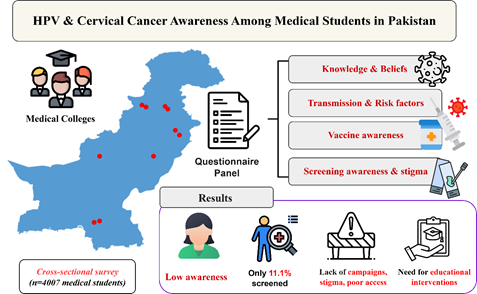
Methods. This cross‐sectional study aimed to evaluate the awareness level of HPV, the attitude towards HPV vaccine, and screening of HPV among students of ten medical colleges across Pakistan. The study was a self‐administered questionnaire‐based survey. A total of 4007 questionnaires were collected and analyzed from medical students studying at different colleges in Pakistan.
Results. The current study revealed a significant lack of knowledge and awareness concerning HPV among medical students in Pakistan as well as low screening rate of (11.1 %) due to many barriers. In the absence of cervical screening program, cancer of cervix remains a major health problem.
Conclusion. Education initiatives in Pakistani schools remain crucial to raise awareness on HPV and promote HPV screening, especially among medical students, who represent the country's future and healthcare system.
Downloads
References
Castle PE, Einstein MH, Sahasrabuddhe VV. Cervical cancer prevention and control in women living with human immunodeficiency virus. CA: Cancer J Clinic. 2021;71(6):505-526.https://doi.org/10.3322/caac.21696
Martínez-Rodríguez F, Limones-González JE, Mendoza-Almanza B, et al. Understanding cervical cancer through proteomics. Cells. 2021;10(8):e1854.https://doi.org/10.3390/cells10081854
Fernandes A, Viveros-Carreño D, Hoegl J, Ávila M, Pareja R. Human papillomavirus-independent cervical cancer. Int J Gynecol Cancer. 2022;32(1):1-7.https://doi.org/10.1136/ijgc-2021-003014
This article discusses cases of cervical cancer that develop independently of HPV infection. It explores the molecular pathways, clinical features, and implications for diagnosis and treatment. The paper is particularly valuable for understanding non-HPV mechanisms of cervical carcinogenesis, which can influence future screening and therapeutic strategies.
Buskwofie A, David-West G, Clare CA. A review of cervical cancer: incidence and disparities. J Nation Med Assoc. 2020;112(2):229-232.https://doi.org/10.1016/j.jnma.2020.03.002
Warner ZC, Reid B, Auguste P, Joseph W, Kepka D, Warner EL. Awareness and knowledge of HPV, HPV vaccination, and cervical cancer among an indigenous Caribbean community. Int J Environ Res Public Health. 2022;19(9):e5694.
https://doi.org/10.3390/ijerph19095694
Nkwabong E, Laure Bessi Badjan I, Sando Z. Pap smear accuracy for the diagnosis of cervical precancerous lesions. Trop Doc. 2019;49(1):34-39.https://doi.org/10.1177/0049475518798532
Farazi PA, Siahpush M, Michaud TL, Kim J, Muchena C. Awareness of HPV and cervical cancer prevention among university health sciences students in cyprus. J Cancer Edu. 2019;34:685-690.https://doi.org/10.1007/s13187-018-1356-2
Badrising U, MaatSchieman M, Ferrari M. Neuromuscular diseases: muscle. Neurology. 2002;58:1779-1785.
https://doi.org/10.1212/WNL.58.12.1779
Mayadev JS, Ke G, Mahantshetty U, Pereira MD, Tarnawski R, Toita T. Global challenges of radiotherapy for the treatment of locally advanced cervical cancer. Int J Gynecol Cancer. 2022;32(3):436-445.https://doi.org/10.1136/ijgc-2021-003001
Zhetpisbayeva I, Kassymbekova F, Sarmuldayeva S, Semenova Y, Glushkova N. Cervical cancer prevention in rural areas. Ann Glob Health. 2023;89(1):e75.https://doi.org/10.5334/aogh.4133
This article focuses on challenges and strategies for cervical cancer prevention in rural settings, where access to screening and vaccination is limited. It emphasizes health system barriers, cultural perceptions, and community-based solutions. The study is significant for understanding how targeted interventions can improve preventive care in underserved rural populations.
Tang Y, Zheng L, Yang S, Li B, Su H, Zhang L-p. Epidemiology and genotype distribution of human papillomavirus (HPV) in Southwest China: a cross-sectional five-year study in non-vaccinated women. Virology J. 2017;14:e84.
https://doi.org/10.1186/s12985-017-0751-3
Deguara M, Calleja N, England K. Cervical cancer and screening: knowledge, awareness and attitudes of women in Malta. J Prevent Med Hyg. 2020;61(4):E584-E592. https://doi.org/10.15167/24214248/jpmh2020.61.4.1521
Sahasrabuddhe VV. Cervical cancer: precursors and prevention. Hematol Oncol Clin North Am. 2024;38(4):771-781.
https://doi.org/10.1016/j.hoc.2024.03.005
This review covers the natural history of cervical cancer, with a focus on precursor lesions and preventive strategies. It highlights HPV vaccination, screening methods, and evolving clinical practices. The article is valuable for clinicians and researchers seeking a concise update on current and emerging preventive measures in cervical cancer control.
Farazi PA, Siahpush M, Michaud TL, Kim J, Muchena C. Awareness of HPV and cervical cancer prevention among university health sciences students in Cyprus. J Cancer Educ. 2019;34(4):685-690. https://doi.org/10.1007/s13187-018-1356-2
Voelker RA. Cervical cancer screening. Jama. 2023;330(20):e2030.https://doi.org/10.1001/jama.2023.21987
Wu MH, Lin LJ, Wu CC. Towards the elimination of cervical cancer in Taiwan. J Formos Med Assoc. 2022;121(7):1188-1190.
https://doi.org/10.1016/j.jfma.2021.10.026
de Sanjose S, Quint WG, Alemany L, et al. Human papillomavirus genotype attribution in invasive cervical cancer: a retrospective cross-sectional worldwide study. Lancet Oncol. 2010;11(11):1048-56.https://doi.org/10.1016/S1470-2045(10)70230-8
Rashid S, Labani S, Das BC. Knowledge, awareness and attitude on HPV, HPV vaccine and cervical cancer among the college students in India. PLoS One. 2016;11(11):e0166713.https://doi.org/10.1371/journal.pone.0166713
HPV. Treatment. https://www.hpvinfo.ca/treatment/#:~:text=HPV%20cannot%20be%20treated.,cannot%20be%20cured%20with%20antibiotics. Accessed August 11, 2025.
Centers for Disease Control and Prevention. Cancers caused by HPV. https://www.cdc.gov/hpv/parents/cancer.html#:~:text=HPV%20also%20affects%20men.,at%20age%2011%E2% 0%9312%20years. Accessed August 11, 2025.
World Health Organization. Comprehensive Cervical Cancer Control: A Guide to Essential Practice. World Health Organization; 2014.
Chido-Amajuoyi OG, Jackson I, Yu R, Shete S. Declining awareness of HPV and HPV vaccine within the general US population. Hum Vaccin Immunother. Feb 1 2021;17(2):420-427. https://doi.org/10.1080/21645515.2020.1783952
Yin G, Zhang Y, Chen C, Ren H, Guo B, Zhang M. Have you ever heard of Human Papillomavirus (HPV) vaccine? The awareness of HPV vaccine for college students in China based on meta-analysis. Hum Vaccin Immunother. 2021;17(8):2736-2747.
https://doi.org/10.1080/21645515.2021.1899731
Djuric O, Markovic Denic L, Popovac S, Todorovic J, Marusic V, Maksimovic N. Awareness and knowledge about HPV infection and HPV vaccination among women undergoing cytology and colposcopy in Serbian cervical cancer counseling center. J Buon. 2020;25(1):116-124.
Vorsters A, Arbyn M, Baay M, et al. Overcoming barriers in HPV vaccination and screening programs. Papillomavirus Res. 2017;4:45-53.https://doi.org/10.1016/j.pvr.2017.07.001
Mortensen JH, Bigaard J, Kvernrød AB. Young Danish HPV vaccinated women's knowledge, barriers and facilitators towards cervical cancer screening: a qualitative study. Prev Med Rep. 2021;24:e101507.https://doi.org/10.1016/j.pmedr.2021.101507
Camara H, Zhang Y, Lafferty L, Vallely AJ, Guy R, Kelly-Hanku A. Self-collection for HPV-based cervical screening: a qualitative evidence meta-synthesis. BMC Public Health. 2021;21(1):e1503.https://doi.org/10.1186/s12889-021-11554-6
Alsous MM, Ali A, Al-Azzam S, Karasneh R, Amawi H. Knowledge about cervical cancer and awareness about Pallomavirus vaccination among medical students in Jordan. Peer J. 2021;9:e11611.https://doi.org/10.7717/peerj.11611
Haddad SF, Kerbage A, Eid R, Kourie HR. Awareness about the human papillomavirus (HPV) and HPV vaccine among medical students in Lebanon. J Med Virol. 2022;94(6):2796-2801.https://doi.org/10.1002/jmv.27509
Duska LR, Podwika SE, Randall LM. Top advances of the year: Cervical cancer. Cancer. 2024;130(15):2571 2576.
Downloads
Published
How to Cite
Issue
Section
License
BSR follows an open-access publishing policy and full text of all published articles is available free, immediately upon publication of an issue. The journal’s contents are published and distributed under the terms of the Creative Commons Attribution 4.0 International (CC-BY 4.0) license. Thus, the work submitted to the journal implies that it is original, unpublished work of the authors (neither published previously nor accepted/under consideration for publication elsewhere). On acceptance of a manuscript for publication, a corresponding author on the behalf of all co-authors of the manuscript will sign and submit a completed the Copyright and Author Consent Form.