
Heavy Metal Concentrations in Soil around Automobile Workshops in Wukari, North East Nigeria
DOI:
https://doi.org/10.32350/sir.102.01Keywords:
automobile workshop, Geo-accumulation index (Igeo), heavy metals, soilAbstract
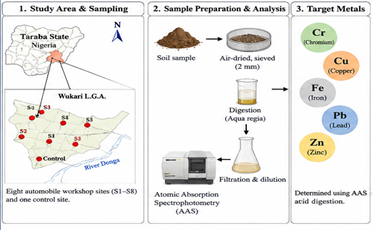
An increasingly major source of heavy metal pollution in developing countries like Nigeria, where environmental regulations are poorly enforced, is automobile repair activity. In this study, soil samples were collected from different automobile workshops in Wukari Local Government in Taraba State, Nigeria to assess the heavy metal (Cr, Cu, Fe, Pb, Zn) concentration. A total of eight sampling points were analyzed using Atomic Absorption Spectrophotometry (AAS) and standard aqua regia digestion and the results were compared with the World Health Organization’s (WHO) permissible limits and a control value. The study shows a significant increase in metal concentration for iron (Fe) and lead (Pb) in soils around high-traffic workshop zones. The five heavy metals, from the geo-accumulation index (Igeo), were found to be within the unpolluted to moderately polluted category. The metal with the highest Igeo value at 0.38 is lead (Pb), suggesting that the presence of lead in the soil around the selected automobile workshops was more elevated as compared to the other metals. The lowest is copper (Cu) with Igeo value of 0.04, indicating the lowest level of contamination. Although the observed values for all the metals were within WHO standard limits, the continuous deposition of these metals in the soil around automobile workshops raises concerns about long-term soil health and potential risks to surrounding communities.
Downloads
References
1. Xu L, Zhao F, Peng J, Ji M, Li BL. A comprehensive review of the application and potential of straw biochar in the remediation of heavy metal-contaminated soil. Toxics. 2025;13(2):69. https://doi.org/10.3390/toxics13020069
This review article examines the role of straw-derived biochar in the remediation of soils contaminated with heavy metals. The authors analyze different preparation methods of biochar, its physicochemical properties, and its capacity to immobilize toxic metals in soil environments. The study highlights the mechanisms through which biochar reduces metal mobility and improves soil quality. The article is significant for environmental scientists and soil chemists because it presents sustainable and cost-effective strategies for mitigating heavy metal pollution in agricultural soils
2. Ali H, Khan E, Ilahi I. Environmental chemistry and ecotoxicology of hazardous heavy metals: Environmental persistence, toxicity, and bioaccumulation. J Chem. 2019;2019:e6730305. https://doi.org/10.1155/2019/6730305
3. Alloway BJ, ed. Heavy metals in soils: Trace metals and metalloids in soils and their bioavailability. 3rd ed. Springer; 2013. Environmental Pollution; vol 22. https://doi.org/10.1007/978-94-007-4470-7
4. Agbaghare DE, Agbaghare GO. Levels of heavy metals in water and fishes from Langtang dams, Langtang North, Plateau State, Nigeria. ChemRxiv. Preprint. 2024. https://doi.org/10.26434/chemrxiv-2024-mfvck
5. Enogbe EJ, Agbaghare DE. Levels of heavy metals concentrations in chocolates from Bwari Market Abuja FCT, Nigeria. Int J Adulteration. 2025;9(10):e2ijad3057. https://doi.org/10.54905/disssi.v9i10.e2ijad3057
6. Daniel DO, Udofia IM, Agwo MU, Asiwe TN. Evaluation of heavy metals contamination from automobile workshops in Uyo Local Government Area, Akwa Ibom State. J Mater Environ Sci. 2025;16(1):102–111.
7. Kabata-Pendias A, Pendias H. Trace Elements in Soils and Plants. 3rd ed. CRC Press; 2001. https://doi.org/10.1201/9781420039900
8. Tang S, Wang C, Song J, Ihenetu SC, Li G. Advances in studies on heavy metals in urban soil: A bibliometric analysis. Sustainability (Basel). 2024;16(2):860. https://doi.org/10.3390/su16020860
This study presents a bibliometric analysis of global research trends related to heavy metals in urban soils. Using scientific databases, the authors analyze publication trends, influential journals, countries contributing to research, and emerging themes in the field. The work identifies key research directions, including pollution sources, risk assessment, and remediation technologies. This article is valuable for researchers seeking an overview of current developments and knowledge gaps in urban soil contamination studies
9. Eid MH, Eissa M, Mohamed EA, et al. Application of stable isotopes, mixing models, and K-means cluster analysis to detect recharge and salinity origins in Siwa Oasis, Egypt. Groundw Sustain Dev. 2024;25:e101124. https://doi.org/10.1016/j.gsd.2024.101124
10. Zheng N, Liu J, Wang Q, Liang Z. Health risk assessment of heavy metal exposure to street dust in the zinc smelting district, northeast of China. Sci Total Environ. 2010;408(4):726–733. https://doi.org/10.1016/j.scitotenv.2009.10.075
11. Shi T, He L, Wang R, Li Z, Hu Z, Wu G. Digital mapping of heavy metals in urban soils: A review and research challenges. Catena. 2023;228:e107183. https://doi.org/10.1016/j.catena.2023.107183
12. Mkhonza NP, Zondo S, Vilakazi S. Toxic heavy metals distribution in urban soils of Africa: A systematic review. Environ Monit Assess. 2026;198(2):e205. https://doi.org/10.1007/s10661-026-15030-9
13. Hou D, Jia X, Wang L, et al. Global soil pollution by toxic metals threatens agriculture and human health. Science. 2025;388(6744):316–321. https://doi.org/10.1126/science.adr5214
14. Nica DV, Bura M, Gergen I, Harmanescu M, Bordean DM. Bioaccumulative and conchological assessment of heavy metal transfer in a soil-plant-snail food chain. Chem Cent J. 2012;6:e55. https://doi.org/10.1186/1752-153X-6-55
15. Mahmood A, Malik RN. Human health risk assessment of heavy metals via consumption of contaminated vegetables collected from different irrigation sources in Lahore, Pakistan. Arab J Chem. 2014;7(1):91–99. https://doi.org/10.1016/j.arabjc.2013.07.002
16. AOAC International. Official Methods of Analysis of AOAC International. 16th ed, 4th rev. AOAC International; 1998.
17. Müller G. Index of geoaccumulation in sediments of the Rhine River. GeoJournal. 1969;2:108–118.
18. Khalil S, Hassan NE. Review of heavy metal removal from soil: Methods and technologies. Glob Acad J Agric Biosci. 2024;6(6):191–198. https://doi.org/10.36348/gajab.2024.v06i06.003
19. Sharma M, Kumar P. Environmental sources of heavy metals and their impacts on human health. In: Kumar P, Gogia N, eds. Heavy Metal Toxicity and Neurodegeneration. Academic Press; 2025:317–326. https://doi.org/10.1016/B978-0-443-36575-1.00030-3
20. Ogidi OI, Onwuagba CG, Richard-Nwachukwu N. Biomonitoring tools, techniques and approaches for environmental assessments. In: Izah SC, Ogwu MC, Hamidifar H, eds. Biomonitoring of Pollutants in the Global South. Springer; 2024:243–273. https://doi.org/10.1007/978-981-97-1658-6_7
21. Duru SC, Echiegu EA, Anyadike CC, Alaneme GU, Okechukwu ME. Spatial variability of heavy metals concentrations in soil of auto-mechanic workshop clusters in Nsukka, Nigeria. Sci Rep. 2024;14:e9681. https://doi.org/10.1038/s41598-024-60044-3
This research investigates the distribution and concentration of heavy metals in soils from auto-mechanic workshop clusters in Nsukka, Nigeria. Soil samples were analyzed to determine levels of metals such as lead, cadmium, chromium, and nickel. The study evaluates pollution indices and assesses environmental risk associated with these contaminants. The findings highlight the impact of automobile repair activities on soil quality and provide data useful for environmental monitoring and pollution control policies
22. Singh N, Sharma B. On the mechanisms of heavy metal-induced neurotoxicity: Amelioration by plant products. Proc Natl Acad Sci India Sect B Biol Sci. 2021;91(4):743–751. https://doi.org/10.1007/s40011-021-01272-9
23. World Health Organization. Arsenic and Arsenic Compounds. 2nd ed. World Health Organization; 2001. Environmental Health Criteria 224.
Downloads
Published
How to Cite
Issue
Section
License
Copyright (c) 2026 Ugochukwu Onyenze, Emmanuel Joy Enogbe, Otuokere Ifeanyi Edozie

This work is licensed under a Creative Commons Attribution 4.0 International License.