Shared Pathways and Potential Therapeutic Targets in Major Psychiatric Disorders: Integrative Network and Molecular Docking Analysis
DOI:
https://doi.org/10.32350/sir.101.05Keywords:
docking, network, neurology, protein-protein interaction (PPI), psychologyAbstract
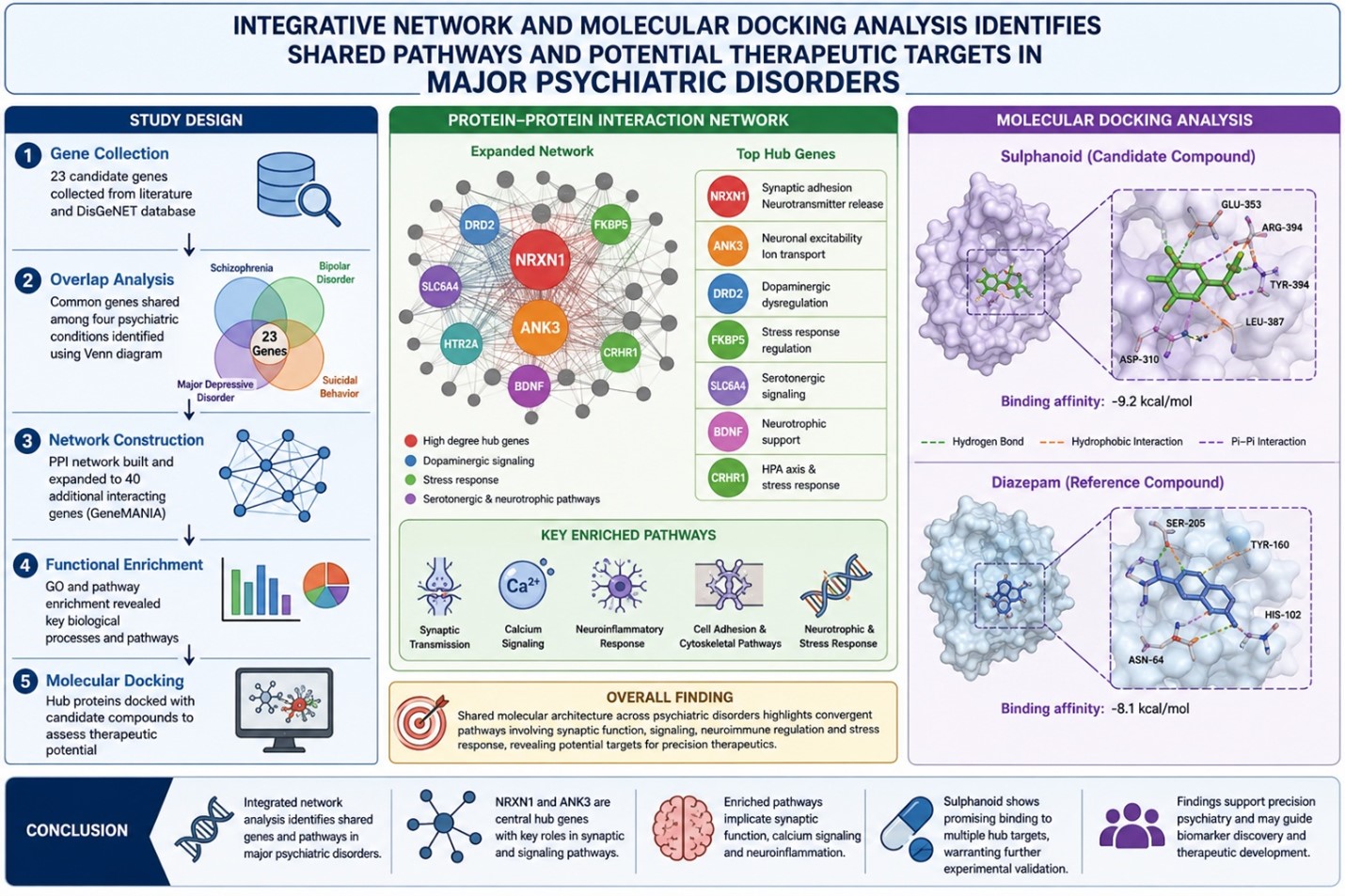
There is significant clinical and genetic similarity between mental health disorders, such as schizophrenia, bipolar disorder (BD), major depressive disorder (MDD), and suicidal behavior. This indicates that there are shared molecular mechanisms in the pathogenesis of these disorders. Understanding these shared biological pathways is crucial to finding strong biomarkers and targeted therapies. The current study focused on the detailed network biology with an aim to uncover the genes that play a major role in neuropsychiatric disorders. The study used different diseases, specific databases, and literature search to identify twenty-three diseases, associated genes, and developed a Protein-Protein Interaction (PPI) network. Forty genes that were functionally interacting and enriched in biologically relevant processes were added to the network to provide a broader picture of the molecular landscape. NRXN1 is the most important molecule in all four disorders, according to an analysis of network topology. This suggests that NRXN1 plays a crucial role in synaptic architecture and neural transmission, which is consistent with its function in the brain. Other hub genes that have been found to be essential to interconnected regulatory networks implicated in neuropsychiatric pathophysiology include ANK3, DRD2, BDNF, FKBP5, SLC6A4, HTR2A, and CACNA1C. The results revealed converging molecular pathways and identified important regulatory hubs that could be of interest in diagnostics and therapy. Based on the prioritized hub proteins, selected candidate compounds were used for structure-based molecular docking to explore the therapeutic potential. The docking analysis showed that the identified molecular targets had favorable protein-ligand binding interactions, indicating their potential for therapeutic applications. While experimental validation is needed, the combination of network biology and molecular docking offers important clues to the common molecular environment of complex psychiatric disorders and can be used to identify potential targets for precision medicine. In conclusion, this study contributed to the understanding of the common molecular architecture of the major neuropsychiatric disorders and offered a systems biology approach to biomarker discovery and targeted therapeutic strategies.
Downloads
References
1. Barabási AL, Gulbahce N, Loscalzo J. Network medicine: a network-based approach to human disease. Nat Rev Genet. 2011;12(1):56–68. doi:10.1038/nrg2918.
This review provides the conceptual foundation for network medicine and supports the use of network-based approaches to investigate shared molecular mechanisms among diseases.
2. Menche J, Sharma A, Kitsak M, et al. Uncovering disease–disease relationships through the incomplete interactome. Science. 2015;347(6224):1257601. doi:10.1126/science.1257601.
This study demonstrates how protein–protein interaction networks can reveal molecular relationships between apparently distinct diseases, supporting the network-based analysis of disease-associated genes.
3. Südhof TC. Neuroligins and neurexins link synaptic function to cognitive disease. Nature. 2008;455(7215):903–911. doi:10.1038/nature07456.
This review establishes the importance of neurexin–neuroligin signaling in synaptic function and its association with cognitive and neuropsychiatric disorders, providing biological context for genes such as NRXN1.
4. Rujescu D, Ingason A, Cichon S, et al. Disruption of the neurexin 1 gene is associated with schizophrenia. Hum Mol Genet. 2009;18(5):988–996. doi:10.1093/hmg/ddn351.
This study provides genetic evidence linking disruption of NRXN1 with schizophrenia, supporting the relevance of NRXN1 as a candidate gene in neuropsychiatric disease.
5. Ferreira MA, O’Donovan MC, Meng YA, et al. Collaborative genome-wide association analysis supports a role for ANK3 in bipolar disorder. Nat Genet. 2008;40(9):1056–1058. doi:10.1038/ng.209.
This genome-wide association study provides evidence for the involvement of ANK3 in bipolar disorder and supports its importance as a susceptibility gene for psychiatric disorders.
6. Leussis MP, Madison JM, Petryshen TL. Ankyrin 3: genetic association with bipolar disorder and relevance to disease pathophysiology. Biol Mood Anxiety Disord. 2012;2:18. doi:10.1186/2045-5380-2-18.
This review summarizes genetic and functional evidence implicating ANK3 in bipolar disorder and provides mechanistic context for its role in psychiatric disease.
7. Schizophrenia Working Group of the Psychiatric Genomics Consortium. Biological insights from 108 schizophrenia-associated loci. Nature. 2014;511:421–427. doi:10.1038/nature13595
8. Cross-Disorder Group of the Psychiatric Genomics Consortium. Genetic relationship between five psychiatric disorders. Nat Genet. 2013;45(9):984–994. doi:10.1038/ng.2711
9. Bhat S, Dao DT, Terrillion CE, Arad M, Smith RJ, Soldatov NM, Gould TD. CACNA1C (Cav1. 2) in the pathophysiology of psychiatric disease. Progress in neurobiology. 2012 Oct 1;99(1):1-4.
10. Miller AH, Raison CL. The role of inflammation in depression. Nat Rev Immunol. 2016;16(1):22–34. doi:10.1038/nri.2015.5
11. Khandaker GM, Dantzer R, Jones PB. Immunopsychiatry: important facts. Psychol Med. 2017;47(13):2229–2237. doi:10.1017/S0033291717000745
12. Piñero J, Bravo À, Queralt-Rosinach N, Gutiérrez-Sacristán A, Deu-Pons J, Centeno E, et al. DisGeNET: a comprehensive platform integrating information on human disease-associated genes and variants. Nucleic Acids Res. 2017;45(D1):D833-D839. doi:10.1093/nar/gkw943. (PubMed Central (PMC))
13. Oliveros JC. Venny. An interactive tool for comparing lists with Venn's diagrams. Version 2.1.0. Available from: https://bioinfogp.cnb.csic.es/tools/venny/
14. Liao Y, Wang J, Jaehnig EJ, Shi Z, Zhang B. WebGestalt 2019: gene set analysis toolkit with revamped UIs and APIs. Nucleic Acids Res. 2019;47(W1):W199-W205. doi:10.1093/nar/gkz401.
15. Warde-Farley D, Donaldson SL, Comes O, Zuberi K, Badrawi R, Chao P, et al. The GeneMANIA prediction server: biological network integration for gene prioritization and predicting gene function. Nucleic Acids Res. 2010;38(Web Server issue):W214-W220. doi:10.1093/nar/gkq537. (GeneMANIA)
16. Shannon P, Markiel A, Ozier O, Baliga NS, Wang JT, Ramage D, et al. Cytoscape: a software environment for integrated models of biomolecular interaction networks. Genome Res. 2003;13(11):2498-2504. doi:10.1101/gr.1239303.
17. Burley SK, Berman HM, Christie C, Duarte JM, Feng Z, Westbrook J, et al. RCSB Protein Data Bank: biological macromolecular structures enabling research and education in fundamental biology, biomedicine, biotechnology and energy. Nucleic Acids Res. 2019;47(D1):D464-D474. doi:10.1093/nar/gky1004.
18. Trott O, Olson AJ. AutoDock Vina: improving the speed and accuracy of docking with a new scoring function, efficient optimization, and multithreading. J Comput Chem. 2010;31(2):455-461. doi:10.1002/jcc.21334. (AutoDock Vina)
19. Pettersen EF, Goddard TD, Huang CC, Couch GS, Greenblatt DM, Meng EC, et al. UCSF Chimera—a visualization system for exploratory research and analysis. J Comput Chem. 2004;25(13):1605-1612. doi:10.1002/jcc.20084. (UCSF CGL)
20. American Psychiatric Association. Diagnostic and Statistical Manual of Mental Disorders. 5th ed. Washington, DC: APA; 2013.
21. World Health Organization. International Classification of Diseases 11th Revision (ICD-11): Mental, behavioural or neurodevelopmental disorders. Geneva: WHO; 2019.
22. Ranea JA, Perkins J, Chagoyen M, Díaz-Santiago E, Pazos F. Network-based methods for approaching human pathologies from a phenotypic point of view. Genes. 2022;13(6):1081.
23. El Hadi C, Ayoub G, Bachir Y, Haykal M, Jalkh N, Kourie HR. Polygenic and Network-based studies in risk identification and demystification of cancer. Expert Review of Molecular Diagnostics. 2022;22(4):427-38.
24. Cooper JN, Mittal J, Sangadi A, Klassen DL, King AM, Zalta M, Mittal R, Eshraghi AA. Landscape of NRXN1 gene variants in phenotypic manifestations of autism spectrum disorder: a systematic review. Journal of clinical medicine. 2024;13(7):2067.
25. Sciacca M, Marino L, Vitaliti G, Falsaperla R, Marino S. NRXN1 deletion in two twins’ genotype and phenotype: a clinical case and literature review. Children. 2022;9(5):698.
26. Shi A. Effects of BDNF and ANK3 in bipolar disorder. InAIP Conference Proceedings 2022 (Vol. 2511, No. 1, p. 020029). AIP Publishing LLC.
27. Gupta R, Jha NK, Kumar N, Nagraik R, Ravi K. From synapse to system: mechanistic pathways of neural signaling dysfunction in psychiatric disorders. Frontiers in Cell and Developmental Biology. 2026;14:1762930.
28. Szymanowicz O, Drużdż A, Słowikowski B, Pawlak S, Potocka E, Goutor U, Konieczny M, Ciastoń M, Lewandowska A, Jagodziński PP, Kozubski W. A review of the CACNA gene family: its role in neurological disorders. Diseases. 2024;12(5):90.
29. Mitrea L, Nemeş SA, Szabo K, Teleky BE, Vodnar DC. Guts imbalance imbalances the brain: a review of gut microbiota association with neurological and psychiatric disorders. Frontiers in medicine. 2022;9:813204.
30. Gomez AM, Traunmüller L, Scheiffele P. Neurexins: molecular codes for shaping neuronal synapses. Nature Reviews Neuroscience. 2021 (3):137-51.
31. Chowdhury MR, Reddy RV, Nampoothiri NK, Erva RR, Vijaykumar SD. Exploring bioactive natural products for treating neurodegenerative diseases: a computational network medicine approach targeting the Estrogen signaling pathway in amyotrophic lateral sclerosis and parkinson’s disease. Metabolic Brain Disease. 2025;40(4):169.
32. Engin E. GABAA receptor subtypes and benzodiazepine use, misuse, and abuse. Frontiers in Psychiatry. 2023;13:1060949.
Downloads
Published
How to Cite
Issue
Section
License
Copyright (c) 2026 Azmat Aziz, Muhammad Shahan, Mahfooz Hassan, Muhammad Ayaz, Muhammad Awais Ali, Mukhtar Alam, Muhammad Ilyas

This work is licensed under a Creative Commons Attribution 4.0 International License.