The Best-Fitted Model for Analyzing Climatic Impact on Crop Production: A Comparative Study of ARIMA and ARIMAX Models
DOI:
https://doi.org/10.32350/sir.103.04Keywords:
ARIMAX, climate change, cotton, mean maximum temperature, sugarcaneAbstract
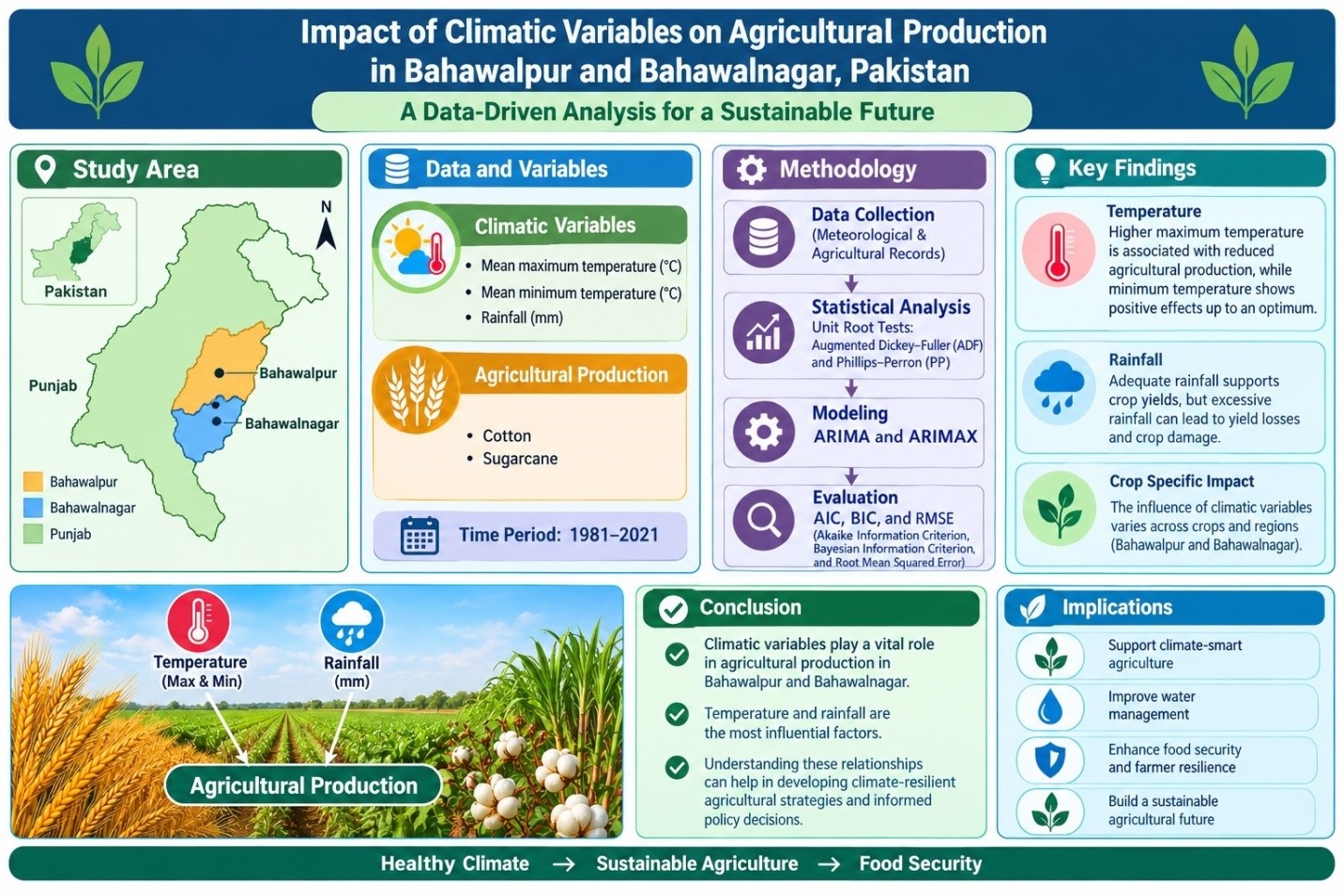
The agriculture sector is highly vulnerable to weather variations. Agricultural output is influenced by several climate-related phenomena, including changes in temperature and rainfall patterns. The main objective of this study was to investigate the impact of climatic parameters on cotton and sugarcane production using Autoregressive Integrated Moving Average (ARIMA) and ARIMAX models. Annual data on mean maximum temperature (YMMTX), mean minimum temperature (YMMTN), and total rainfall for 1981–2021 at the Bahawalnagar and Bahawalpur stations was obtained from the Pakistan Meteorological Department (PMD), Karachi. Time-series data on crop production and cultivated area was obtained from the Pakistan Bureau of Statistics. Stationarity of data was assessed using the Augmented Dickey-Fuller (ADF) and Phillips-Perron (PP) tests. Based on the minimum values of the Akaike Information Criterion (AIC), Bayesian Information Criterion (BIC), and Root Mean Square Error (RMSE), the best-fitted ARIMAX models for cotton and sugarcane production in Bahawalnagar and Bahawalpur were ARIMAX (1,1,0), (1,0,0), (1,1,0), and (3,1,0), respectively. The results indicated that climatic factors significantly affect cotton and sugarcane production. These findings may be useful for planning and development departments, farmers, and other stakeholders.
Highlights
- Climatic impact on agricultural production in Bahawalpur and Bahawalnagar.
- ARIMA and ARIMAX models were compared using historical data for the time period (1981-2021).
- ARIMAX demonstrated better forecasting performance than ARIMA based on AIC, BIC, and RMSE.
Downloads
References
1. Samoon L. Pakistan's shift to value-added agricultural exports. The Agricultural Economist. Published November 6, 2025. Accessed June 2, 2026. https://www.agrieconomist.com/pakistans-shift-to-value-added-agricultural-exports
2. Nisar M, Ullah A, Farooq N, et al. Analysis of population growth as sociological factor affecting sugarcane productivity in Pakistan. Multicult Educ. 2021;7(9):349–357. https://doi.org/10.5281/zenodo.5515637
3. Pakistan Bureau of Statistics. 6th Population and Housing Census 2017. Government of Pakistan; 2017. https://www.pbs.gov.pk/censusarchive/
4. Chohan M. Impact of climate change on sugarcane crop and remedial measures: a review. Pak Sugar J. 2019;34(1):15–22. https://doi.org/10.35380/sugar.034.01.0141
5. Afghan S, Khan ME, Arshad WR, Malik KB, Nikpay A. Economic importance and yield potential of sugarcane in Pakistan. In: Ghimire BK, ed. Sugarcane—Its Products and Sustainability. IntechOpen; 2023. https://doi.org/10.5772/intechopen.105517
6. Syed A, Liu X, Moniruzzaman M, et al. Assessment of climate variability among seasonal trends using in situ measurements: a case study of Punjab, Pakistan. Atmosphere. 2021;12(8):939. https://doi.org/10.3390/atmos12080939
7. Silva JJ, Iamanaka BT, Fungaro MHP, Taniwaki MH. Aflatoxins in sugarcane production chain: what could be the source? Curr Opin Food Sci. 2019;29:94–98. https://doi.org/10.1016/j.cofs.2019.08.010
8. Waqas MA, Kaya C, Riaz A, et al. Potential mechanisms of abiotic stress tolerance in crop plants induced by thiourea. Front Plant Sci. 2019;10:1336. https://doi.org/10.3389/fpls.2019.01336
9. Mackay A. Climate change 2007: impacts, adaptation and vulnerability. Contribution of Working Group II to the Fourth Assessment Report of the Intergovernmental Panel on Climate Change. J Environ Qual. 2008;37(6):2407. https://doi.org/10.2134/jeq2008.0015br
10. Eckstein D, Künzel V, Schäfer L. Global Climate Risk Index 2021: Who Suffers Most From Extreme Weather Events? Weather-Related Loss Events in 2019 and 2000 to 2019. Germanwatch; 2021. https://www.germanwatch.org/en/cri
11. Bokhari SAA, Rasul G, Ruane AC, Hoogenboom G, Ahmad A. The past and future changes in climate of the rice-wheat cropping zone in Punjab, Pakistan. Pak J Meteorol. 2017;13(26):9–23.
12. Abbas S. Climate change and cotton production: an empirical investigation of Pakistan. Environ Sci Pollut Res Int. 2020;27(23):29580–29588. https://doi.org/10.1007/s11356-020-09222-0
13. Hamjah MA, Chowdhury MAK. Measuring climatic and hydrological effects on cash crop production and production forecasting in Bangladesh using ARIMAX model. Math Theory Model. 2014;4(6):138–152.
14. Tyagi S, Chandra S, Tyagi G. Climate change and its impact on sugarcane production and future forecast in India: a comparison study of univariate and multivariate time series models. Sugar Tech. 2023;25(5):1061–1069. https://doi.org/10.1007/s12355-023-01271-2
15. Pan H, Liu J, Li F, et al. Improving influenza prediction in Quanzhou, China: an ARIMAX model integrated with meteorological drivers. Front Public Health. 2025;13:1662775. https://doi.org/10.3389/fpubh.2025.1662775
16. Yayar R, Hekim M, Yilmaz V, Bakirci F. A comparison of ANFIS and ARIMA techniques in the forecasting of electric energy consumption of Tokat province in Turkey. J Econ Soc Stud. 2011;1(2):87–112. https://doi.org/10.14706/jecoss11124
17. Nair KR, Vanitha V, Jisma M. Forecasting of wind speed using ANN, ARIMA and hybrid models. In: 2017 International Conference on Intelligent Computing, Instrumentation and Control Technologies (ICICICT). IEEE; 2017:170–175. https://doi.org/10.1109/ICICICT1.2017.8342555
18. Ou P, Wang H. Financial volatility forecasting by least square support vector machine based on GARCH, EGARCH and GJR models: evidence from ASEAN stock markets. Int J Econ Finance. 2010;2(1):51–64. https://doi.org/10.5539/ijef.v2n1p51
19. Maku TO, Adehi MU, Adenomon MO. Modeling and forecasting electricity consumption in Nigeria using ARIMA and ARIMAX time series models. Sci World J. 2023;18(3):414–421. https://doi.org/10.4314/swj.v18i3.14
20. Ďurka P, Pastoreková S. ARIMA vs. ARIMAX—which approach is better to analyze and forecast macroeconomic time series? In: Proceedings of the 30th International Conference on Mathematical Methods in Economics. Silesian University in Opava; 2012:136–140.
21. Goyal M, Agarwal S, Ghalawat S, Malik JS. ARIMA and ARIMAX analysis on the effect of variability of rainfall, temperature on wheat yield in Haryana. Indian J Ext Educ. 2024;60(1):95–99. https://doi.org/10.48165/IJEE.2024.60118
22. Yasin MY, Khan MR, Amin M. Impacts of spatio-temporal changes in rainfall and temperature on different crops in selected districts of Punjab, Pakistan. Sarhad J Agric. 2018;34(2):400–413. https://doi.org/10.17582/journal.sja/2018/34.2.400.413
23. Ali S, Liu Y, Ishaq M, et al. Climate change and its impact on the yield of major food crops: evidence from Pakistan. Foods. 2017;6(6):39. https://doi.org/10.3390/foods6060039
24. Shahzadi I, Mazhar N, Abbas S. An assessment of changes and variability of climate impact on cotton production yield over southern Punjab, Pakistan. Environ Dev Sustain. 2024;26(11):29331–29347. https://doi.org/10.1007/s10668-023-03867-w
25. Ali S, Zubair M, Hussain S. The combined effect of climatic factors and technical advancement on yield of sugarcane by using ARDL approach: evidence from Pakistan. Environ Sci Pollut Res Int. 2021;28(29):39787–39804. https://doi.org/10.1007/s11356-021-13313-x
Published
How to Cite
Issue
Section
License
Copyright (c) 2026 Sajid Ali Khan, Muhammad Ali, Bulbul Jan, Azhar Iqbal

This work is licensed under a Creative Commons Attribution 4.0 International License.