
Arcane Channels of Knowledge Generation in Artificial Intelligence for Fraud Detection in Financial Operations: A Bibliometric Overview
DOI:
https://doi.org/10.32350/jarms.71.05Keywords:
artificial intelligence, bibliometric analysis, fraud detection, risk analyticsAbstract
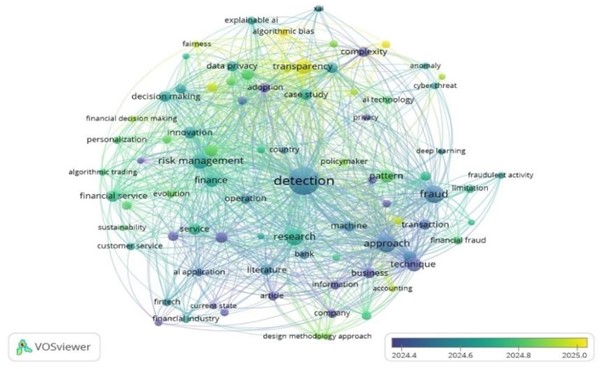
In this research, we survey and sketch the bibliometric landscape of intellectual evolution, topic distributions, and growing paths of the multidisciplinary topic of artificial intelligence (AI) used for fraud detection within the finance sector. With 243 entries indexed by Scopus between 2020-2025, this investigation provides a comprehensive overview of intellectual research in the field by exploring and illustrating its evolution across the key actors, institutions, nations, and conceptual co-occurrence, by utilizing keywords strategy in Scopus, science-mapping, and performance metrics tools in VOSviewer. The main topics discovered are machine learning, anomaly detection, and risk analytics as the maturing methodological base, emerging research areas include explainable AI, blockchain and FinTech. India emerged as the largest contributing country, though with relatively low collaboration overall. These findings also reveal how AI-based fraud classification has expanded across diverse application domains beyond finance, and how, alongside the field's traditionally technical and sophisticated methodology-driven investigations, 'softer' dimensions—fairness, ethics, and regulatory compliance—along with proactive, prevention-focused approaches, are only beginning to emerge at the margins rather than forming a central focus of the field. Instead of just reporting the data, in this study we propose a theoretical framework regarding evolution of detection field including rule-based, graph-based and explainable AI approaches, and benchmarks it against previous bibliometric researches. The finding of this paper contributes in several ways, unifying inconsistent knowledge dispersed information, indicating avenues of research in areas with research vacuum, providing ideas for academicians toward publications, and guiding practice regarding fraud-risk governance.
Downloads
References
Abdallah, A., Maarof, M. A., & Zainal, A. (2016). Fraud detection system: A survey. Journal of Network and Computer Applications, 68, 90–113. https://doi.org/10.1016/j.jnca.2016.04.007
Albalawi, T., & Dardouri, S. (2025). Enhancing credit card fraud detection using traditional and deep learning models with class imbalance mitigation. Frontiers in Artificial Intelligence, 8, Article e1643292. https://doi.org/10.3389/frai.2025.1643292
Ali, A., Abd Razak, S., Othman, S. H., Eisa, T. A. E., Al-Dhaqm, A., Nasser, M., Elhassan, T., Elshafie, H., & Saif, A. (2022). Financial fraud detection based on machine learning: A systematic literature review. Applied Sciences, 12(19), Article e9637. https://doi.org/10.3390/app12199637
Baas, J., Schotten, M., Plume, A., Côté, G., & Karimi, R. (2020). Scopus as a curated, high-quality bibliometric data source for academic research in quantitative science studies. Quantitative Science Studies, 1(1), 377–386. https://doi.org/10.1162/qss_a_00019
Bayero, S. A., Manoharan, G., & Kumar, S. (2025). Machine learning in finance: The revolutionized fusion. In F. Ghosn, G. Awad, & K. Darwich (Eds.), AI’s transformative impact on finance, auditing, and investment (pp. 43–72). IGI Global Scientific Publishing.
Bello, O. A., & Olufemi, K. (2024). Artificial intelligence in fraud prevention: Exploring techniques and applications, challenges, and opportunities. Computer Science & IT Research Journal, 5(6), 1505–1520. https://doi.org/10.51594/csitrj.v5i6.1252
Bello, O. A., Ogundipe, A., Mohammed, D., Folorunso, A., & Alonge, O. A. (2023). AI-driven approaches for real-time fraud detection in US financial transactions: Challenges and opportunities. European Journal of Computer Science and Information Technology, 11(6), 84–102. https://doi.org/10.37745/ejcsit.2013/vol11n684102
Bolton, R. J., & Hand, D. J. (2002). Statistical fraud detection: A review. Statistical Science, 17(3), 235–255. https://doi.org/10.1214/ss/1042727940
Dal Pozzolo, A., Boracchi, G., Caelen, O., Alippi, C., & Bontempi, G. (2018). Credit card fraud detection: A realistic modeling and a novel learning strategy. IEEE Transactions on Neural Networks and Learning Systems, 29(8), 3784–3797. https://doi.org/10.1109/TNNLS.2017.2736643
Federal Bureau of Investigation. (2025). Internet crime report 2024. FBI Internet Crime Complaint Center. https://www.ic3.gov/Media/PDF/AnnualReport/2024_IC3Report.pdf
Federal Trade Commission. (2025, March 10). New FTC data show a big jump in reported losses to fraud to $12.5 billion in 2024. https://www.ftc.gov/news-events/news/press-releases/2025/03/new-ftc-data-show-big-jump-reported-losses-fraud-125-billion-2024
Hafez, I. Y., Hafez, A. Y., Saleh, A., Abd El-Mageed, A. A., & Abohany, A. A. (2025). A systematic review of AI-enhanced techniques in credit card fraud detection. Journal of Big Data, 12(1), Article e6. https://doi.org/10.1186/s40537-024-01048-8
Halteh, K., & Tiwari, M. (2023). Preempting fraud: A financial distress prediction perspective on combating financial crime. Journal of Money Laundering Control, 26(6), 1194–1202. https://doi.org/10.1108/JMLC-01-2023-0013
IBM Security. (2024). Cost of a data breach report 2024. IBM. https://www.ibm.com/reports/data-breach
Kamuangu, P. (2024). A review on financial fraud detection using AI and machine learning. Journal of Economics, Finance and Accounting Studies, 6(1), 67–77. https://doi.org/10.32996/jefas.6.1.7
Kaur, M., & Dhiman, B. (2025). A multidisciplinary approach to building resilience against deepfakes in the financial sector. In S. Taneja, S. Gupta, M. Kukreti, & A. S. Chauhan (Eds.), Mastering deepfake technology: Strategies for ethical management and security (pp. 111–121). River Publishers.
Khanday, M. A., Negi, N., & Hirani, T. (2025). AI in financial risk management: Transformative potential, ethical challenges, and emerging threats. In A. M. S. Derbali (Ed.), Artificial intelligence for financial risk management and analysis (pp. 335–354). IGI Global Scientific Publishing.
Kou, Y., Lu, C.-T., Sirwongwattana, S., & Huang, Y.-P. (2004, March 21–23). Survey of fraud detection techniques. Proceedings of 2004 IEEE International Conference on Networking, Sensing and Control, Taipei, Taiwan.
Laxman, V., Ramesh, N., Jaya Prakash, S. K., & Aluvala, R. (2025). Emerging threats in digital payment and financial crime: A bibliometric review. Journal of Digital Economy, 3, 205–222. https://doi.org/10.1016/j.jdec.2025.04.002
Li, W., Liu, X., & Zhou, S. (2024). Deep learning model based research on anomaly detection and financial fraud identification in corporate financial reporting statements. Journal of Combinatorial Mathematics and Combinatorial Computing, 123, 343–355. https://doi.org/10.61091/jcmcc123-24
Manoharan, G., Kumar, S., & Talukder, M. B. (2024). Artificial intelligence enhancing customer relations in financial sectors. In D. Darwish & S. Kumar (Eds.), Utilizing AI and machine learning in financial analysis (pp. 283–300). IGI Global Scientific Publishing.
Moura, L., Barcaui, A., & Payer, R. (2025). AI and financial fraud prevention: Mapping the trends and challenges through a bibliometric lens. Journal of Risk and Financial Management, 18(6), Article e323. https://doi.org/10.3390/jrfm18060323
Ngai, E. W. T., Hu, Y., Wong, Y. H., Chen, Y., & Sun, X. (2011). The application of data mining techniques in financial fraud detection: A classification framework and an academic review of literature. Decision Support Systems, 50(3), 559–569. https://doi.org/10.1016/j.dss.2010.08.006
Parth, P. (2025). Leveraging artificial intelligence for predictive financial risk management in emerging markets. In A. M. S. Derbali (Ed.), Artificial intelligence for financial risk management and analysis (pp. 249–270). IGI Global Scientific Publishing.
Phua, C., Lee, V., Smith-Miles, K., & Gayler, R. (2010). A comprehensive survey of data mining-based fraud detection research. ArXiv. https://doi.org/10.48550/arXiv.1009.6119
Reid, A. S. (2018). Financial crime in the twenty-first century: The rise of the virtual collar criminal. In N. Ryder (Ed.), White collar crime and risk: Financial crime, corruption and the financial crisis (pp. 231–251). Palgrave Macmillan.
Rohilla, A., Jindal, A., & Jindal, P. (2025). Revolutionizing the indigenous financial system with the utilization of artificial intelligence. In I. Ghosal, S. Gupta, S. Rana, & D. Saha (Eds.), Indigenous empowerment through human–machine interactions: The challenges and strategies from business lenses (pp. 153–165). Emerald Publishing.
Sha, Q., Tang, T., Du, X., Liu, J., Wang, Y., & Sheng, Y. (2025). Detecting credit card fraud via heterogeneous graph neural networks with graph attention. ArXiv. https://doi.org/10.48550/arXiv.2504.08183
Singh, B., Dutta, P. K., & Kaunert, C. (2025). Deep diving into financial frauds via ad click, credit card management, and document dispensation in e-commerce transactions. In P. R. Chelliah, P. K. Dutta, A. Kumar, E. D. R. S. Gonzalez, M. Mittal, & S. Gupta (Eds.), Generative artificial intelligence in finance: Large language models, interfaces, and industry use cases to transform accounting and finance processes (pp. 99–123). Wiley.
Singh, B., Kaunert, C., & Kaushik, T. K. (2024). Unscrambling financial fraud with AI and machine learning in e-commerce transactions: Airing into ad clicks, credit card management. In B. A. Pandow (Ed.), Navigating the future of finance in the age of AI (pp. 253–271). IGI Global Scientific Publishing.
Singh, B., Raghav, A., Ahmed, S., Arora, M. K., & Lal, S. (2025). Smearing machine learning and deep learning in e-commerce transactions for monetary justice: Crushing financial frauds and fostering strong financial institutions. In C. Kaunert, A. Raghav, K. Ravesangar, B. Singh, & B. A. Riswandi (Eds.), Artificial intelligence in peace, justice, and strong institutions (pp. 303–320). IGI Global Scientific Publishing.
Sood, P., Sharma, C., Nijjer, S., & Sakhuja, S. (2023). Review the role of artificial intelligence in detecting and preventing financial fraud using natural language processing. International Journal of System Assurance Engineering and Management, 14(6), 2120–2135. https://doi.org/10.1007/s13198-023-02043-7
TransUnion. (2025). H2 2025 update: Top fraud trends. https://www.transunion.com/fraud-trends
Valencia, L. R., Ochoa Arellano, M. J., Gutiérrez Figueroa, S. A., Mur Nuño, C., Monsalve Piqueras, B., Corrales Paredes, A. D. V., Bemposta Rosende, S., López López, J. M., Puertas Sanz, E., & Levi Alfaroviz, A. (2025). A systematic review of artificial intelligence applied to compliance: Fraud detection in cryptocurrency transactions. Journal of Risk and Financial Management, 18(11), Article e612. https://doi.org/10.3390/jrfm18110612
van Eck, N. J., & Waltman, L. (2010). Software survey: VOSviewer, a computer program for bibliometric mapping. Scientometrics, 84(2), 523–538. https://doi.org/10.1007/s11192-009-0146-3
Verma, J. (2022). Application of machine learning for fraud detection—A decision support system in the insurance sector. In K. Sood, B. Balusamy, S. Grima, & P. Marano (Eds.), Big data analytics in the insurance market (pp. 251–262). Emerald Publishing. https://doi.org/10.1108/978-1-80262-637-720221014
West, J., & Bhattacharya, M. (2016). Intelligent financial fraud detection: A comprehensive review. Computers & Security, 57, 47–66. https://doi.org/10.1016/j.cose.2015.09.005
Yuhertiana, I., & Amin, A. H. (2024). Artificial intelligence driven approaches for financial fraud detection: A systematic literature review. KnE Social Sciences, 9(20), 448–468. https://doi.org/10.18502/kss.v9i20.16551
Zakaria, R. M., Rahman, M. M., Choudhury, M. T. H., Rahman, H., & Rafi, M. A. (2025). Detecting financial fraud in real-time transactions using graph neural networks and anomaly detection techniques. Journal of Economics, Finance and Accounting Studies, 7(6), 1–13.
Downloads
Published
How to Cite
Issue
Section
License
Copyright (c) 2026 Maryam Tanveer , Farah Naz

This work is licensed under a Creative Commons Attribution 4.0 International License.