Assessing Perceptions of Research Ethics in Higher Education Institutions in Khyber Pakhtunkhwa-Pakistan
DOI:
https://doi.org/10.32350/bsr.82.03Keywords:
Ethical committee, Higher education institutions, , Informed consent, Research ethics, Khyber PakhtunkhwaAbstract
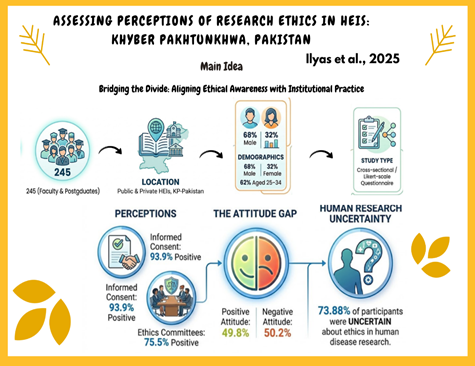
Background. The current study aimed to assess the level of perceptions, attitudes, and awareness regarding research ethics among faculty members and postgraduate students in Higher Education Institutions (HEIs) of Khyber Pakhtunkhwa (KPK), Pakistan.
Methods. The research was conduct in HEIs in Khyber Pakhtunkhwa (KPK), Pakistan, from August 2024 to January 2025. The study design was cross sectional. After obtaining ethical approval, about 245 participants were enrolled through convenience sampling. The data collection tool was a structured questionnaire reviewed by subject experts having questions related to perceptions of informed consent, attitudes towards research ethics, and views about university ethical committees. Data was analyzed using SPSS V. 22 where frequencies and percentages were calculated for summary statistics. For inferential statistics, chi-square and Kruskal-Wallis tests were applied for association between demographic and outcome variables.
Results. Majority of the participants were males (68%) and had a Master’s degree with age range from 25-34(62%) years. Regarding perceptions of informed consent, about 93.9% expressed positive perceptions, 49.8% reported favorable attitudes towards research ethics, while 75.5% viewed research ethics committees positively. Significant association was observed between gender and attitudes towards research ethics (p = .031) along with perceptions of research ethics committees (p = .008). Age was also significantly correlated (p < .001) with attitudes towards research ethics, whereas those receiving ethical training exhibited better awareness (p < .001), attitudes (p < .001), perceptions of informed consent (p = .019), and ethics committees (p < .001).
Conclusion:.The current study broadly highlighted a positive understanding of research ethics and participant perceptions. However, the key area highlighted required improvement and targeted approaches in context of attitudes and perceptions of ethical committees. By arranging trainings through institutional support, the culture of research ethics, individual perceptions, and ethical compliance can be positively reinforced.
Downloads
References
1. Resnik DB. Informed consent, understanding, and trust. Am J Bioeth. 2021;21(5):61-63. https://doi.org/10.1080/15265161.2021.1906987
2. Beauchamp TL, Childress JF. Principles of Biomedical Ethics. Edicoes Loyola; 1994.
3. Li D. Ethical governance in Chinese universities: an overview of research ethics committees. Ethics Behav. 2025;35(1):1-2. https://doi.org/10.1080/10508422.2024.2301764
4. Steneck NH. Fostering integrity in research: definitions, current knowledge, and future directions. Sci Eng Ethics. 2006;12(1):53-74. https://doi.org/10.1007/s11948-006-0006-y
5. Gul S, Parveen Q, Yousuf MI. Ethics of conducting research in social sciences at the university level in Pakistan. Glob Soc Sci Rev. 2018;3(4):486-497. https://doi.org/10.35484/gssr.2018(3:4)37
6. Emanuel EJ, Wendler D, Grady C. What makes clinical research ethical? In: Pimple KD, ed. Research Ethics. Routledge; 2017:229-239. https://doi.org/10.1001/jama.283.21.2701
7. Sandu A. Ethical and legal perspectives on informed consent in the context of international human rights law. Logos Universality Mentality Education Novelty Law. 2025;13(1):21-29. https://doi.org/10.18662/lumenlaw/13.1/95
8. Beauchamp TL, Childress JF. Principles of biomedical ethics: marking its fortieth anniversary. Am J Bioeth. 2019;19(11):9-12.https://doi.org/10.1080/15265161.2019.1665402
9. Luyirika E, Nshabohurira R, Nakanjako D, Mutyaba T. Ethics review and training of researchers in health research in Uganda: a descriptive study. BMC Med Ethics. 2020;21(1):e60. https://doi.org/10.1186/s12910-020-00502-3
10. Qadri HM, Shahid R, Fatima SB, et al. Knowledge, attitude and perception of research ethics and research ethics committees among post-graduate residents of neurosciences: a nationwide analysis from Pakistan. Pak J Med Sci. 2024;40(12):S55-S62. https://doi.org/10.12669/pjms.40.12(PINS).11116
11. Than MM, Htike H, Silverman HJ. Knowledge, awareness, attitudes, and practices towards research ethics and research ethics committees among Myanmar post-graduate students. Asian Bioeth Rev. 2020;(4):379-98. https://doi.org/10.1007/s41649-020-00148-w
12. Knight J. Evaluating the impacts of a research ethics training course on university researchers. Soc Sci. 2023;12(3):e182. https://doi.org/10.3390/socsci12030182
13. Gopalan N, Khan RI, Silverman HJ, et al. Enhancing research ethics capacity in Asia: Fogarty International Center supported initiatives in India, Malaysia, Myanmar, and Pakistan. J Empir Res Hum Res Ethics. 2025;20:e15562646251323133.https://doi.org/10.1177/1556264625132313
14. Frez-Pulgar G, Valdés-Rodríguez Y, Negrier-Seguel V, et al. Institutionalization of bioethics in higher education institutions: a systematic mapping. J Bioeth Inq. 2025;22:979-997. https://doi.org/10.1007/s11673-025-10442-7
15. Resnik DB. The Ethics of Research with Human Subjects: Protecting People, Advancing Science, Promoting Trust. Springer; 2018.
16. Phoomirat R, Kerdsomboon T, Palittapongarnpim P. Current status of approaches of universities in fostering research ethics in Thailand. Account Res. 2024;31(5):456-478. https://doi.org/10.1080/08989621.2022.2145195
17. Drolet MJ, Rose-Derouin E, Leblanc JC, et al. Ethical issues in research: perceptions of researchers, research ethics board members and research ethics experts. J Acad Ethics. 2023;21(2):269-292.
Downloads
Published
How to Cite
Issue
Section
License
Copyright (c) 2026 Muhammad Ilyas, Shehryar Ahmad, Atta ur Rehman, Muhammad Ayaz, Raza Ullah, Sheraz Ahmad, Muhammad Haroon

This work is licensed under a Creative Commons Attribution 4.0 International License.
BSR follows an open-access publishing policy and full text of all published articles is available free, immediately upon publication of an issue. The journal’s contents are published and distributed under the terms of the Creative Commons Attribution 4.0 International (CC-BY 4.0) license. Thus, the work submitted to the journal implies that it is original, unpublished work of the authors (neither published previously nor accepted/under consideration for publication elsewhere). On acceptance of a manuscript for publication, a corresponding author on the behalf of all co-authors of the manuscript will sign and submit a completed the Copyright and Author Consent Form.