Effects of Rhizospheric A. terreus upon Growth, Phytohormone Homeostasis, and Antioxidant Responses in B. Juncea L. under Arsenic Stress: A Multivariate Approach
DOI:
https://doi.org/10.32350/bsr.83.04Keywords:
Arsenic toxicity, A. terreus, B. juncea, Phytoremediation, PhytohormonesAbstract
Background. Agricultural soil contamination by arsenic (As) is a severe environmental problem and affects soil-plant systems which can pose risk to food safety by trophic transfer. Inoculation with microorganisms can be used as a tool to enhance plant performance under metal(loid) stress; however, the physiological and biochemical mechanisms by which rhizospheric fungi affect plant responses to arsenic are poorly understood, especially in Brassica juncea. In the current study, the rhizosphere isolate of fungus Aspergillus terreus was evaluated as bioinoculant to reduce arsenic phytotoxicity in B. juncea, an oilseed crop with agronomic and phytoremediation significance.
Methods. A total of thirteen treatments were employed, comprising the control treatment, four arsenic treatments (30-120 ppm), four treatments of arsenic + A. terreus, and four treatments of A. terreus. The number of plants that were used to maintain three uniform plants per pot was determined for each treatment (3 replicates) as biological replicates. Growth and biochemical characteristics of the plants were determined, while the variations among the different treatments and responses due to biomass were evaluated using PCA and structural path analysis.
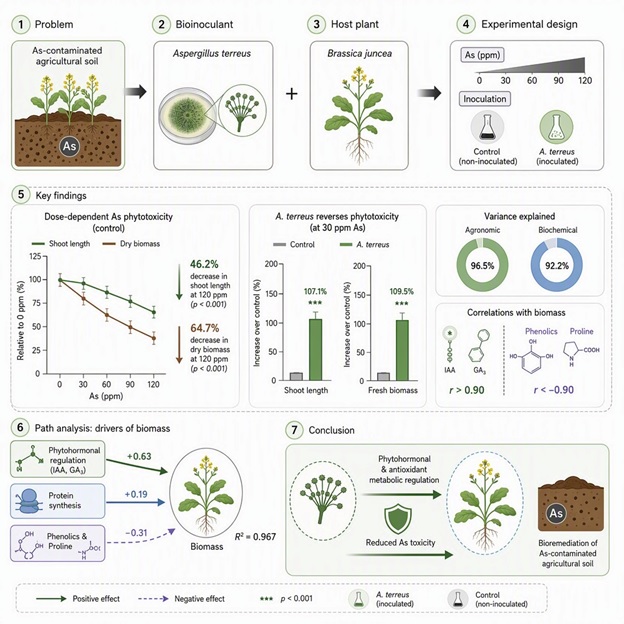
Results. Dose-dependent phytotoxicity occurred on exposure to arsenic, which caused a 46.2% decrease in shoot length and 64.7% decrease in dry biomass at 120 ppm (p < 0.001). A. terreus inoculation was able to reverse this toxicity, with an increase of 7.1% in shoot length and 9.5% in fresh biomass at 30 ppm, as compared to controls. Further, 96.5% of agronomic variance and 92.2% of biochemical variance respectively was explained with clear separation among treatments. The correlation of phytohormones with biomass was high (r > 0.90) and those for phenols and proline were high negative (r < −0.90). Path analysis results showed that protein synthesis (r = +0.19) and phytohormonal regulation (r = +0.63) are the main drivers of biomass (R2 = 0.967).
Conclusion. The phytohormonal and antioxidant metabolic regulation by A. terreus in B. juncea represents a viable and cost-effective approach for bioremediation of As-contaminated agricultural soils.
Highlights
- Under As-stress, terreus showed a significant effect on reducing growth inhibition and enhancing biomass production in B. juncea.
- Increased levels of phytohormones (IAA and GA₃) and protein buildup along with decreased oxidative stress markers showed that fungal inoculation provided stress tolerance.
- Through multivariate and path analyses, phytohormonal regulation and protein synthesis were found to be the key processes that influenced biomass recovery and suggested the potential of terreus in sustainable bioremediation of As-contaminated soils.
Downloads
References
1. Rai PK, Lee SS, Zhang M, Tsang YF, Kim KH. Heavy metals in food crops: Health risks, fate, mechanisms, and management. Environ Int. 2019;125:365–385. https://doi.org/10. 1016/j.envint.2019.01.067
2. Kumar V, Sharma A, Kaur P, et al. Pollution assessment of heavy metals in soils of India and ecological risk assessment: A state-of-the-art. Chemosphere. 2019;216:449–462. https://doi.org/10.1016/j.chemosphere.2018.10.066
3. Abbas G, Murtaza B, Bibi I, et al. Arsenic uptake, toxicity, detoxification, and speciation in plants: Physiological, biochemical, and molecular aspects. Int J Environ Res Public Health. 2018;15(1):59. https://doi.org/10.3390/ijerph15010059
4. Ali H, Khan E, Ilahi I. Environmental chemistry and ecotoxicology of hazardous heavy metals: Environmental persistence, toxicity, and bioaccumulation. J Chem. 2019;2019:6730305. https://doi.org/ 10.1155/2019/6730305
5. Bhat SA, Bashir O, Haq SAU, et al. Phytoremediation of heavy metals in soil and water: An eco-friendly, sustainable and multidisciplinary approach. Chemosphere. 2022;303:134788. https://doi.org/10. 1016/j.chemosphere.2022.134788
6. Ullah S, Khan J, Hayat K, et al. Comparative study of growth, cadmium accumulation and tolerance of three chickpea (Cicer arietinum L.) cultivars. Plants (Basel). 2020;9(3):310. https://doi.org/10. 3390/plants9030310
7. Gill RA, Ali B, Cui P, et al. Comparative transcriptome profiling of two Brassica napus cultivars under chromium toxicity and its alleviation by reduced glutathione. BMC Genomics. 2016;17:885. https://doi. org/10.1186/s12864-016-3200-6
8. Bali AS, Sidhu GPS, Kumar V. Root exudates ameliorate cadmium tolerance in plants: A review. Environ Chem Lett. 2020;18(4):1243–1275. https://doi.org/10.1007/s10311-020-01012-x
9. Ju W, Liu L, Jin X, et al. Co-inoculation effect of plant-growth-promoting rhizobacteria and rhizobium on EDDS assisted phytoremediation of Cu contaminated soils. Chemosphere. 2020;254:126724. https://doi.org/10. 1016/j.chemosphere.2020.126724
10. Zaheer IE, Ali S, Rizwan M, et al. Citric acid assisted phytoremediation of copper by Brassica napus L. Ecotoxicol Environ Saf. 2015;120:310–317. https://doi.org/10. 1016/j.ecoenv.2015.06.020
11. Hayat S, Hayat Q, Alyemeni MN, Wani AS, Pichtel J, Ahmad A. Role of proline under changing environments: A review. Plant Signal Behav. 2012;7(11):1456–1466. https://doi. org/10.4161/psb.21949
12. Deng S, Zhang X, Zhu Y, Zhuo R. Recent advances in phyto-combined remediation of heavy metal pollution in soil. Biotechnol Adv. 2024;72:108337. https://doi.org/10. 1016/j.biotechadv.2024.108337
13. Dilawar N, Hamayun M, Iqbal A, et al. Rhizofungus Aspergillus terreus mitigates heavy metal stress-associated damage in Triticum aestivum L. Plants (Basel). 2024;13(18):2643. https://doi.org/10. 3390/plants13182643
14. Bilal S, Shahzad R, Khan AL, et al. Endophytic microbial consortia of phytohormones-producing fungus Paecilomyces formosus LHL10 and bacteria Sphingomonas sp. LK11 to Glycine max L. regulates physio-hormonal changes to attenuate aluminum and zinc stresses. Front Plant Sci. 2018;9:1273. https://doi.org/ 10.3389/fpls.2018.01273
15. Saifullah M, Dilawar N, Rahman A, et al. Role of rhizofungus (Aspergillus terreus) in improving biochemical and physiological parameters affected by lead stress in Allium. SSRN. Published February 9, 2025. https://doi.org/ 10.2139/ssrn.5737248
16. Kaur R, Saxena S. Evaluation of drought-tolerant endophytic fungus Talaromyces purpureogenus as a bioinoculant for wheat seedlings under normal and drought-stressed circumstances. Folia Microbiol (Praha). 2023;68(5):781–799. https:// doi.org/10.1007/s12223-023-01051-1
17. Waqas M, Khan AL, Hamayun M, et al. Endophytic infection alleviates biotic stress in sunflower through regulation of defence hormones, antioxidants and functional amino acids. Eur J Plant Pathol. 2015;141(4):803–824. https://doi.org /10.1007/s10658-014-0581-8
18. Shahid S, Ambrin, Khan MA, Ahmad S, Sharipova V, Asad F. Potential of rhizospheric fungus Aspergillus terreus in mitigating lead toxicity in wheat seedlings. Pak J Bot. 2026;58(1):325–334. https://doi.org/ 10.30848/PJB2026-1(27)
19. Mosa KA, Saadoun I, Kumar K, Helmy M, Dhankher OP. Potential biotechnological strategies for the cleanup of heavy metals and metalloids. Front Plant Sci. 2016;7:303. https://doi.org/10.3389/ fpls.2016.00303
20. Bertolli SC, Mazzafera P, Souza GM. Why is it so difficult to identify a single indicator of water stress in plants? A proposal for a multivariate analysis to assess emergent properties. Plant Biol (Stuttg). 2014;16(3):578–585. https://doi.org/10.1111/plb.12088
21. White TJ, Bruns TD, Lee S, Taylor JW. Amplification and direct sequencing of fungal ribosomal RNA genes for phylogenetics. In: Innis MA, Gelfand DH, Sninsky JJ, White TJ, eds. PCR Protocols: A Guide to Methods and Applications. Academic Press; 1990:315–322. https://doi.org/ 10.1016/B978-0-12-372180-8.50042-1
22. Arnon DI. Copper enzymes in isolated chloroplasts. Polyphenoloxidase in Beta vulgaris. Plant Physiol. 1949;24(1):1–15. https://doi.org/10. 1104/pp.24.1.1
23. Kettner J, Dörffling K. Biosynthesis and metabolism of abscisic acid in tomato leaves infected with Botrytis cinerea. Planta. 1995;196(4):627–634. https://doi.org/10.1007/BF0 1106753
24. Gordon SA, Weber RP. Colorimetric estimation of indoleacetic acid. Plant Physiol. 1951;26(1):192–195. https:// doi.org/10.1104/pp.26.1.192
25. Warrier RR, Paul M, Vineetha MV. Estimation of salicylic acid in Eucalyptus leaves using spectrophotometric methods. Genet Plant Physiol. 2013;3(1–2):90–97.
26. Lowry OH, Rosebrough NJ, Farr AL, Randall RJ. Protein measurement with the Folin phenol reagent. J Biol Chem. 1951;193(1):265–275. https://doi.org/ 10.1016/S0021-9258(19)52451-6
27. Carillo P, Gibon Y. Protocol: Extraction and determination of proline. PrometheusWiki. 2011. iris.unicampania.it
28. DuBois M, Gilles KA, Hamilton JK, Rebers PA, Smith F. Colorimetric method for determination of sugars and related substances. Anal Chem. 1956;28(3):350–356. https://doi.org/ 10.1021/ac60111a017
29. Ainsworth EA, Gillespie KM. Estimation of total phenolic content and other oxidation substrates in plant tissues using Folin-Ciocalteu reagent. Nat Protoc. 2007;2(4):875–877. https://doi.org/10.1038/nprot.2007.102
30. Ali H, Asad F, Dilawar N, Sharipova V, Ahmad I, Zeb A. Symbiotic Aspergillus terreus alleviates drought and waterlogged stress in Zea mays L. Turk J Bot. 2025;49(5):375–387. https://doi.org/10.55730/1300-008X.2870
31. Adrees M, Ali S, Rizwan M, et al. The effect of excess copper on growth and physiology of important food crops: A review. Environ Sci Pollut Res Int. 2015;22(11):8148–8162. https://doi. org/10.1007/s11356-015-4496-5
32. Finnegan PM, Chen W. Arsenic toxicity: The effects on plant metabolism. Front Physiol. 2012;3:182. https://doi.org/10.3389/ fphys.2012.00182
33. Shahid S, Ambrin, Bibi S, Sharipova V, Asad F, Gechev T. Bioprotective role of Cladosporium tenuissimum counteracting heavy metal (chromium) stress in Triticum aestivum L. Front Microbiol. 2025;16:1685402. https:// doi.org/10.3389/fmicb.2025.1685402
34. Piotrowska-Niczyporuk A, Bajguz A, Zambrzycka-Szelewa E, Bralska M. Exogenously applied auxins and cytokinins ameliorate lead toxicity by inducing antioxidant defence system in green alga Acutodesmus obliquus. Plant Physiol Biochem. 2018;132:535–546. https://doi.org/ 10.1016/j.plaphy.2018.09.038
35. Shahid S, Asad F, Hussain F, et al. Effect of serine on growth and biochemical constituents of Zea mays L., Triticum aestivum L., and Abelmoschus esculentus L. under arsenic toxicity. Adv Life Sci. 2023;10(3):398–405. https://doi.org/ 10.62940/als.v10i3.1743
36. Tyagi S, Dhiman VK, Dhiman VK, Pandey H, Singh D, Sharma A. Plant defense strategies and biomarkers against heavy metal-induced stress: A comprehensive review. ACS Agric Sci Technol. 2024;4(2):129–143. https:// doi.org/10.1021/acsagscitech.3c00271
37. Naseer M, Adil M, Ahmad S, et al. Gas chromatography-mass spectrometry analysis, genoprotective, and antioxidant potential of Curio radicans (L. f.) P.V. Heath. ChemistryOpen. 2025;14(11):e202500175. https://doi .org/10.1002/open.202500175
38. Sharma A, Shahzad B, Kumar V, et al. Phytohormones regulate accumulation of osmolytes under abiotic stress. Biomolecules. 2019;9(7):285. https:// doi.org/10.3390/biom9070285
39. Dilawar N, Asad F, Shahid S. Role of hydroxyl benzoic acid foliar spray on amelioration of lead tolerance on Triticum aestivum L. Pure Appl Biol. 2021;10(3):861–871. https://doi.org/ 10.19045/bspab.2021.100088
Downloads
Published
How to Cite
Issue
Section
License
Copyright (c) 2026 Aima Javed, Tabassum Yaseen, Imtiaz Ahmad, Naveen Dilawar, Fayaz Asad

This work is licensed under a Creative Commons Attribution 4.0 International License.
BSR follows an open-access publishing policy and full text of all published articles is available free, immediately upon publication of an issue. The journal’s contents are published and distributed under the terms of the Creative Commons Attribution 4.0 International (CC-BY 4.0) license. Thus, the work submitted to the journal implies that it is original, unpublished work of the authors (neither published previously nor accepted/under consideration for publication elsewhere). On acceptance of a manuscript for publication, a corresponding author on the behalf of all co-authors of the manuscript will sign and submit a completed the Copyright and Author Consent Form.