
Morphological Variation of the Human Tongue in an Ethnic Population of Swat: Implications for Forensic Personal Identification
DOI:
https://doi.org/10.32350/sir.103.01Keywords:
forensic odontology, tongue color, tongue morphology, tongue shapeAbstract
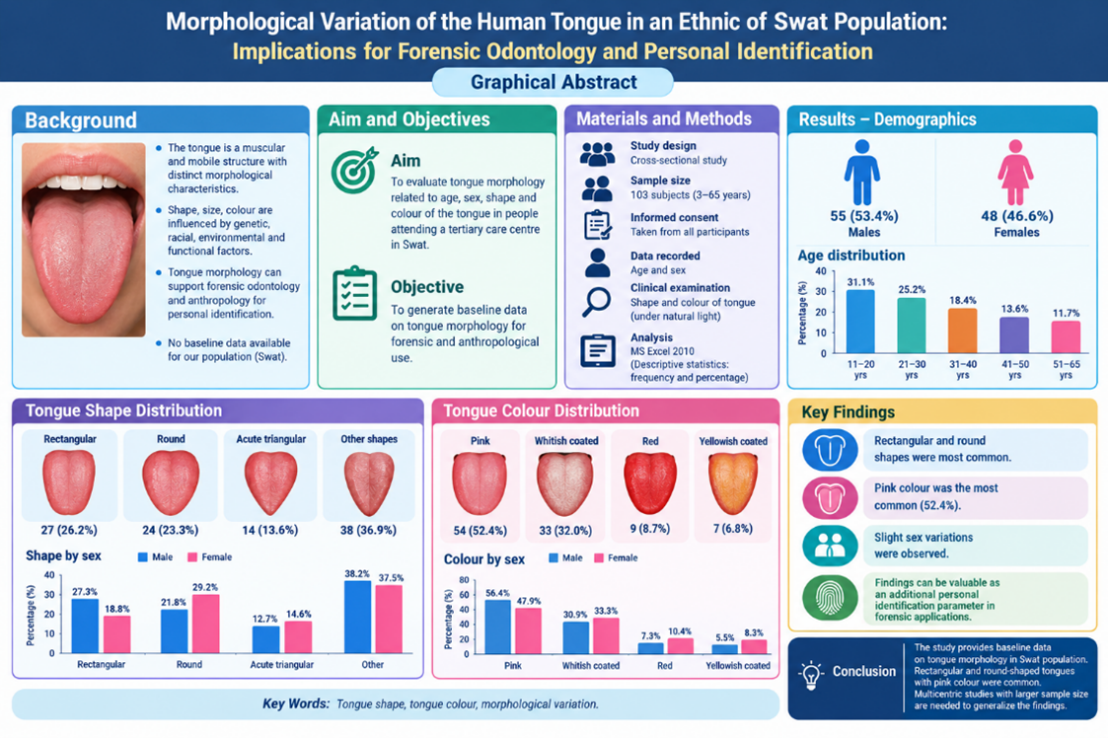
Tongue is a muscular and mobile organ with considerable morphological variation. Tongue shape and color may be influenced by genetic, environmental, and functional factors and have been investigated as potential supplementary characteristics in forensic odontology. The current study was undertaken to determine the variation of tongue morphology, with special reference to the shape and color of the tongue, among the individuals of Swat population. Furthermore, the study also focused to generate baseline population-specific data for forensic purposes. The descriptive cross-sectional study was conducted on 103 participants of Swat District, Khyber Pakhtunkhwa (KPK), Pakistan. The participants were recruited by convenience sampling according to the pre-established eligibility criteria. Written informed consent was obtained prior to examination. Tongue morphology was assessed by direct physical examination and the observations were recorded as per the classification criteria of the study. The data was summarized as frequencies and percentages. There were 55 males (53.4%) and 48 females (46.6%) in the study. Eight categories of tongue shape were recorded. The most frequent categories included rectangular (25, 24.3%), round (24, 23.3%), and acute triangular (14, 13.6%). The most common color of the tongue was pink (54, 52.4%), followed by whitish coated (33, 32.0%), red (11, 10.7%), and yellowish coated (5, 4.9%). Males most commonly fell in the rectangular shape category, whereas females most commonly fell in the round shape category. The results showed a considerable variation in the shape and color of tongue among the studied Swat population. These features may have potential value as supplementary forensic characteristics, in conjunction with established methods of identification. Larger, multicentric studies with standardized classification systems and reliability assessment are needed to establish their reproducibility and forensic discriminatory value.
Downloads
References
1. Zaidi FN, Meadows P, Jacobowitz O, Davidson TM. Tongue anatomy and physiology, the scientific basis for a novel targeted neurostimulation system designed for the treatment of obstructive sleep apnea. Neuromodulation. 2013;16(4):376–386. https://doi.org/ 10.1111/j.1525-1403.2012.00514.x
2. Sreepradha C, Vaishali MR, David MP. Tongue replica for personal identification: A digital photographic study. J Indian Acad Oral Med Radiol. 2019;31(1):57–61. https://doi.org/10.4103/jiaomr. jiaomr_59_19
3. Khare P, Bhargava K, Siddharth M, Bhargava D, Sarangi D, Sarangi D. Role of tongue prints and morphology in human identification: A review on an emerging forensic tool. J Punjab Acad Forensic Med Toxicol. 2025;25(1):85–92. https://doi.org/10.5958/0974-083X.2025.00019.7
4. Dahal A, McNevin D, Chikhani M, Ward J. An interdisciplinary forensic approach for human remains identification and missing persons investigations. WIREs Forensic Sci. 2023;5(4):e1484. https://doi.org/10.1002/wfs2.1484
5. Jeddy N, Radhika T, Nithya S. Tongue prints in biometric authentication: A pilot study. J Oral Maxillofac Pathol. 2017;21(1):176–179. https://doi.org/10.4103/jomfp.JOMFP_185_15
6. Zhang D, ed. Biometric Solutions: For Authentication in an E-World. Springer; 2002. The Springer International Series in Engineering and Computer Science; vol 697. https://doi.org/10.1007/978-1-4615-1053-6
7. Nagalaxmi V, Ugrappa S, Naga Jyothi M, Lalitha Ch, Maloth KN, Kodangal S. Cheiloscopy, palatoscopy and odontometrics in sex prediction and discrimination—a comparative study. Open Dent J. 2014;8:269–279. https://doi.org/10.2174/1874210601408010269
8. Astekar M, Saxena S, Sapra G, Agarwal A, Murari A. Lingual morphology: A secure method for forensic identification. J Forensic Sci Crim Investig. 2018;9(2):e555759. https://doi.org/10.19080/ JFSCI.2018.09.555759
9. Tang C, Shi D, Shi X, et al. An annotated dataset of tongue images. IEEE DataPort. 2019. https://dx.doi.org/10.21227/mtt8-q366
10. Liu Z, Yan JQ, Zhang D, Tang QL. A tongue-print image database for recognition. In: Proceedings of the Sixth International Conference on Machine Learning and Cybernetics. Vol 4. IEEE; 2007:2235–2238. https://doi.org/10.1109/ICMLC.2007.4370517
11. Johnson A, Gandhi B, Joseph SE. A morphological study of tongue and its role in forensics odontology. J Forensic Sci Crim Investig. 2018;7(5):e555723. https://doi.org/10.19080/JFSCI.2018.07.555723
12. Malik S, Nayak MT, Goyal M, Sanath AK, Malik U. Determination of sexual dimorphism using tongue prints—a prospective cross-sectional study. Univ J Dent Sci. 2022;8(1):54–58. https://doi.org/10.21276/ ujds.2022.8.1.10
13. Hsu PC, Wu HK, Huang YC, et al. Gender- and age-dependent tongue features in a community-based population. Medicine (Baltimore). 2019;98(51):e18350. https://doi.org/10.1097/MD.0000000000018350
14. Jeddy N, Radhika T, Nithya S. Tongue prints in biometric authentication: A pilot study. J Oral Maxillofac Pathol. 2017;21(1):176-179. https://doi.org/10.4103/jomfp.JOMFP_185_15
15. Kulig K, Wiśniowski M, Thum-Tyzo K, Chałas R. Differences in the morphological structure of the human tongue. Folia Morphol (Warsz). 2024;83(2):262–274. https://doi.org/10.5603/FM.a2023.0048
16. Hingad N, Kumar G, Singh K, Mahajan A, Singh MP, Gambhir RS. Tongue print as a valuable biometric and forensic tool: A digital photographic study. Niger Med J. 2024;65(5):673–681. https://doi.org/10.60787/nmj.v65i5.515
17. Zhang B, Zhang H. Significant geometry features in tongue image analysis. Evid Based Complement Alternat Med. 2015;2015:e897580. https://doi.org/10.1155/2015/897580
18. Musa OA, Elsheikh TE, Hassona ME. Tongues: Could they also be another fingerprint? Indian J Forensic Med Toxicol. 2014;8(1):171–175. https://doi.org/10.5958/j.0973-9130.8.1.037
19. Takemoto H. Morphological analyses of the human tongue musculature for three-dimensional modeling. J Speech Lang Hear Res. 2001;44(1):95–107. https://doi.org/10.1044/1092-4388(2001/009)
20. Garg K, Sachdev R, Singh G, Singh PJ, Chauhan SS. Tongue prints: An emerging biometric forensic tool. Indian J Forensic Med Toxicol. 2019;13(4):88–90. https://doi.org/10.5958/0973-9130.2019.00267.6
Downloads
Published
How to Cite
Issue
Section
License
Copyright (c) 2026 Murad Ali, Abbas Bostan, Sabir Khan, Asad Ullah, Fazal Akbar

This work is licensed under a Creative Commons Attribution 4.0 International License.