
Effectiveness of Jacobson Relaxation Technique and Quranic Recitation in Reducing Anxiety among University Students: A Quasi-Experimental Study
DOI:
https://doi.org/10.32350/ihr.61.01Keywords:
DASS-21, exam anxiety, Jacobson Progressive Muscle Relaxation (JPMR), Quranic Recitation, Surah Al-RehmanAbstract
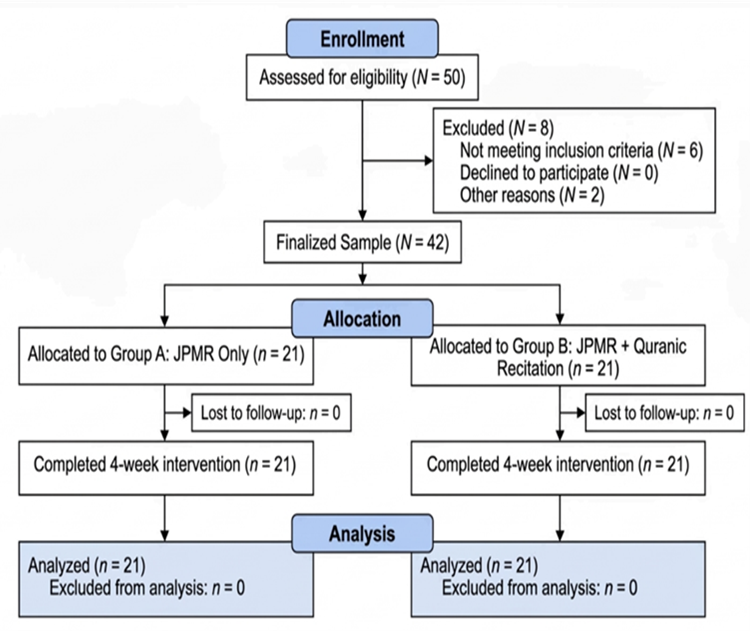
Anxiety is a common disorder among students due to workload or panic-related conditions during initial academic interactions before exams. Jacobson Progressive Muscle Relaxation (JPMR) techniques, involving tensing and relaxing body muscles, have shown efficacy in alleviating anxiety and strengthening muscles. Additionally, Quranic Recitation has demonstrated effectiveness in reducing student anxiety, promoting mental and spiritual relaxation. The objective of this study is to evaluate the efficiency of JPMR and Quranic Recitation among university students in relieving anxiety level before their exams. The research employed a Quasi-Experimental design by using non-probability convenience sampling with a sample size of 42 participants. Data analysis was conducted using the Statistical Package for the Social Sciences (SPSS) version 29. The study utilized the Depression, Anxiety, Stress Scale (DASS-21), an internationally recognized questionnaire. Participants provided informed consent and were selected based on specific inclusion criteria: first-year students experiencing exam-related anxiety, elevated DASS scores, and absence of other psychotic or stress-related issues. The study aimed to assess the effectiveness of interventions in mitigating anxiety among these students. JPMR and Quranic Recitation are both clinically and significantly effective treatment protocol for anxiety in students. However, the Group B (Combined) participants achieved a lower post-treatment median anxiety score of 2 compared to Group A (only JPMR) with a median of 3. This led to the conclusion that significant difference between both groups, showing Quranic Recitation combined with JPMR were more effective than JPMR.
Downloads
References
1. Pihkala P. Anxiety and the ecological crisis: an analysis of eco-anxiety and climate anxiety. Sustainability (Basel). 2020;12(19):e7836. https://doi.org/10.3390/su12197836
2. Chorpita BF, Barlow DH. The development of anxiety: the role of control in the early environment. In: The Neurotic Paradox. 2nd ed. 2018:227-264. https://doi.org/10.4324/9781315619996
3. Brady ST, Hard BM, Gross JJ. Reappraising test anxiety increases academic performance of first-year college students. J Educ Psychol. 2018;110(3):395-406. https://doi.org/10.1037/edu0000219
4. Quek TTC, Tam WWS, Tran BX, et al. The global prevalence of anxiety among medical students: a meta-analysis. Int J Environ Res Public Health. 2019;16(15):e2735. https://doi.org/10.3390/ijerph16152735
5. Shao R, He P, Ling B, et al. Prevalence of depression and anxiety and correlations between depression, anxiety, family functioning, social support and coping styles among Chinese medical students. BMC Psychol. 2020;8(1):e38. https://doi.org/10.1186/s40359-020-00402-8
6. Ghorbannejad S, Mehdizadeh Tourzani Z, Kabir K. The effectiveness of Jacobson's progressive muscle relaxation technique on maternal, fetal and neonatal outcomes in women with non-severe preeclampsia: a randomized clinical trial. J Educ Health Promot. 2022;11:e203. https://doi.org/10.1016/j.heliyon.2022.e09709
7. Icel S, Başoğul C. Effects of progressive muscle relaxation training with music therapy on sleep and anger of patients at community mental health center. Complement Ther Clin Pract. 2021;43:e101338. https://doi.org/10.1016/j.ctcp.2021.101338
8. Toussaint L, Nguyen QA, Roettger C, et al. Effectiveness of progressive muscle relaxation, deep breathing, and guided imagery in promoting psychological and physiological states of relaxation. Evid Based Complement Alternat Med. 2021;2021:e5924040. https://doi.org/10.1155/2021/5924040
9. Hamdani SU, Zafar SW, Suleman N, et al. Effectiveness of relaxation techniques as an active ingredient of psychological interventions to reduce distress, anxiety and depression in adolescents: a systematic review and meta-analysis. Child Adolesc Psychiatry Ment Health. 2022;16(1):e31. https://doi.org/10.1186/s13033-022-00541-y
10. Harorani M, Davodabady F, Masmouei B, Barati N. The effect of progressive muscle relaxation on anxiety and sleep quality in burn patients: a randomized clinical trial. Burns. 2020;46(5):1107-1113. https://doi.org/10.1016/j.burns.2019.11.021
11. Toqan D, Ayed A, Khalaf IA. Effect of progressive muscle relaxation exercise on anxiety among nursing students prior to critical care clinical training. SAGE Open Nurs. 2023;9:1–5. https://doi.org/10.1177/22799036231181668
12. Rafique R, Anjum A, Raheem SS. Efficacy of Surah Al-Rehman in managing depression in Muslim women. J Relig Health. 2019;58(2):516-526. https://doi.org/10.1007/s10943-017-0492-z
13. Mojarrab S, Bazrafkan L, Jaberi A. The effect of a stress and anxiety coping program on objective structured clinical examination performance among nursing students in Shiraz, Iran. BMC Med Educ. 2020;20(1):e301. https://doi.org/10.1186/s12909-020-02228-9
14. Shalaby MA. Qur'anic recitation in Pittsburgh, PA and Cairo, Egypt: shaping identity, nostalgia, and religious practice across the Egyptian-American diaspora. dissertation. University of Pittsburgh; 2018.
15. Coker AO, Coker OO, Sanni D. Psychometric properties of the 21-item Depression Anxiety Stress Scale (DASS-21). Afr Res Rev. 2018;12(2):135-142.
16. Silva HA, Passos MH, Oliveira VM, et al. Short version of the Depression Anxiety Stress Scale-21: is it valid for Brazilian adolescents? Einstein (Sao Paulo). 2016;14(4):486-493. https://doi.org/10.1590/S1679-45082016AO3732
17. Beaufort IN, De Weert-Van Oene GH, Buwalda VA, et al. The Depression, Anxiety and Stress Scale (DASS-21) as a screener for depression in substance use disorder inpatients: a pilot study. Eur Addict Res. 2017;23(5):260-268. https://doi.org/10.1159/000485182
18. Sudheer V, Naachimuthu KP. Effect of JPMR on state-trait anxiety among young female adults during COVID-19 pandemic lockdown. Int J Health Sci. 2022;6(S5):1192-1202. https://doi.org/10.53730/ijhs.v6nS5.8848
19. Rianti KI, Septadina IS, Prananjaya BA. Holy Quran recitation of Surah Al-Mulk and Al-Hasyr on decreasing anxiety in medical students. J Kedokt Kesehat. 2021;2(1):1-6.
20. Roozbahani T, Nourian M, Saatchi K, Moslemi A. Effect of progressive muscle relaxation on anxiety in pre-university students: a randomized controlled clinical trial. J Caring Sci. 2017;6(1):32-37.
21. Ozamiz-Etxebarria N, Santamaría MD, Munitis AE, Gorrotxategi MP. Reduction of COVID-19 anxiety levels through relaxation techniques: a study carried out in Northern Spain on a sample of young university students. Front Psychol. 2020;11:e2038. https://doi.org/10.3389/fpsyg.2020.02038
22. Akbari A, Ahmadi F, Jalili E, Khazaei S. The effect of relaxation technique (Jacobsen and Benson) on depression, anxiety, and stress in patients with multiple sclerosis. Curr Psychol. 2020;16(3):213-219. https://doi.org/10.2174/2666082216999200819105928
23. Tapeh ZA, Darvishpour A, Besharati F, Gholami-Chaboki B. Effect of Jacobson’s progressive muscle relaxation on anxiety and happiness of older adults in the nursing home. Iran J Nurs Midwifery Res. 2024;29(1):78-84. https://doi.org/10.4103/ijnmr.ijnmr_183_22
24. Jacob S, Sharma S. Efficacy of progressive muscular relaxation on coping strategies and management of stress, anxiety and depression. Int J Indian Psychol. 2018;6(1):106-124.
25. Zarea Gavgani V, Ghojazadeh M, Sadeghi-Ghyassi F, Khodapanah T. Effects of listening to Quran recitation on anxiety reduction in elective surgeries: a systematic review and meta-analysis. Arch Psychol Relig. 2022;44(2):111-126. https://doi.org/10.1177/00846724221102198
26. Latif MM, Bhatti AH. Proximate analysis of Holy Quran recitations on physiological, psychological, and neural functioning in Muslims. Int J Islam Khazanah. 2024;14(1):43-60. https://doi.org/10.15575/ijik.v14i1.33615
27. Ghiasi A, Keramat A. The effect of listening to Holy Quran recitation on anxiety: a systematic review. Iran J Nurs Midwifery Res. 2018;23(6):411-420. https://doi.org/10.4103/ijnmr.IJNMR_173_17
28. Hadju V, Syamsuddin S, Arundhana AI. The effect of listening to the recitation of Qur’an (Murottal Ar-Rahman surah) on the level of anxiety of pregnant women. Enferm Clin. 2020;30:238-242. https://doi.org/10.1016/j.enfcli.2019.07.097
Downloads
Published
How to Cite
Issue
Section
License
Copyright (c) 2026 Gulzar Ahmad, Fahad Hashmi

This work is licensed under a Creative Commons Attribution 4.0 International License.