
Impact of Human Resource Planning on Organizational Performance in Colleges of Education in Oyo State, Nigeria
DOI:
https://doi.org/10.32350/uer.82.05Keywords:
higher education, human resource planning, organizational performance, student enrollmentAbstract
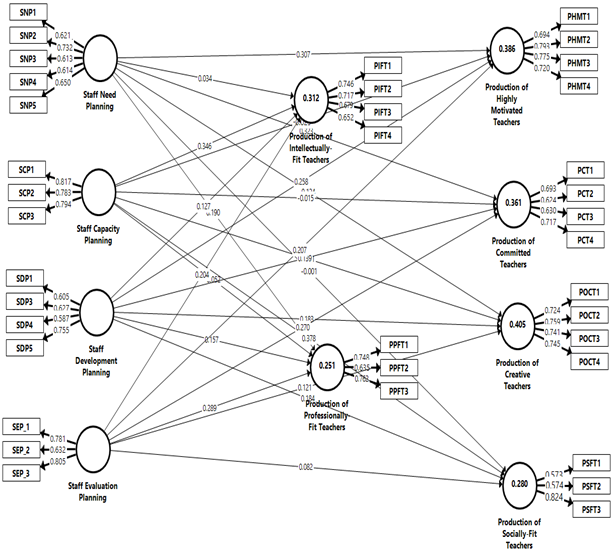
The current study aimed to inspect the impact of Human Resource Planning (HRP) on organizational performance in Colleges of Education in Oyo State, Nigeria. The study used a descriptive research design of correlation type. Moreover, a sample of 384 academic staff was selected using stratified random sampling technique. Two questionnaires titled ‘‘Human Resource Planning Questionnaire’’ (HRPQ) and Organizational Performance Questionnaire (OPQ) were used to collect data from the respondents. The reliability coefficients for HRPQ and OPQ were found to be 0.84 and 0.83, respectively. Three research questions were raised, while four research hypotheses were formulated to guide the study. Descriptive statistic was used to answer the research questions, while Partial Least Square Equation Modeling (PLS-SEM) via Smart PLS 4.3.2. was used to test the hypotheses formulated at .05 level of significance. The findings of the study indicated that: HRP in the Colleges of Education in Oyo State was high (Grand median value of 3.7). Organizational performance in the Colleges of Education in Oyo State was high (Grand median value of 3.9). There was a significant relationship between HRP and organizational performance in Colleges of Education in Oyo State (β= 0.74, t = 28.88, p < 0.05). The study concluded that effective HRP greatly enhances the organizational performance of Colleges of Education, contributing to the achievement of educational objectives. Moreover, the study recommended to sustain high organizational performance by ensuring an adequate number of qualified staff to meet the rising student enrollment in Colleges of Education across the State.
Downloads
References
Ahmed, E. (2019). Motivation and its impact on job performance. Journal of Economics, 2(1), 1–8.
Anya, C. J. P., Umoh, G. I., & Worlu, G. (2017). Human resource planning and organizational performance in oil and gas firms in Port Harcourt. International Journal of Advanced Academic Research: Social & Management Sciences, 3(9), 110–129.
Armstrong, M. (2014). Armstrong’s handbook of human resource management practice. Kogan Page.
Armstrong, M., & Locke, C. (2012). The handbook of human resource development. John Wiley & Sons.
Biswajeet, P. (2010). Human resource management (3rd ed.). PHI Learning Private Limited.
Chen, Y., & Huang, J. C. (2009). Strategic human resource practices and innovation performance: The mediating role of knowledge management capacity. Journal of Business Research, 62(1), 104–114. https://doi.org/10.1016/j.jbusres.2007.11.016
Chioke, S. C., & Mbamalu, K. U. (2020). Human resource planning and organizational performance: A philosophical approach. International Journal of Management, Social Sciences, Peace and Conflict Studies, 3(3), 387–398.
Chuai, X. I. P., & Preece, D. (2010). Talent management and HRM in multinational companies in Beijing: Definitions, differences and drivers. Journal of World Business, 45(2), 179–189. https://doi.org/10.1016/j.jwb.2009.09.014
Dessler, G., Cole, N. D., Sutherland, V. J., & Chhinzer, N. (2020). Human resource management in Canada (14th ed.). Pearson Canada.
Dialoke, I. (2016). Advanced human resource planning (PhD class note). Department of Industrial Relations & Personnel Management, Michael Okpara University of Agriculture.
Edeh, F. O., & Dialoke, I. (2020). Effect of human resource planning on organizational performance of the hospitality sector in Nigeria. Business Perspective Review, 2(1), 1–12. https://doi.org/10.38157/business-perspective-review.v2i1.71
Eketu, C. A., & Edeh, F. O. (2017). Human resource planning and organisational sustainability: A study of selected telecommunication firms in Rivers State. International Journal of Social Sciences and Management Research, 3(3), 37–46.
Fadipe, J. O. (2011). Quality control in education: The teacher factor. In T. E. Ajayi & J. Fadipe (Eds.), Skills improvement programme for effective performance of teachers in Nigerian schools. NIEPA Publications.
Farman, A., Kashif, M., Syed, M. R. S., Muhammad, S., & Muhammad, H. (2013). Effect of human resource planning on organizational performance of the telecom sector. Information and Knowledge Management, 3(2), 173–182.
George, N. R. (2017). Examples of organizational performance management. http://smallbusiness.chron.com/examples-organizational-performance-management-11508.html
Hamza, P. A., Othman, B., Gardi, B., Sorguli, S., Aziz, H., Ahmed, S., Sabir, B. Y., Ismael, N. B., Ali, B., & Anwar, K. (2021). Recruitment and selection: The relationship between recruitment and selection with organizational performance. International Journal of Engineering, Business and Management, 5(3), Article e1. https://doi.org/10.22161/ijebm.5.3.1
Hasan. (2019). Conceptual issues of linkage in the assessment of organizational performance. Academy of Management Review, 7(1), 49–58. https://doi.org/10.2307/257248
Helavalada, W., & Julius, T. N. (2017). Significance of manpower planning for effective utilization of human resources in an organization: A conceptual approach. International Journal of Business and Management Invention, 6(8), 16–22.
Heywood, D. (2012). Strategic human resource management: Integrating the universalistic, contingent, configurational and context perspectives. International Journal of Human Resource Management, 16(5), 633–659. https://doi.org/10.1080/09585190500082519
Hillriegel. (2018). Assessing construct validity in organizational research. Administrative Science Quarterly, 36, 421–458. https://doi.org/10.2307/2393203
Igbinoba, E., Joel, O., Igbadumhe, F., & Peter, D. (2022). Employees’ retention strategies and organizational performance. Academy of Entrepreneurship Journal, 28(S5), 1–12.
Kinicki, A., & Kreitner, R. (2003). Organizational behavior: Key concepts, skills, and best practices. McGraw-Hill Irwin.
Krejcie, R. V., & Morgan, D. W. (1970). Determining sample size for research activities. Educational and Psychological Measurement, 30, 607–610. https://doi.org/10.1177/001316447003000308
Maina, D. K., & Kwasira, J. (2015). Role of human resource planning practices on employee performance in county governments in Kenya: A case of Nakuru County. International Journal of Economics, Commerce and Management, 3(5), 1569–1580.
Management Study Guide. (2026, January 19). What is human resource planning? https://www.managementstudyguide.com/human-resource-planning.htm
Maryam, S., Muhammad, S., & Rab, N. L. (2014). Impact study of enterprise resource planning (ERP) in HRM practices. Middle-East Journal of Scientific Research, 21(1), 218–222.
Mathis, R. L., & Jackson, J. H. (2010). Human resource management (13th ed.). South-Western College Publishing.
Mkandatsama, P., & Nyanhete, T. (2017). Human resource planning in an unstable economy: Challenges faced (A case of state universities in Zimbabwe). International Journal of Asian Social Science, 7(3), 206–217. https://doi.org/10.18488/journal.1/2017.7.3/1.3.206.217
Oyeniran, S., Ayanwale, M. A., Atolagbe, A. A., & Mochekele, M. (2025). Construction and validation of goal achievement scale for colleges of education. Journal of Applied Research in Higher Education, 17(7), 131–150. https://doi.org/10.1108/JARHE-07-2024-0336
Federal Republic of Nigeria (FGN) (2014). National Policy on Education
Robbins, S. P., Judge, T. A., & Sanghi, S. (2009). Organizational behavior (13th ed.). Prentice Hall.
Rohollah, R., & SeidMehdi, V. (2015). Investigating the effect of human resource planning (HRP) on the quality of services of Melli Bank via the mediating variable of employees’ service behaviors. WALIA Journal, 31(S1), 47–53.
Shikha, N. K., & Karishma, G. (2012). Human resource planning practices. Journal of Business and Management, 3(6), 6–13.
Talukder, A. K. M. M. H., & Khan, M. I. (2013). Human resource planning and competitive advantage: Investigating the relationship. KASBIT Business Journal, 6, 29–37.
Ugwu, F. I., & Hubs, Y. (2020). Effect of workforce planning on the organizational performance of SMEs in Enugu State, Nigeria. International Journal of Advanced Research in Management and Social Sciences, 9(2), 52–77.
Published
How to Cite
Issue
Section
License

This work is licensed under a Creative Commons Attribution 4.0 International License.
UER follows an open-access publishing policy and full text of all published articles is available free, immediately upon publication of an issue. The journal’s contents are published and distributed under the terms of the Creative Commons Attribution 4.0 International (CC-BY 4.0) license. Thus, the work submitted to the journal implies that it is original, unpublished work of the authors (neither published previously nor accepted/under consideration for publication elsewhere). On acceptance of a manuscript for publication, a corresponding author on the behalf of all co-authors of the manuscript will sign and submit a completed Copyright and Author Consent Form.
Copyright (c) The Authors