
Convergence Crises: Climate Change as an Accelerant of the Global Antibiotic Resistance Crisis
DOI:
https://doi.org/10.32350/bsr.83.02Keywords:
antibiotic resistance, climate change, feedback loop, global health, one health, Vicious CycleAbstract
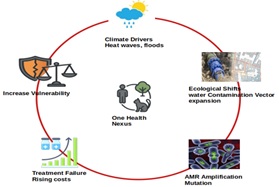
Background. Global health security is seriously threatened by syndemic created by antibiotic resistance and climate change, each crisis exacerbating the other.
Methodology. This review collected data from peer-reviewed literature published between 2000 and 2025 on the intersection of climate change and Antimicrobial Resistance (AMR). Data was extracted for climate drivers, resistance mechanisms health outcomes, and geographical patterns, with findings synthesized narratively. Results. The feedback loop (vicious cycle) disproportionately impacts vulnerable populations and pushes healthcare systems towards collapse while reducing the efficacy of advanced medicines.
Conclusion. The study argued that the climate-AMR nexus necessitates a paradigm shift from independent interventions towards integrated “One Health” policies. Transcending this cycle requires urgent, synergistic efforts that link climate change mitigation with enhanced AMR stewardship, new drugs, and effective global surveillance. A coordinated response to this interconnected crisis is urgently needed; if the relevant measures are not taken timely, foreseeable future risks serious weakening of environmental protections.
Downloads
References
1. Abbass K, Qasim MZ, Song H, Murshed M, Mahmood H, Younis I. A review of the global climate change impacts, adaptation, and sustainable mitigation measures. Environ Sci Pol-lut Res Int. 2022;29(28):42539–42559. https://doi.org/10.1007/s11356-022-19718-6
2. Van Boeckel TP, Gandra S, Ashok A, et al. Global antibiotic consumption 2000 to 2010: An analysis of national pharmaceutical sales data. Lancet In-fect Dis. 2014;14(8):742–750. https://doi.org/10.1016/S1473-3099(14)70780-7
3. Huemer M, Mairpady Shambat S, Brugger SD, Zinkernagel AS. Antibi-otic resistance and persistence—implications for human health and treatment perspectives. EMBO Rep. 2020;21(12):e51034. https://doi.org/ 10.15252/embr.202051034
4. Talebi Bezmin Abadi A, Rizvanov AA, Haertlé T, Blatt NL. World Health Organization report: Current crisis of antibiotic resistance. BioNa-noScience. 2019;9(4):778–788. https://doi.org/ 10.1007/s12668-019-00658-4
5. Sajjad W, Ilahi N, Haq A, et al. Bac-teria populating freshly appeared su-praglacial lake possess metals and an-tibiotic-resistant genes. Environ Res. 2024;247:e118288. https://doi.org/10. 1016/j.envres.2024.118288
6. Sajjad W, Rafiq M, Din G, et al. Res-urrection of inactive microbes and re-sistome present in the natural frozen world: Reality or myth? Sci Total En-viron. 2020;735:139275. https://doi. org/10.1016/j.scitotenv.2020.139275
7. Wong C. Antibiotic resistance is a growing threat—is climate change making it worse? Nature. Published online January 8, 2024. https://doi.org/ 10.1038/d41586-023-04077-0
8. Sajjad W, Ali B, Niu H, et al. High prevalence of antibiotic-resistant and metal-tolerant cultivable bacteria in remote glacier environment. Environ Res. 2023;239(Pt 2):117444. https:// doi.org/10.1016/j.envres.2023.117444
9. Kester JC, Fortune SM. Persisters and beyond: Mechanisms of phenotypic drug resistance and drug tolerance in bacteria. Crit Rev Biochem Mol Biol. 2014;49(2):91–101. https://doi.org/ 10.3109/10409238.2013.869543
10. World Health Organization. Overcom-ing Antimicrobial Resistance. World Health Organization; 2000. Accessed April 26, 2026. https://iris.who.int/items/ba46fa94-adda-42c8-b6d2-a2253b79b776
11. Kouadio IK, Aljunid S, Kamigaki T, Hammad K, Oshitani H. Infectious diseases following natural disasters: Prevention and control measures. Ex-pert Rev Anti Infect Ther. 2012;10(1):95–104. https://doi.org/ 10.1586/eri.11.155
12. Lee BX, Kjaerulf F, Turner S, et al. Transforming our world: Implement-ing the 2030 Agenda through Sus-tainable Development Goal indica-tors. J Public Health Policy. 2016;37(suppl 1):13–31. https://doi.org/10.1057/s41271-016-0002-7
13. Alara JA, Alara OR. An overview of the global alarming increase of multi-ple drug resistant: A major challenge in clinical diagnosis. Infect Disord Drug Targets. 2024;24(3):e250723219043. https:// doi.org/10.2174/1871526523666230725103902
14. Blair JM, Webber MA, Baylay AJ, Ogbolu DO, Piddock LJ. Molecular mechanisms of antibiotic resistance. Nat Rev Microbiol. 2015;13(1):42–51. https://doi.org/10.1038/nrmicro3380
15. Lin D, Du S, Zhao Z, et al. Climate warming fuels the global antibiotic re-sistome by altering soil bacterial traits. Nat Ecol Evol. 2025;9(8):1512–1526. https://doi.org/10.1038/s41559-025-02740-5
16. Semenza JC, Menne B. Climate change and infectious diseases in Eu-rope. Lancet Infect Dis. 2009;9(6):365–375. https://doi.org/ 10.1016/S1473-3099(09)70104-5
17. Sajjad W, Kang S, Yin X, et al. Depth-resolved transcriptional activity of an-tibiotic resistance genes in deep per-mafrost of the Qinghai–Tibet Plateau. Commun Biol. Published online June 30, 2026. https:// doi.org/10.1038/s42003-026-10593-2
18. Kaba HE, Kuhlmann E, Scheithauer S. Thinking outside the box: Associa-tion of antimicrobial resistance with climate warming in Europe—a 30 country observational study. Int J Hyg Environ Health. 2020;223(1):151–158. https://doi.org/10.1016/j.ijheh.2019.09.006
19. Arora P, Singh P, Wang Y, et al. Envi-ronmental isolation of Candida auris from the coastal wetlands of Anda-man Islands, India. mBio. 2021;12(2):e03181-20. https://doi.org/ 10.1128/mBio.03181-20
20. Chaves LF, Koenraadt CJM. Climate change and highland malaria: Fresh air for a hot debate. Q Rev Biol. 2010;85(1):27–55. https://doi.org/10. 1086/650284
21. O'Neill J. Tackling Drug-Resistant Infections Globally: Final Report and Recommendations. Review on Anti-microbial Resistance; 2016. Accessed April 26, 2026. https://amr-re-view.org/sites/default/files/160518_Final%20paper_with%20cover.pdf
22. Rzymski P, Gwenzi W, Poniedziałek B, Mangul S, Fal A. Climate warming, environmental degradation and pollu-tion as drivers of antibiotic resistance. Environ Pollut. 2024;346:e123649. https://doi.org/10. 1016/j.envpol.2024.123649
23. Klein EY, Sun L, Smith DL, Laxmina-rayan R. The changing epidemiology of methicillin-resistant Staphylococ-cus aureus in the United States: A na-tional observational study. Am J Epi-demiol. 2013;177(7):666–674. https://doi.org/10.1093/aje/kws 273
24. Blanco N, Perencevich E, Li SS, et al. Effect of meteorological factors and geographic location on methicillin-resistant Staphylococcus aureus and vancomycin-resistant enterococci colonization in the US. PLoS One. 2017;12(5):e0178254. https://doi.org/ 10.1371/journal.pone.0178254
25. Basikolo L. Occurrence of Extended-Spectrum Beta-Lactamase-Producing Enterobacteriaceae and Bacterial Loads in Dust From Poultry Farms in Lusaka-Zambia [doctoral thesis]. Uni-versity of Zambia; 2023. Accessed April 26, 2026. https://dspace. un-za.zm/handle/123456789/8502
26. Kalasseril SG, Krishnan R, Vattiringal RK, Paul R, Mathew P, Pillai D. Detec-tion of New Delhi metallo-β-lactamase 1 and cephalosporin re-sistance genes among carbapenem-resistant Enterobacteriaceae in water bodies adjacent to hospitals in India. Curr Microbiol. 2020;77(10):2886–2895. https://doi.org/10.1007/s00284-020-02107-y
27. Zhao Q, Shen Y, Chen G, Luo Y, Cui S, Tian Y. Prevalence and molecular characterization of fluoroquinolone-resistant Escherichia coli in healthy children. Front Cell Infect Microbiol. 2021;11:e743390. https://doi.org/10. 3389/fcimb.2021.743390
28. Makarov DA, Ivanova OE, Pomazkova AV, et al. Antimicrobial resistance of commensal Enterococ-cus faecalis and Enterococcus faeci-um from food-producing animals in Russia. Vet World. 2022;15(3):611–619. https://doi.org/10.14202/vetworld. 2022.611-619
29. Gordon LG, Elliott TM, Forde B, et al. Budget impact analysis of routinely using whole-genomic sequencing of six multidrug-resistant bacterial path-ogens in Queensland, Australia. BMJ Open. 2021;11(2):e041968. https://doi.org/10.1136/bmjopen-2020-041968
30. Moriel DG, Beatson SA, Wurpel DJ, et al. Identification of novel vaccine candidates against multidrug-resistant Acinetobacter baumannii. PLoS One. 2013;8(10):e77631. https://doi.org/10. 1371/journal.pone.0077631
31. Mina SA, Hasan MZ, Hossain AKMZ, Barua A, Mirjada MR, Chowdhury AMMA. The prevalence of multi-drug resistant Salmonella Typhi isolated from blood sample. Microbiol Insights. 2023;16:e11786361221150760. https://doi.org/10.1177/11786361221150760
32. Mokaddas EM, Rotimi VO, Albert MJ. Implications of Streptococcus pneumoniae penicillin resistance and serotype distribution in Kuwait for disease treatment and prevention. Clin Vaccine Immunol. 2008;15(2):203–207. https://doi.org/10.1128/CVI. 00277-07
33. Tsuzuki S, Matsunaga N, Yahara K, et al. National trend of blood-stream infection attributable deaths caused by Staphylococcus aureus and Esch-erichia coli in Japan. J Infect Chemother. 2020;26(4):367–371. https://doi.org/10.1016/j.jiac.2019.10.017
34. Founou RC, Founou LL, Allam M, Ismail A, Essack SY. Whole genome sequencing of extended spectrum β-lactamase (ESBL)-producing Klebsiella pneumoniae isolated from hospitalized patients in KwaZulu-Natal, South Africa. Sci Rep. 2019;9:e6266. https:// doi.org/10.1038/s41598-019-42672-2
35. Al-Orphaly M, Hadi HA, Eltayeb FK, et al. Epidemiology of multidrug-resistant Pseudomonas aeruginosa in the Middle East and North Africa re-gion. mSphere. 2021;6(3):e00202-21. https://doi.org/10.1128/mSphere.00202-21
36. Edgeworth JD, Batra R, Wulff J, Har-rison D. Reductions in methicillin-resistant Staphylococcus aureus, Clostridium difficile infection and in-tensive care unit-acquired blood-stream infection across the United Kingdom following implementation of a national infection control cam-paign. Clin Infect Dis. 2020;70(12):2530–2540. https://doi.org/10.1093/cid/ciz764
37. Mohamed A, Daef E, Nafie A, Sha-ban L, Ibrahim M. Characteristics of carbapenem-resistant gram-negative bacilli in patients with ventilator-associated pneumonia. Antibiotics (Basel). 2021;10(11):e1325. https:// doi.org/10.3390/antibiotics10111325
38. Kayastha K, Dhungel B, Karki S, et al. Extended-spectrum β-lactamase-producing Escherichia coli and Klebsiella species in pediatric patients visiting International Friendship Chil-dren's Hospital, Kathmandu, Nepal. Infect Drug Resist. 2020;13:e1178633720909798. https:// doi.org/10.1177/1178633720909798
39. Ndir A, Diop A, Ka R, et al. Infections caused by extended-spectrum beta-lactamases producing Enterobacteri-aceae: Clinical and economic impact in patients hospitalized in 2 teaching hospitals in Dakar, Senegal. Antimi-crob Resist Infect Control. 2016;5:e13. https:// doi.org/10.1186/s13756-016-0114-7
40. Purwaningrum D, Pratama A. Climate change and antimicrobial resistance: A global public health crisis at the en-vironmental nexus. Pharmacy Re-ports. 2024;4(1):e94. https://doi.org/10. 51511/pr.94
41. Chowdhury MSR, Hossain H, Rah-man MN, et al. Emergence of highly virulent multidrug and extensively drug resistant Escherichia coli and Klebsiella pneumoniae in buffalo subclinical mastitis cases. Sci Rep. 2025;15:e11704. https://doi.org/10. 1038/s41598-025-95914-x
42. Kain MJ, Reece NL, Parry CM, Ra-jahram GS, Paterson DL, Woolley SD. The rapid emergence of hypervirulent Klebsiella species and Burkholderia pseudomallei as major health threats in Southeast Asia: The urgent need for recognition as neglected tropical diseases. Trop Med Infect Dis. 2024;9(4):e80. https:// doi.org/10.3390/tropicalmed9040080
43. Alhassan MY, Ahmad AA. Antimi-crobial resistance in a changing cli-mate: A One Health approach for adaptation and mitigation. Bull Natl Res Cent. 2025;49:e26. https:// doi.org/10.1186/s42269-025-01318-2
44. Yang JW, Nam JH, Lee KJ, Yoo JS. Effect of temperature on car-bapenemase-encoding plasmid trans-fer in Klebsiella pneumoniae. Microorganisms. 2024;12(3):e454. https://doi.org/10.3390/microorganisms12030454
45. Furlan JPR, Sellera FP, Lincopan N, Debone D, Miraglia SGEK, Tavella RA. Catastrophic floods and antimi-crobial resistance: Interconnected threats with wide-ranging impacts. One Health. 2024;19:e100891. https://doi.org/10. 1016/j.onehlt.2024.100891
46. Pinto Jimenez CE, Keestra S, Tandon P, et al. Biosecurity and water, sanita-tion, and hygiene (WASH) interven-tions in animal agricultural settings for reducing infection burden, antibiotic use, and antibiotic resistance: A One Health systematic review. Lancet Planet Health. 2023;7(5):e418–e434. https://doi.org/ 10.1016/S2542-5196(23)00049-9
47. Zhang MS, Li W, Zhang WG, Li YT, Li JY, Gao Y. Agricultural land-use change exacerbates the dissemination of antibiotic resistance genes via sur-face runoffs in Lake Tai Basin, Chi-na. Ecotoxicol Environ Saf. 2021;220:e112328. https://doi.org/10. 1016/j.ecoenv.2021.112328
48. Rehman M, Sajjad W, Kang S, Rafiq M, Zhao Y. Mobilization of the an-cient resistome from thawing perma-frost. Crit Rev Microbiol. Published online July 9, 2026:1–21. https://doi.org/10. 1080/1040841X.2026.2698958
49. Okoth D. Climate change fuels drug resistance in poor countries. SciDev.Net. Published May 1, 2025. Accessed April 26, 2026. https://www.scidev.net/global/news/climate-change-fuels-drug-resistance-in-poor-countries/
50. Pruden A, Larsson DGJ, Amézquita A, et al. Management options for reduc-ing the release of antibiotics and anti-biotic resistance genes to the envi-ronment. Environ Health Perspect. 2013;121(8):878–885. https://doi.org/ 10.1289/ehp.1206446
51. Czatzkowska M, Harnisz M, Korzen-iewska E, et al. The impact of antimi-crobials on the efficiency of methane fermentation of sewage sludge, changes in microbial biodiversity and the spread of antibiotic resistance. J Hazard Mater. 2021;416:e125773. https://doi.org/10. 1016/j.jhazmat.2021.125773
52. Thorpe KE, Joski P, Johnston KJ. An-tibiotic-resistant infection treatment costs have doubled since 2002, now exceeding $2 billion annually. Health Aff (Millwood). 2018;37(4):662–669. https://doi.org/10.1377/hlthaff.2017.1153
53. Bell BG, Schellevis F, Stobberingh E, Goossens H, Pringle M. A systematic review and meta-analysis of the ef-fects of antibiotic consumption on antibiotic resistance. BMC Infect Dis. 2014;14:13. https://doi.org/10.1186/ 1471-2334-14-13
54. Roope LSJ, Smith RD, Pouwels KB, et al. The challenge of antimicrobial re-sistance: What economics can con-tribute. Science. 2019;364(6435):eaau4679. https://doi. org/10.1126/science.aau4679
55. Alkorta I, Garbisu C. Expanding the focus of the One Health concept: Links between the Earth-system pro-cesses of the planetary boundaries framework and antibiotic resistance. Rev Environ Health. 2025;40(1):159–173. https:// doi.org/10.1515/reveh-2024-0013
56. World Health Organization. Global Action Plan on Antimicrobial Re-sistance. World Health Organization; 2015.
57. Semenza JC, Paz S. Climate change and infectious disease in Europe: Im-pact, projection and adaptation. Lan-cet Reg Health Eur. 2021;9:e100216. https://doi.org/10. 1016/j.lanepe.2021.100216
58. Rzymski P, Gwenzi W, Poniedziałek B, Mangul S, Fal A. Climate warming, environmental degradation and pollu-tion as drivers of antibiotic resistance. Environ Pollut. 2024;346:e123649. https://doi.org/10. 1016/j.envpol.2024.123649
59. Magnano San Lio R, Favara G, Mau-geri A, Barchitta M, Agodi A. How an-timicrobial resistance is linked to cli-mate change: An overview of two in-tertwined global challenges. Int J En-viron Res Public Health. 2023;20(3):e1681. https://doi.org/10. 3390/ijerph20031681
60. Laxminarayan R, Duse A, Wattal C, et al. Antibiotic resistance—the need for global solutions. Lancet Infect Dis. 2013;13(12):1057–1098. https://doi. org/10.1016/S1473-3099(13)70318-9
61. Zeng Y, Li W, Zhao M, et al. The as-sociation between ambient tempera-ture and antimicrobial resistance of Klebsiella pneumoniae in China: A difference-in-differences analysis. Front Public Health. 2023;11:e1158762. https://doi.org/10. 3389/fpubh.2023.1158762
62. Godman B, Fadare J, Kwon HY, et al. Evidence-based public policy making for medicines across countries: Find-ings and implications for the future. J Comp Eff Res. 2021;10(12):1019–1052. https://doi.org/10.2217/cer-2020-0273
63. Piddock LJV, Alimi Y, Anderson J, et al. Advancing global antibiotic re-search, development and access. Nat Med. 2024;30(9):2432–2443. https:// doi.org/10.1038/s41591-024-03218-w
64. Ventola CL. The antibiotic resistance crisis: Part 1: Causes and threats. P T. 2015;40(4):277–283.
65. Sun J, Jin L, He T, et al. Antibiotic resistance genes (ARGs) in agricultural soils from the Yangtze River Delta, China. Sci Total Environ. 2020;740:e140001. https://doi.org/ 10.1016/j.scitotenv.2020.140001
Downloads
Published
How to Cite
Issue
Section
License
Copyright (c) 2026 Maqsood Ahmad, Faheem Nawaz, Anila Bahadur, Fouzia Bahadur, Sadaf Aslam Ghori, Hafiza Hina Irfan, Imran Ali Sani, Sobia Faisal, Muhammad Farhan, Syed Ali Raza

This work is licensed under a Creative Commons Attribution 4.0 International License.
BSR follows an open-access publishing policy and full text of all published articles is available free, immediately upon publication of an issue. The journal’s contents are published and distributed under the terms of the Creative Commons Attribution 4.0 International (CC-BY 4.0) license. Thus, the work submitted to the journal implies that it is original, unpublished work of the authors (neither published previously nor accepted/under consideration for publication elsewhere). On acceptance of a manuscript for publication, a corresponding author on the behalf of all co-authors of the manuscript will sign and submit a completed the Copyright and Author Consent Form.