
Predictive Artificial Intelligence for Climate-Resilient Crop Breeding: Integrating Genomics, Phenomics, and Climate Modeling
DOI:
https://doi.org/10.32350/sir.101.02Keywords:
climate resilient crops, crop breeding, genome prediction, machine learning, phenomics, predictive artificial intelligenceAbstract
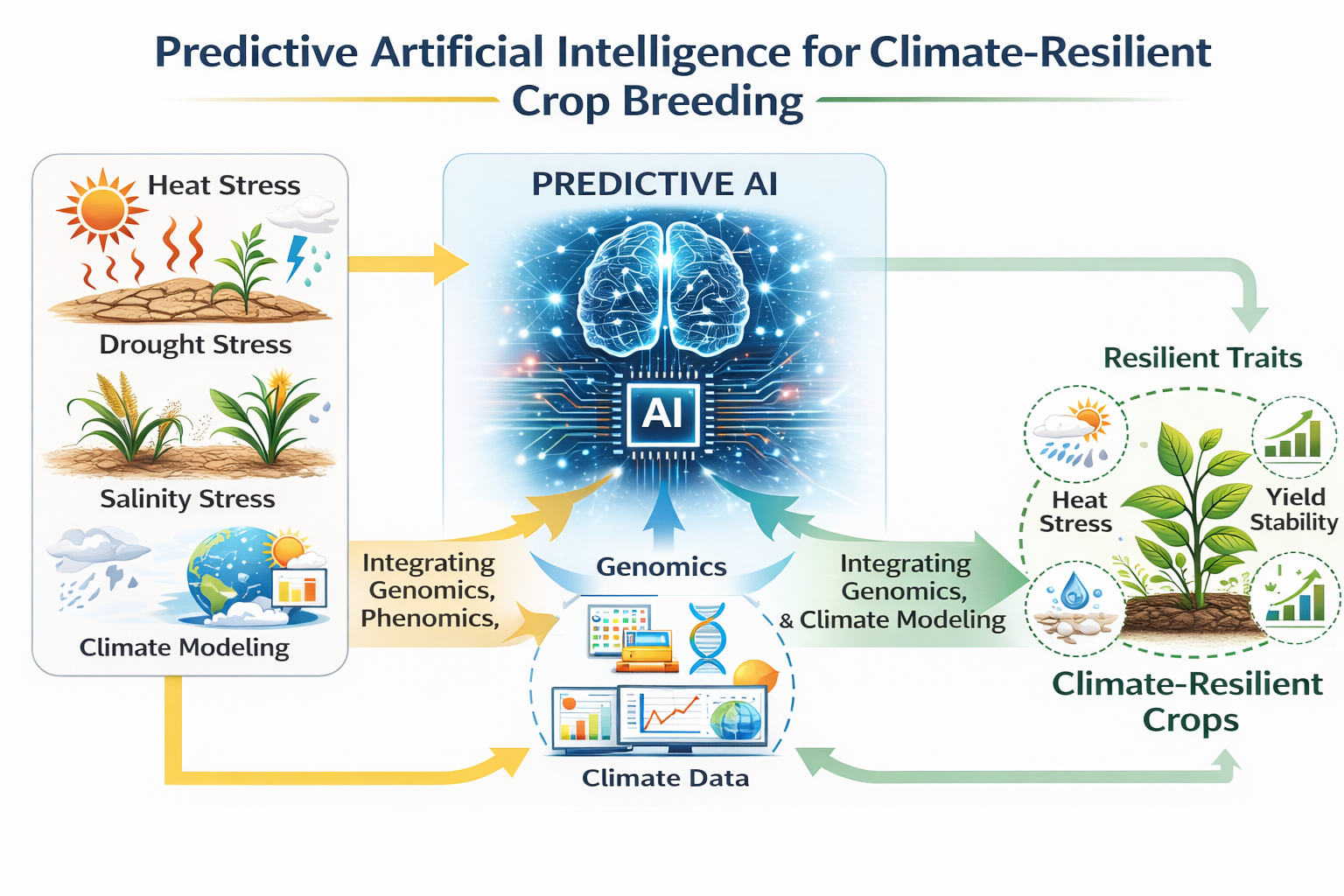
Global food security is increasingly threatened by climate change, which intensifies both biotic and abiotic stresses on crops, leading to reduced yield stability and productivity. Conventional breeding approaches are insufficient to address these challenges due to long breeding cycles, strong genotype–environment interactions, and limited capacity to predict crop performance under future climate scenarios. Predictive artificial intelligence (AI) offers a powerful solution by integrating genomics, phenomics, environmental, and climate data to model complex traits, stress tolerance, and genotype performance across diverse agroecological conditions. This review synthesized recent advances in Machine Learning (ML), Deep Learning (DL), genomic prediction, high-throughput phenotyping, and climate modeling that collectively support the development of climate-resilient crop varieties. The application of predictive AI in plant breeding enhances selection accuracy, accelerates breeding decisions, reduces dependency on costly and time-consuming field trials, as well as improves resource-use efficiency. By enabling data-driven decision-making, AI-based approaches significantly improve the precision and scalability of modern crop improvement programs. Looking ahead, the integration of predictive AI with explainable modeling frameworks, multi-omics datasets, and genome-editing technologies holds significant promise for accelerating the development of high-yielding, resilient, and sustainable crops, thereby contributing to long-term food security under changing climatic conditions.
Downloads
References
1. Cobb JN, Juma RU, Biswas PS, et al. Enhancing the rate of genetic gain in public-sector plant breeding programs: Lessons from the breeder’s equation. Theor Appl Genet. 2019;132(3):627–645. https://doi.org/10.1007/s00122-019-03317-0
2. Crossa J, Pérez-Rodríguez P, Cuevas J, et al. Genomic selection in plant breeding: Methods, models, and perspectives. Trends Plant Sci. 2017;22(11):961–975. https://doi.org/10.1016/j.tplants.2017.08.011
3. Danilevicz MF, Gill M, Anderson R, et al. Plant genotype to phenotype prediction using machine learning. Front Genet. 2022;13:e822173. https://doi.org/10.3389/fgene.2022.822173
4. Varshney RK, Sinha P, Singh VK, Kumar A, Zhang Q, Bennetzen JL. 5Gs for crop genetic improvement. Curr Opin Plant Biol. 2020;56:190–196. https://doi.org/10.1016/j.pbi.2019.12.004
5. Crossa J, Fritsche-Neto R, Montesinos-López O, et al. The modern plant breeding triangle: Optimizing the use of genomics, phenomics, and enviromics data. Front Plant Sci. 2021;12:e651480. https://doi.org/10.3389/fpls.2021.651480
6. Yang W, Feng H, Zhang X, et al. Crop phenomics and high-throughput phenotyping: Past decades, current challenges, and future perspectives. Mol Plant. 2020;13(2):187–214. https://doi.org/10.1016/j.molp.2020.01.008
7. Farooq M, van Dijk ADJ, Nijveen H, Mansoor S, de Ridder D. Genomic prediction in plants: Opportunities for ensemble machine learning based approaches [version 2; peer review: 1 approved, 2 approved with reservations]. F1000Res. 2023;11:802. https://doi.org/10.12688/f1000research.122437.2
8. Khan MHU, Wang S, Wang J, et al. Applications of artificial intelligence in climate-resilient smart-crop breeding. Int J Mol Sci. 2022;23(19):11156. https://doi.org/10.3390/ijms231911156
9. Washburn JD, Burch MB, Valdes Franco JA. Predictive breeding for maize: Making use of molecular phenotypes, machine learning, and physiological crop models. Crop Sci. 2020;60(2):622–638. https://doi.org/10.1002/csc2.20052
10. Roulé T, Christ A, Hussain N, et al. The lncRNA MARS modulates the epigenetic reprogramming of the marneral cluster in response to ABA. Mol Plant. 2022;15(5):840–856. https://doi.org/10.1016/j.molp.2022.02.007
11. Montesinos-López OA, Montesinos-López A, Pérez-Rodríguez P, et al. A review of deep learning applications for genomic selection. BMC Genomics. 2021;22(1):e19. https://doi.org/10.1186/s12864-020-07319-x
12. van Dijk ADJ, Kootstra G, Kruijer W, de Ridder D. Machine learning in plant science and plant breeding. iScience. 2021;24(1):e101890. https://doi.org/10.1016/j.isci.2020.101890
13. Montesinos-López A, Montesinos-López OA, Gianola D, Crossa J, Hernández-Suárez CM. Multi-environment genomic prediction of plant traits using deep learners with dense architecture. G3 (Bethesda). 2018;8(12):3813–3828. https://doi.org/10.1534/g3.118.200740
14. Cook JP, Acharya RK, Martin JM, et al. Genetic analysis of stay-green, yield, and agronomic traits in spring wheat. Crop Sci. 2021;61(1):383–395. https://doi.org/10.1002/csc2.20302
15. Scheben A, Yuan Y, Edwards D. Advances in genomics for adapting crops to climate change. Curr Plant Biol. 2016;6:2–10. https://doi.org/10.1016/j.cpb.2016.09.001
16. Ullah A, Nadeem F, Nawaz A, Siddique KHM, Farooq M. Heat stress effects on the reproductive physiology and yield of wheat. J Agron Crop Sci. 2022;208(1):1–17. https://doi.org/10.1111/jac.12572
17. Intergovernmental Panel on Climate Change. Climate Change 2021: The Physical Science Basis: Working Group I Contribution to the Sixth Assessment Report of the Intergovernmental Panel on Climate Change. Cambridge University Press; 2023. https://doi.org/10.1017/9781009157896
18. Intergovernmental Panel on Climate Change. Climate Change 2022: Impacts, Adaptation and Vulnerability: Working Group II Contribution to the Sixth Assessment Report of the Intergovernmental Panel on Climate Change. Cambridge University Press; 2023. https://doi.org/10.1017/9781009325844
19. Naqvi RZ, Siddiqui HA, Mahmood MA, et al. Smart breeding approaches in post-genomics era for developing climate-resilient food crops. Front Plant Sci. 2022;13:e972164. https://doi.org/10.3389/fpls.2022.972164
20. Tong H, Nikoloski Z. Machine learning approaches for crop improvement: Leveraging phenotypic and genotypic big data. J Plant Physiol. 2021;257:e153354. https://doi.org/10.1016/j.jplph.2020.153354
21. Bibi F, Rahman A. An overview of climate change impacts on agriculture and their mitigation strategies. Agriculture (Basel). 2023;13(8):e1508. https://doi.org/10.3390/agriculture13081508
22. Sun D, Xu Y, Cen H. Optical sensors: Deciphering plant phenomics in breeding factories. Trends Plant Sci. 2022;27(2):209–210. https://doi.org/10.1016/j.tplants.2021.06.012
23. Wanga MA, Shimelis H, Mashilo J, Laing MD. Opportunities and challenges of speed breeding: A review. Plant Breed. 2021;140(2):185–194. https://doi.org/10.1111/pbr.12909
24. Hickey LT, Hafeez AN, Robinson H, et al. Breeding crops to feed 10 billion. Nat Biotechnol. 2019;37(7):744–754. https://doi.org/10.1038/s41587-019-0152-9
25. Fu H, Lu J, Cui G, et al. Advanced plant phenotyping: Unmanned aerial vehicle remote sensing and CimageA software technology for precision crop growth monitoring. Agronomy (Basel). 2024;14(11):e2534. https://doi.org/10.3390/agronomy14112534
26. Costa-Neto G, Crossa J, Fritsche-Neto R. Enviromic assembly increases accuracy and reduces costs of the genomic prediction for yield plasticity in maize. Front Plant Sci. 2021;12:e717552. https://doi.org/10.3389/fpls.2021.717552
27. Mochida K, Koda S, Inoue K, et al. Computer vision-based phenotyping for improvement of plant productivity: A machine learning perspective. Gigascience. 2019;8(1):egiy153. https://doi.org/10.1093/gigascience/giy153
28. Chawla R, Poonia A, Samantara K, et al. Green revolution to genome revolution: Driving better resilient crops against environmental instability. Front Genet. 2023;14:e1204585. https://doi.org/10.3389/fgene.2023.1204585
29. Yin X, Struik PC, Goudriaan J. On the needs for combining physiological principles and mathematics to improve crop models. Field Crops Res. 2021;271:e108254. https://doi.org/10.1016/j.fcr.2021.108254
30. Millet EJ, Kruijer W, Coupel-Ledru A, et al. Genomic prediction of maize yield across European environmental conditions. Nat Genet. 2019;51(6):952–956. https://doi.org/10.1038/s41588-019-0414-y
31. Xu Y, Zhang X, Li H, et al. Smart breeding driven by big data, artificial intelligence, and integrated genomic-enviromic prediction. Mol Plant. 2022;15(11):1664–1695. https://doi.org/10.1016/j.molp.2022.09.001
32. Food and Agriculture Organization of the United Nations, International Fund for Agricultural Development, United Nations Children’s Fund, World Food Programme, World Health Organization. The State of Food Security and Nutrition in the World 2021: Transforming Food Systems for Food Security, Improved Nutrition and Affordable Healthy Diets for All. Food and Agriculture Organization of the United Nations; 2021. https://doi.org/10.4060/cb4474en
33. Tilman D, Balzer C, Hill J, Befort BL. Global food demand and the sustainable intensification of agriculture. Proc Natl Acad Sci U S A. 2011;108(50):20260–20264. https://doi.org/10.1073/pnas.1116437108
34. Araus JL, Kefauver SC. Breeding to adapt agriculture to climate change: Affordable phenotyping solutions. Curr Opin Plant Biol. 2018;45:237–247. https://doi.org/10.1016/j.pbi.2018.05.003
35. Azodi CB, Tang J, Shiu SH. Opening the black box: Interpretable machine learning for geneticists. Trends Genet. 2020;36(6):442–455. https://doi.org/10.1016/j.tig.2020.03.005
36. van Eeuwijk FA, Bustos-Korts DV, Malosetti M. What should students in plant breeding know about the statistical aspects of genotype × environment interactions? Crop Sci. 2016;56(5):2119–2140. https://doi.org/10.2135/cropsci2015.06.0375
37. Liakos KG, Busato P, Moshou D, Pearson S, Bochtis D. Machine learning in agriculture: A review. Sensors (Basel). 2018;18(8):e2674. https://doi.org/10.3390/s18082674
38. Gorelick N, Hancher M, Dixon M, Ilyushchenko S, Thau D, Moore R. Google Earth Engine: Planetary-scale geospatial analysis for everyone. Remote Sens Environ. 2017;202:18–27. https://doi.org/10.1016/j.rse.2017.06.031
39. Wolfert S, Ge L, Verdouw C, Bogaardt MJ. Big data in smart farming: A review. Agric Syst. 2017;153:69–80. https://doi.org/10.1016/j.agsy.2017.01.023
40. Benos L, Tagarakis AC, Dolias G, Berruto R, Kateris D, Bochtis D. Machine learning in agriculture: A comprehensive updated review. Sensors (Basel). 2021;21(11):e3758. https://doi.org/10.3390/s21113758
41. Xu Y. Envirotyping for deciphering environmental impacts on crop plants. Theor Appl Genet. 2016;129(4):653–673. https://doi.org/10.1007/s00122-016-2691-5
42. Xu Y, Crouch JH. Marker-assisted selection in plant breeding: From publications to practice. Crop Sci. 2008;48(2):391–407. https://doi.org/10.2135/cropsci2007.04.0191
43. Poland JA, Rife TW. Genotyping-by-sequencing for plant breeding and genetics. Plant Genome. 2012;5(3):92–102. https://doi.org/10.3835/plantgenome2012.05.0005
44. Varshney RK, Bohra A, Yu J, Graner A, Zhang Q, Sorrells ME. Designing future crops: Genomics-assisted breeding comes of age. Trends Plant Sci. 2021;26(6):631–649. https://doi.org/10.1016/j.tplants.2021.03.010
45. Jeong JH, Resop JP, Mueller ND, et al. Random forests for global and regional crop yield predictions. PLoS One. 2016;11(6):e0156571. https://doi.org/10.1371/journal.pone.0156571
46. Tester M, Langridge P. Breeding technologies to increase crop production in a changing world. Science. 2010;327(5967):818–822. https://doi.org/10.1126/science.1183700
47. Furbank RT, Tester M. Phenomics-technologies to relieve the phenotyping bottleneck. Trends Plant Sci. 2011;16(12):635–644. https://doi.org/10.1016/j.tplants.2011.09.005
48. Kuhn M, Johnson K. Applied Predictive Modeling. Springer; 2013. https://doi.org/10.1007/978-1-4614-6849-3
49. Munns R, Tester M. Mechanisms of salinity tolerance. Annu Rev Plant Biol. 2008;59:651–681. https://doi.org/10.1146/annurev.arplant.59.032607.092911
50. Wang X, Xu Y, Hu Z, Xu C. Genomic selection methods for crop improvement: Current status and prospects. Crop J. 2018;6(4):330–340. https://doi.org/10.1016/j.cj.2018.03.001
51. James G, Witten D, Hastie T, Tibshirani R. An Introduction to Statistical Learning: With Applications in R. 2nd ed. Springer; 2021. https://doi.org/10.1007/978-1-0716-1418-1
52. Meuwissen THE, Hayes BJ, Goddard ME. Prediction of total genetic value using genome-wide dense marker maps. Genetics. 2001;157(4):1819–1829. https://doi.org/10.1093/genetics/157.4.1819
53. Mohanty SP, Hughes DP, Salathé M. Using deep learning for image-based plant disease detection. Front Plant Sci. 2016;7:e1419. https://doi.org/10.3389/fpls.2016.01419
54. Intergovernmental Panel on Climate Change. Climate Change and Land: IPCC Special Report on Climate Change, Desertification, Land Degradation, Sustainable Land Management, Food Security, and Greenhouse Gas Fluxes in Terrestrial Ecosystems. Cambridge University Press; 2022. https://doi.org/10.1017/9781009157988
55. Chen T, Guestrin C. XGBoost: A scalable tree boosting system. In: Proceedings of the 22nd ACM SIGKDD International Conference on Knowledge Discovery and Data Mining. Association for Computing Machinery; 2016:785–794. https://doi.org/10.1145/2939672.2939785
56. VanRaden PM. Efficient methods to compute genomic predictions. J Dairy Sci. 2008;91(11):4414–4423. https://doi.org/10.3168/jds.2007-0980
57. Adadi A, Berrada M. Peeking inside the black-box: A survey on explainable artificial intelligence (XAI). IEEE Access. 2018;6:52138–52160. https://doi.org/10.1109/ACCESS.2018.2870052
58. Lourenço VM, Ogutu JO, Rodrigues RAP, Posekany A, Piepho HP. Genomic prediction using machine learning: A comparison of the performance of regularized regression, ensemble, instance-based and deep learning methods on synthetic and empirical data. BMC Genomics. 2024;25(1):152. https://doi.org/10.1186/s12864-023-09933-x
59. Elgart M, Lyons G, Romero-Brufau S, et al. Non-linear machine learning models incorporating SNPs and PRS improve polygenic prediction in diverse human populations. Commun Biol. 2022;5:856. https://doi.org/10.1038/s42003-022-03812-z
60. Westhues CC, Mahone GS, da Silva S, et al. Prediction of maize phenotypic traits with genomic and environmental predictors using gradient boosting frameworks. Front Plant Sci. 2021;12:699589. https://doi.org/10.3389/fpls.2021.699589
61. Nazzicari N, Biscarini F. Stacked kinship CNN vs GBLUP for genomic predictions of additive and complex continuous phenotypes. Sci Rep. 2022;12(1):e19889. https://doi.org/10.1038/s41598-022-24405-0
62. Gao C. Genome engineering for crop improvement and future agriculture. Cell. 2021;184(6):1621–1635. https://doi.org/10.1016/j.cell.2021.01.005
63. Gill T, Gill SK, Saini DK, Chopra Y, de Koff JP, Sandhu KS. A comprehensive review of high-throughput phenotyping and machine learning for plant stress phenotyping. Phenomics. 2022;2(3):156–183. https://doi.org/10.1007/s43657-022-00048-z
64. Sarić R, Nguyen VD, Burge T, et al. Applications of hyperspectral imaging in plant phenotyping. Trends Plant Sci. 2022;27(3):301–315. https://doi.org/10.1016/j.tplants.2021.12.003
65. Tattaris M, Reynolds MP, Chapman SC. A direct comparison of remote sensing approaches for high-throughput phenotyping in plant breeding. Front Plant Sci. 2016;7:e1131. https://doi.org/10.3389/fpls.2016.01131
66. Abbas A, Zhang Z, Zheng H, et al. Drones in plant disease assessment, efficient monitoring, and detection: A way forward to smart agriculture. Agronomy (Basel). 2023;13(6):e1524. https://doi.org/10.3390/agronomy13061524
67. Ferentinos KP. Deep learning models for plant disease detection and diagnosis. Comput Electron Agric. 2018;145:311–318. https://doi.org/10.1016/j.compag.2018.01.009
68. Shahi D, Guo J, Pradhan S, et al. Multi-trait genomic prediction using in-season physiological parameters increases prediction accuracy of complex traits in US wheat. BMC Genomics. 2022;23(1):298. https://doi.org/10.1186/s12864-022-08487-8
69. Kamilaris A, Prenafeta-Boldú FX. Deep learning in agriculture: A survey. Comput Electron Agric. 2018;147:70–90. https://doi.org/10.1016/j.compag.2018.02.016
70. Singh AK, Ganapathysubramanian B, Sarkar S, Singh A. Deep learning for plant stress phenotyping: Trends and future perspectives. Trends Plant Sci. 2018;23(10):883–898. https://doi.org/10.1016/j.tplants.2018.07.004
71. Saggi MK, Jain S. A survey towards decision support system on smart irrigation scheduling using machine learning approaches. Arch Comput Methods Eng. 2022;29(6):4455–4478. https://doi.org/10.1007/s11831-022-09746-3
72. Klerkx L, Rose D. Dealing with the game-changing technologies of Agriculture 4.0: How do we manage diversity and responsibility in food system transition pathways? Glob Food Sec. 2020;24:e100347. https://doi.org/10.1016/j.gfs.2019.100347
73. Nampally T, Kumar K, Chatterjee S, Pachamuthu R, Naik B, Desai UB. StressNet: A spatial-spectral-temporal deformable attention-based framework for water stress classification in maize. Front Plant Sci. 2023;14:e1241921. https://doi.org/10.3389/fpls.2023.1241921
74. Cobb JN, DeClerck G, Greenberg A, Clark R, McCouch S. Next-generation phenotyping: Requirements and strategies for enhancing our understanding of genotype-phenotype relationships and its relevance to crop improvement. Theor Appl Genet. 2013;126(4):867–887. https://doi.org/10.1007/s00122-013-2066-0
75. Jannink JL, Lorenz AJ, Iwata H. Genomic selection in plant breeding: From theory to practice. Brief Funct Genomics. 2010;9(2):166–177. https://doi.org/10.1093/bfgp/elq001
76. He K, Yu T, Gao S, et al. Leveraging automated machine learning for environmental data-driven genetic analysis and genomic prediction in maize hybrids. Adv Sci (Weinh). 2025;12(17):e2412423. https://doi.org/10.1002/advs.202412423
77. Banerjee S, Reynolds J, Taggart M, Daniele M, Bozkurt A, Lobaton E. Quantifying visual differences in drought-stressed maize through reflectance and data-driven analysis. AI. 2024;5(2):790–802. https://doi.org/10.3390/ai5020040
78. Challinor AJ, Koehler AK, Ramirez-Villegas J, Whitfield S, Das B. Current warming will reduce yields unless crop breeding and adaptation accelerate. Nat Clim Chang. 2016;6(10):954–959. https://doi.org/10.1038/nclimate3061
79. Upadhyaya SR, Danilevicz MF, Dolatabadian A, et al. Genomics-based plant disease resistance prediction using machine learning. Plant Pathol. 2024;73(9):2298–2309. https://doi.org/10.1111/ppa.13988
80. Kebede EA, Abou Ali H, Clavelle T, et al. Assessing and addressing the global state of food production data scarcity. Nat Rev Earth Environ. 2024;5(4):295–311. https://doi.org/10.1038/s43017-024-00516-2
81. Van Klompenburg T, Kassahun A, Catal C. Crop yield prediction using machine learning: A systematic literature review. Comput Electron Agric. 2020;177:105709. https://doi.org/10.1016/j.compag.2020.105709
Downloads
Published
How to Cite
Issue
Section
License
Copyright (c) 2026 Eizha Amir, Sumaira Mazhar

This work is licensed under a Creative Commons Attribution 4.0 International License.