
Differential Expression of HPV16/18 E6 in Gynecological Cancers and its Association with MMP-2 Expression
DOI:
https://doi.org/10.32350/bsr.82.07Keywords:
Human papillomavirus 16, endometrial and ovarian cancers, Matrix Metalloproteinase 2 (MMP2), uterine cervical neoplasmsAbstract
Background. Human Papillomavirus (HPV) is the most common sexually transmitted infection, worldwide. High-risk HPV 16 and 18 remain significant factors in the development of HPV-related malignancies. In Pakistan, where HPV screening and vaccination programs are not yet widespread, exploring HPV prevalence in gynecological cancers is essential. Matrix metalloproteinase-2 (MMP-2) is an enzyme responsible for extracellular matrix degradation and contributes to tumor invasion and metastasis. This study aimed to investigate the prevalence of HPV16/18’s oncoprotein E6 expression in gynecological malignancies and its relationship with MMP-2.
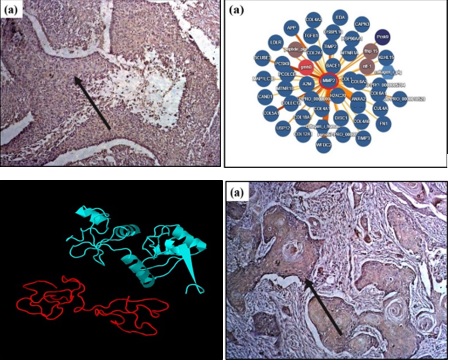
Methods. The study cohort included formalin-fixed paraffin embedded (FFPE) tissue biopsies from patients with cervical cancer (n= 29), ovarian cancer (n= 16), and endometrial cancer (n= 16). Immunohistochemistry was performed to evaluate the expression levels of HPV16/18 E6 and MMP-2. Protein-protein interaction was investigated using PEPPI and INTAct tools.
Results. The study found HPV16/18 E6 expression in 93% of cervical cancer cases, as compared to 12% ovarian and 18% endometrial cancer cases. This difference in expression across tissues is highly significant (p<0.0001), emphasizing the strong association of E6 expression with cervical cancer. A strong correlation was also observed between E6 and MMP-2 (p=0.001). When analyzed separately, only MMP-2 expression significantly predicted malignancy (p=0.025); however, their co-expression demonstrated a stronger association with malignant phenotype (p=0.008). Interestingly, protein-protein interaction analysis suggested that E6 does not directly bind to MMP-2 but may instead act through a broader interaction network, indirectly driving disease progression.
Conclusion. HPV E6 expression has a strong association with MMP-2 and their co-expression serves as a significant predictor of malignancy.
Downloads
References
1. Hausen HZ. Papillomavirus infections—a major cause of human cancers. Biochim Biophys Acta. 1996;1288(2):F55–F78. https://doi.org/10.1016/0304-419X(96)00020-0
2. Riaz L, Manazir S, Jawed F, Arshad Ali S, Riaz R. Knowledge, perception, and prevention practices related to human papillomavirus-based cervical cancer and its socioeconomic correlates among women in Karachi, Pakistan. Cureus. 2020;12(3):e7183. https://doi.org/10.7759/cureus.7183
3. Aziz H, Mehmood H, Arif S, et al. Distribution of HPV types in cervical cancer in Pakistan: implications for screening and vaccination programs. J Clin Lab Anal. 2025;39(1):e25130. https://doi.org/10.1002/jcla.25130
4. Cherif S, Amine A, Thies S, et al. Prevalence of human papillomavirus detection in ovarian cancer: a meta-analysis. Eur J Clin Microbiol Infect Dis. 2021;40(9):1791–1802. https://doi.org/10.1007/s10096-021-04282-7
5. Mendonça F, Teles AM, Nascimento M, et al. Human papillomavirus modulates matrix metalloproteinases during carcinogenesis: clinical significance and role of viral oncoproteins. In Vivo. 2022;36(6):2531–2541.
https://doi.org/10.21873/invivo.12990
6. Zhu D, Ye M, Zhang W. E6/E7 oncoproteins of high risk HPV-16 upregulate MT1-MMP, MMP-2 and MMP-9 and promote the migration of cervical cancer cells. Int J Clin Exp Pathol. 2015;8(5):4981–4989.
7. Sun J, Mou J, Zhang Y, Yuan K, Yang Y, Tang Q. Matrix metalloproteinase-2 delivery to extracellular vesicles produced by HPV-positive cervical cancer cells enhances metastasis via the Akt pathway. Cell Biol Int. 2023;47(9):1558–1572. https://doi.org/10.1002/cbin.12054
8. Egeblad M, Werb Z. New functions for the matrix metalloproteinases in cancer progression. Nat Rev Cancer. 2002;2(3):161–174. https://doi.org/10. 1038/nrc745
9. Wang PH, Ko JL, Yang SF, et al. Significant relation of tissue inhibitor of matrix metalloproteinase-2 and its combination with matrix metalloproteinase-2 to survival of patients with cancer of uterine cervix. Reprod Sci. 2011;18(8):798–808. https://doi.org/10.1177/1933719111398143
10. Li Y, Wu T, Zhang B, Yao Y, Yin G. Matrix metalloproteinase-9 is a prognostic marker for patients with cervical cancer. Med Oncol. 2012;29(5):3394–3399. https://doi.org/10.1007/s12032-012-0283-z
11. Smola-Hess S, Pahne J, Mauch C, Zigrino P, Smola H, Pfister HJ. Expression of membrane type 1 matrix metalloproteinase in papillomavirus-positive cells: role of the human papillomavirus (HPV) 16 and HPV8 E7 gene products. J Gen Virol. 2005;86(Pt 5):1291–1296. https://doi.org/10.1099/vir.0.80551-0
12. Uehara K, Tanabe Y, Hirota S, et al. Co-expression of low-risk HPV E6/E7 and EBV LMP-1 leads to precancerous lesions by DNA damage. BMC Cancer. 2021;21(1):e688. https://doi.org/10.1186/s12885-021-08397-0
13. Chen PM, Cheng YW, Wang YC, Wu TC, Chen CY, Lee H. Up-regulation of FOXM1 by E6 oncoprotein through the MZF1/NKX2-1 axis is required for human papillomavirus-associated tumorigenesis. Neoplasia. 2014;16(11):961–971. https://doi.org/10.1016/j.neo.2014.09.010
14. Sheu BC, Lien HC, Ho HN, et al. Increased expression and activation of gelatinolytic matrix metalloproteinases is associated with the progression and recurrence of human cervical cancer. Cancer Res. 2003;63(19):6537–6542.
15. Nasr M, Ayyad SB, El-Lamie IK, Mikhail MY. Expression of matrix metalloproteinase-2 in preinvasive and invasive carcinoma of the uterine cervix. Eur J Gynaecol Oncol. 2005;26(2):199–202.
16. Herbster S, Paladino A, de Freitas S, Boccardo E. Alterations in the expression and activity of extracellular matrix components in HPV-associated infections and diseases. Clinics (Sao Paulo). 2018;73(suppl 1):e551s. https://doi.org/10.6061/clinics/2018/e551s
17. Hauff SJ, Raju SC, Orosco RK, et al. Matrix-metalloproteinases in head and neck carcinoma-cancer genome atlas analysis and fluorescence imaging in mice. Otolaryngol Head Neck Surg. 2014;151(4):612–618. https://doi.org/10.1177/0194599814545083
18. Griep AE, Herber R, Jeon S, Lohse JK, Dubielzig RR, Lambert PF. Tumorigenicity by human papillomavirus type 16 E6 and E7 in transgenic mice correlates with alterations in epithelial cell growth and differentiation. J Virol. 1993;67(3):1373–1384. https://doi.org/10.1128/jvi.67.3.1373-1384.1993
19. Yutsudo M, Okamoto Y, Hakura A. Functional dissociation of transforming genes of human papillomavirus type 16. Virology. 1988;166(2):594–597. https://doi.org /10.1016/0042-6822(88)90532-6
20. Ilahi NE, Hashmi SN, Anwar S, Murad S. Retrospective analysis of HPV 16/18-related disease burden using archival clinical samples. J Cancer Res Clin Oncol. 2016;142(11):2367–2373. https://doi.org/10.1007/s00432-016-2227-z
21. Bell EW, Schwartz JH, Freddolino PL, Zhang Y. PEPPI: whole-proteome protein-protein interaction prediction through structure and sequence similarity, functional association, and machine learning. J Mol Biol. 2022;434(11):e167530. https://doi.org/10.1016/j.jmb.2022.167530
22. Del Toro N, Shrivastava A, Ragueneau E, et al. The IntAct database: efficient access to fine-grained molecular interaction data. Nucleic Acids Res. 2022;50(D1):D648–D653. https://doi.org/10.1093/nar/gkab1006
23. Duvlis S, Popovska-Jankovic K, Arsova ZS, Memeti S, Popeska Z, Plaseska-Karanfilska D. HPV E6/E7 mRNA versus HPV DNA biomarker in cervical cancer screening of a group of Macedonian women. J Med Virol. 2015;87(9):1578–1586. https://doi.org/10.1002/jmv.24199
24. Lai CH, Hsueh S, Lin CY, et al. Human papillomavirus in benign and malignant ovarian and endometrial tissues. Int J Gynecol Pathol. 1992;11(3):210–215. https://doi.org/10.1097/00004347-199207000-00007
25. Rosa MI, Silva GD, de Azedo Simoes PW, et al. The prevalence of human papillomavirus in ovarian cancer: a systematic review. Int J Gynecol Cancer. 2013;23(3):437–441. https://doi.org/10.1097/IGC.0b013e318280f3e0
26. Wu QJ, Guo M, Lu ZM, Li T, Qiao HZ, Ke Y. Detection of human papillomavirus-16 in ovarian malignancy. Br J Cancer. 2003;89(4):672–675. https://doi.org/10.1038/sj.bjc.6601172
27. Olesen TB, Svahn MF, Faber MT, et al. Prevalence of human papillomavirus in endometrial cancer: a systematic review and meta-analysis. Gynecol Oncol. 2014;134(1):206–215. https://doi.org/10.1016/j.ygyno.2014.02.040
28. Siqueira AS, Carvalho MR, Monteiro AC, Freitas VM, Jaeger RG, Pinheiro JJ. Matrix metalloproteinases, TIMPs and growth factors regulating ameloblastoma behaviour. Histopathology. 2010;57(1):128–137. https://doi.org/10.1111/j.1365-2559.2010.03596.x
29. Tester AM, Waltham M, Oh SJ, et al. Pro-matrix metalloproteinase-2 transfection increases orthotopic primary growth and experimental metastasis of MDA-MB-231 human breast cancer cells in nude mice. Cancer Res. 2004;64(2):652–658. https://doi.org/10.1158/0008-5472.CAN-0384-2
30. Kenny HA, Kaur S, Coussens LM, Lengyel E. The initial steps of ovarian cancer cell metastasis are mediated by MMP-2 cleavage of vitronectin and fibronectin. J Clin Invest. 2008;118(4):1367–1379. https://doi.org/10.1172/JCI33775
31. Rundhaug JE. Matrix metalloproteinases and angiogenesis. J Cell Mol Med. 2005;9(2):267–285. https://doi.org/10.1111/j.1582-4934.2005.tb00355.x
32. Vashisht S, Mishra H, Mishra PK, Ekielski A, Talegaonkar S. Structure, genome, infection cycle and clinical manifestations associated with human papillomavirus. Curr Pharm Biotechnol. 2019;20(15):1260–1280. https://doi.org/10.2174/1389201020666190802115722
33. Mousavi SZ, Poortahmasebi V, Mokhtari-Azad T, et al. The dysregulation of microarray gene expression in cervical cancer is associated with overexpression of a unique messenger RNA signature. Iran J Microbiol. 2020;12(6):629–635. https://doi.org/10.18502/ijm.v12i6.5039
Downloads
Published
How to Cite
Issue
Section
License
Copyright (c) 2026 Sabreen Abdul Qayyum, Shagufta Maroof, Sobia Tabassum, Aamna Dilshad, Huma Saifullah, Ammad Aslam Khan, Naureen Ehsan Ilahi

This work is licensed under a Creative Commons Attribution 4.0 International License.
BSR follows an open-access publishing policy and full text of all published articles is available free, immediately upon publication of an issue. The journal’s contents are published and distributed under the terms of the Creative Commons Attribution 4.0 International (CC-BY 4.0) license. Thus, the work submitted to the journal implies that it is original, unpublished work of the authors (neither published previously nor accepted/under consideration for publication elsewhere). On acceptance of a manuscript for publication, a corresponding author on the behalf of all co-authors of the manuscript will sign and submit a completed the Copyright and Author Consent Form.